Silver Rises Over 120% YTD


The Triffin Dilemma and What it Means for Your Savings

Key Takeaways The Triffin dilemma impacts any country whose currency also serves as the world’s reserve currency. That country must run deficits to supply its currency globally, and those deficits slowly erode confidence in the currency itself. Economist Robert Triffin identified the problem in 1960. He warned that the dollar’s fixed gold peg could not survive the growing pile of dollars held overseas, and he was proven right in 1971 when Nixon closed the gold window. The Triffin dilemma is playing out today. The U.S. current account deficit hit $226.8 billion in Q1 2026 alone (U.S. Bureau of Economic Analysis). […]
Government Debt and Currency Devaluation

Key Takeaways Government debt devaluation occurs when rising sovereign debt creates pressure for monetary expansion, eroding purchasing power over time. The U.S. dollar has lost approximately 87% of its purchasing power since 1971, per BLS CPI-U data — the year the dollar’s link to gold was severed (BLS CPI-U). As of June 2026, U.S. net interest payments reached $628 billion in the first seven months of FY2026 — on track to exceed $1.0 trillion for the full year, surpassing projected defense spending ($885 billion) and trailing only Social Security (CBO, May 2026; CBO, February 2026). The CBO projects interest costs […]
Fractional Reserve Banking

Key Takeaways Fractional reserve banking lets banks create money from deposits. Banks keep only a fraction of what you deposit and lend the rest. That loan gets re-deposited, and the cycle repeats — multiplying the original deposit many times over. This is the money multiplier effect. The US reserve requirement has been 0% since March 2020. The Federal Reserve eliminated it entirely on March 26, 2020 (Federal Reserve Board, Reserve Requirements). There is now no regulatory floor on how much banks must hold against deposits. The result is visible in the data. US M2 money supply hit a record $22.69 […]
Quantitative Easing Explained

Key Takeaways Quantitative easing expands the money supply and compresses real yields — both historically drive gold prices higher. Gold rose approximately 50% during QE1 alone, and surged from its 2008 crisis lows near $760 to $1,921 across the full 2008–2011 QE era. The real yield — the inflation-adjusted return on Treasury bonds — is the single most important variable connecting Fed policy to gold. The Fed’s balance sheet grew from roughly $870 billion in 2007 to $8.9 trillion by 2022, with no precedent in modern peacetime history (Federal Reserve). Central banks have bought over 3,100 tonnes of gold since […]
Central Bank Gold Reserves
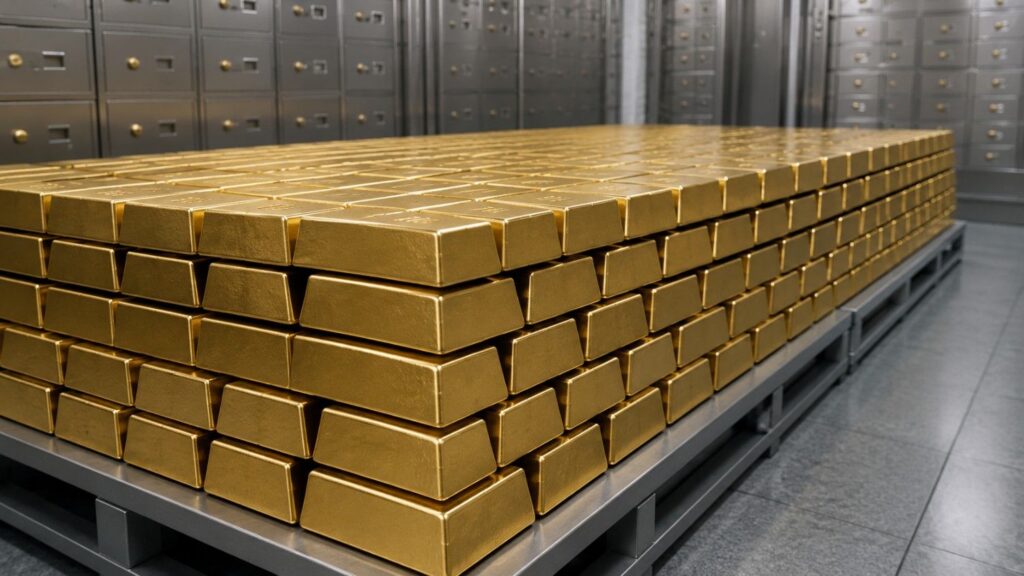
Key Takeaways Central banks have been net buyers of gold for 16 consecutive years, purchasing 863 tonnes in 2025 — 82% above the 2010–2021 average of 473 tonnes per year (World Gold Council, Gold Demand Trends Full Year 2025). Q1 2026 demand rebounded to 244 tonnes, a 17% increase quarter-over-quarter, exceeding both the prior quarter and the five-year average (World Gold Council, Gold Demand Trends Q1 2026). The 2022 freeze of approximately $300 billion in Russian foreign exchange reserves by Western nations was the single most significant catalyst for reserve diversification into gold (IMF; G7 Task Force). Poland leads current […]
What Is Fiat Currency?

Key Takeaways A fiat currency is money backed by nothing but collective trust — no gold, no commodity, no redemption promise. All major currencies today are fiat. US M2 money supply has expanded roughly 50-fold since 1971 (Federal Reserve H.6 Money Stock Measures; FRED M2SL series). The dollar has lost about 87% of its purchasing power since Nixon ended gold convertibility (BLS CPI-U, 1971–2026). Central banks purchased a net 863 tonnes of gold in 2025 — more than twice the pre-2022 average of 473 tonnes per year (World Gold Council, Gold Demand Trends Full Year 2025). The very institutions that […]
The 1971 Nixon Shock

Key Takeaways The Nixon Shock (August 15, 1971) ended dollar-to-gold convertibility, terminated the Bretton Woods system, and launched the modern era of fiat currencies (Federal Reserve History). Gold has risen approximately 12,300% from its fixed $35/oz peg to over $4,300 today — reflecting the dollar’s roughly 87% loss of purchasing power since 1971 (Bureau of Labor Statistics, CPI). The Triffin Dilemma, named for economist Robert Triffin, predicted Bretton Woods’ structural collapse in 1960 — and its logic still operates in today’s unconstrained fiat system (Federal Reserve History). Central banks bought over 1,000 tonnes of gold per year in 2022, 2023, […]
Bretton Woods and the Gold Standard

Key Takeaways The Bretton Woods Agreement (1944) fixed the US dollar to gold at $35/oz, with all other major currencies pegged to the dollar — the world’s first fully negotiated gold-backed monetary system (Library of Congress, 2026). The Triffin Dilemma made the system structurally unstable: the more dollars the US issued to meet global demand, the wider the gap between dollar liabilities and gold reserves grew (IMF Staff Papers, 1961). Nixon closed the gold window on August 15, 1971 — ending gold convertibility and launching the era of pure fiat currency for every major economy (Federal Reserve History, 2013). Since […]