Silver Rises Over 120% YTD


U.S. October Budget Deficit Hits $404 Billion: What Gold Owners Should Know

The U.S. began fiscal 2027 with a $404 billion October deficit. A closer look at payment timing, debt costs and real yields explains what the report means for long-term gold and silver owners.
Treasury Borrowing Forecast: $618 Billion, $24 Billion Catch

A $125 billion Treasury refunding is not $125 billion in new borrowing. The November 4 plan replaces about $97 billion of maturing debt, while the separate quarter-wide forecast calls for $618 billion in net borrowing. The starting cash balance explains the apparent contradiction.
What Is the Debt-to-GDP Ratio, and What the US Number Tells You About Gold

The debt-to-GDP ratio measures a government’s debt against the size of its economy. See what America’s 122.6% reading means, how it compares to Japan and Italy, and why it keeps pointing back to gold.
The Treasury’s Next Move Isn’t a Rate Cut. It’s a $967 Billion Checking Account.

Two senior Treasury officials say a nearly $1 trillion cash account could help fund the bond buyback program starting September 9. Here is why the funding source matters more for gold and silver than the headline dollar figure.
Two Investors Ran the Debt Math Separately. Both Landed on 15% Gold.

Ray Dalio’s August 21 post cited an $11 trillion debt-service figure behind his call to hold 10-15% of a portfolio in gold. Days later, gold-app CEO David McAlvany independently reached a strikingly similar conclusion — and neither man sizes bitcoin anywhere close to gold.
Gold’s Pullback Isn’t About ETFs. It’s About a Treasury Buyback.

Gold and silver are cooling after a 4-6% surge this week, and the popular explanation making the rounds is incomplete. The real driver: the U.S. Treasury just doubled its own bond buybacks after a failed auction, not ETF inflows.
M2 Money Supply: The Number That Makes Your Portfolio Meaningless

Most investors check their portfolio every day. Very few have ever looked at a chart of M2 money supply. That gap — between what feels important and what actually is — turns out to be one of the most expensive mistakes a long-term saver can make. Here is what M2 is, why it grew 55 percent since 2020, and why it tells you something your portfolio never will.
87% Dollar Devaluation Since 1971: Why Central Banks Keep Buying Gold

Since the Nixon Shock in 1971, the U.S. dollar has lost roughly 87% of its purchasing power, according to Bureau of Labor Statistics CPI data. Meanwhile, central banks have been net buyers of gold for 16 consecutive years. Here’s what the data shows — and what individual investors can learn from it.
The U.S. Government’s Own Numbers Show It’s Insolvent
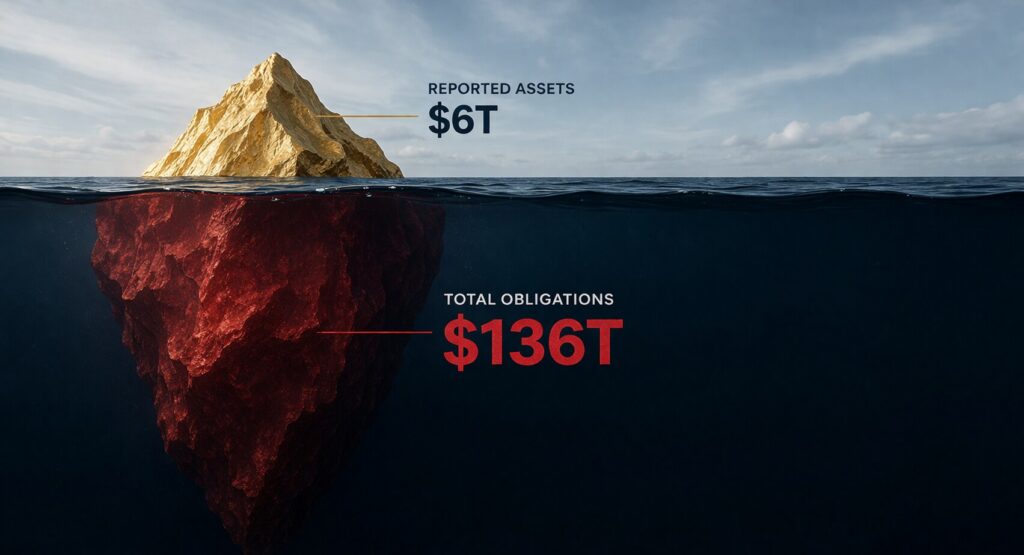
The U.S. government’s own financial statements show $6.06 trillion in assets against $47.78 trillion in liabilities. The media missed it. Here’s what it means.
Could the US Revalue Its Gold Reserves to Pay Down Debt?

The US still values its gold at $42.22 an ounce — a price frozen since the 1970s. Here’s what revaluing those reserves would actually mean, and why the math doesn’t add up the way politicians hope.