Silver Rises Over 120% YTD




Published: 08-06-2026, 12:37 pm
Most coverage of the Trump administration’s pending polysilicon tariff stops at solar panels and semiconductor chips. That analysis is incomplete. Polysilicon sits at the start of a supply chain that ends at silver paste — the conductive material applied to every solar cell on the planet. When tariffs reshape that chain, silver investors have a reason to pay attention.
Silver is trading at $61.39 as of August 6, 2026, down slightly on the day. The metal is lagging gold’s four-session rally, and today’s tariff development explains part of the reason why.
What Is the Polysilicon Tariff and Why Does It Matter for Silver?
The Trump administration is preparing to impose a 15% tariff, combined with minimum import price floors, on polysilicon and its downstream derivatives — wafers, solar cells, and finished modules. The action follows a year-long Commerce Department national security investigation under Section 232 of the Trade Expansion Act. According to Reuters and four sources familiar with the plan, the announcement could come as early as this week.
Polysilicon is the ultra-pure form of silicon that sits at the very beginning of two critical supply chains. Solar panels consume the bulk of global polysilicon output. Semiconductor chips consume a smaller but strategically important share — roughly 2.4% of global demand, according to the Semiconductor Industry Association. The tariff targets both.
The silver connection runs through solar. Solar panels require silver paste to function. Specifically, manufacturers apply silver to the front and back contacts of each photovoltaic cell to collect and conduct the electricity the cell generates. Without silver, the electrons have nowhere to go. As a result, the solar industry is silver’s single largest industrial customer.
The Edge Every Investor Needs Smarter precious metals investing starts here. The Nuggets Newsletter brings you essential market insights, Fed updates, global trends, educational videos, and much more.
How Much of Silver’s Demand Does Solar Actually Drive?
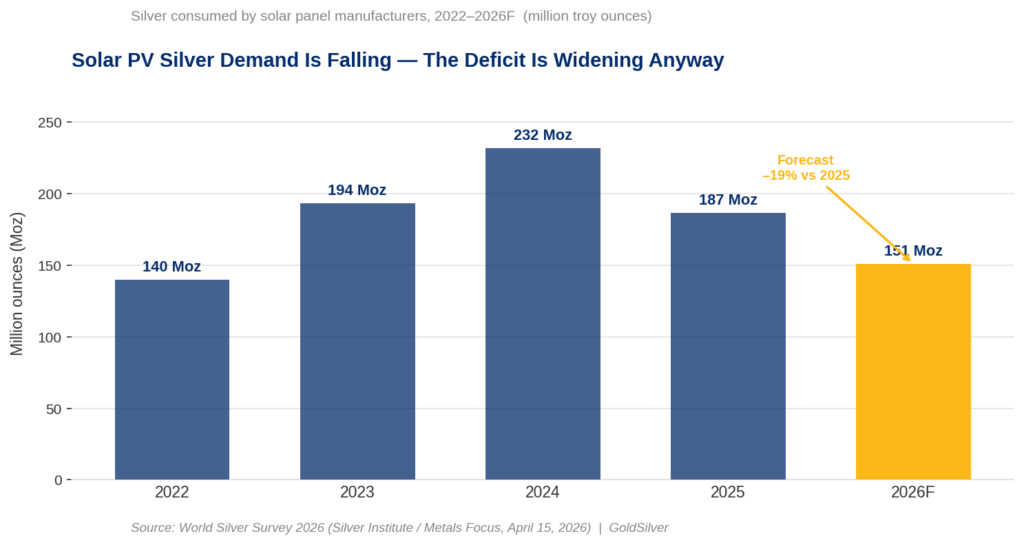
In 2025, the solar sector consumed approximately 186.6 million ounces of silver — down 6% from 2024’s record of roughly 232 million ounces — according to the World Silver Survey 2026. Solar has accounted for approximately 29% of all industrial silver demand in recent years, per the Silver Institute, making it larger than electronics, automotive, and brazing applications combined.
The picture for 2026 is more complicated. Solar PV silver demand is forecast to fall to approximately 151 million ounces this year, a 19% decline, because manufacturers have aggressively reduced the amount of silver paste used per cell. This process — known as thrifting — has accelerated as silver prices climbed above $80 per ounce earlier in 2026. The economics of using less silver per panel became too attractive to ignore. We have already documented in this year’s World Silver Survey why thrifting is not the same as substitution, and why the distinction matters for the structural thesis.
The important point here is that solar demand was already declining before the polysilicon tariff entered the picture. The tariff does not create a new problem. Instead, it introduces a new layer of uncertainty over a demand base that was already under pressure.
What Does the Tariff Actually Do to Silver Demand?
The mechanism works in two directions, and they point opposite ways.
In the near term, the tariff raises costs for solar project developers in the United States. China controls approximately 93% of global polysilicon production capacity, according to industry analysis, and more than 80% of overall solar manufacturing across wafers, cells, and modules, according to Wood Mackenzie and the International Energy Agency. Because Chinese-made polysilicon and solar wafers already face a 50% Section 301 tariff — raised from 25% effective January 1, 2025 — the new Section 232 tariff and price floors would add further costs throughout the downstream supply chain. The result is likely to slow the pace of US solar installations — and therefore reduce the silver that would otherwise go into those panels.
Over a longer horizon, however, the picture shifts. The explicit goal of the tariff is to encourage reshoring — to rebuild US polysilicon production at companies like Hemlock Semiconductor and Wacker Chemie, and to attract solar cell and panel manufacturing back to domestic factories. If that reshoring materializes, every panel built in the US would require silver sourced through normal commercial channels, creating a more stable and domestically rooted demand base for the metal.
The short-term and long-term effects therefore pull in opposite directions: near-term demand pressure, potential long-term demand support.
Is There a China Retaliation Risk for Silver?
China responded to recent US trade actions this week. On August 5, Beijing announced controls on drone exports to the United States and banned six American entities from Chinese trade relationships. The Commerce Ministry described the measures as a “restrained” response to earlier US moves, including Federal Communications Commission restrictions on Chinese robots and Department of Homeland Security forced labor designations.
It is important to note that China’s August 5 response was triggered by those earlier actions — not by the polysilicon tariff specifically. However, the pattern of escalation matters. If the polysilicon tariff pushes Beijing toward additional countermeasures in the coming weeks, the silver market could face further demand uncertainty from the manufacturing side. China is not only the dominant solar manufacturer — it is also a significant user of silver in electronics and EV components.
What Does This Mean for the Structural Case for Silver?
The polysilicon tariff does not alter the fundamental supply picture. The World Silver Survey 2026, published by the Silver Institute and Metals Focus, recorded the sixth consecutive annual supply deficit at 46.3 million ounces. Since 2021, the silver market has drawn down approximately 762 million ounces from above-ground stockpiles. Those numbers reflect a market where demand has persistently exceeded supply, regardless of which end-use categories are growing or contracting in any given year.
Industrial demand represents approximately 58% of total silver demand, according to the World Silver Survey 2026. Because of that industrial weight, policy shifts that affect manufacturing — tariffs, trade restrictions, reshoring incentives — carry real consequences for silver’s supply-demand balance in ways they do not for gold.
Here is the second corner most trade coverage misses: the United States currently has two conflicting policy goals for solar. It wants to slow Chinese solar imports. It also wants to build domestic solar manufacturing capacity. These goals require polysilicon to become simultaneously more expensive for importers and more affordable for domestic manufacturers. That contradiction cannot be resolved without an explicit US industrial policy on silver supply — and none currently exists. For investors who hold physical silver as part of a sound money allocation, neither outcome destroys the structural case. However, one of them — successful reshoring of solar manufacturing — is meaningfully more bullish for US-based silver demand over a five-year horizon. That is the scenario worth watching.
What Should Silver Investors Watch Next?
Three developments will clarify this story quickly. First, watch for the official tariff proclamation — the Globe & Mail reported an announcement could come as early as August 6, but details were still being finalized as of this writing. The specific product scope and any exemptions for importers investing in US manufacturing will determine whether the near-term demand hit is concentrated or diffuse.
Second, watch for industry response from US solar developers. If major project pipelines announce delays or cancellations in response to higher polysilicon costs, that is a concrete signal of near-term silver demand softening.
Third, watch China’s next move. Beijing warned further countermeasures are possible if the US rolls out additional restrictions. A response that targets materials used in US manufacturing — silver is not the only option on that list — would add a supply dimension to what is currently a demand story.
Stay On Top of Gold & Silver Prices
Get important market alerts sent straight to your inbox.
SOURCES
1. Reuters — “US weighs polysilicon price floor, tariffs to counter China in solar and chips,” August 4, 2026. finance.yahoo.com
2. Silver Institute / Metals Focus — World Silver Survey 2026, April 15, 2026. silverinstitute.org
3. NBC News / Associated Press — “China announces countermeasures against Washington,” August 5, 2026. nbcnews.com
4. US Trade Representative — Section 301 tariff increase on Chinese polysilicon and solar wafers to 50%, effective January 1, 2025. ustr.gov
Disclaimer: This article is for informational purposes only and does not constitute investment advice. Past performance is not indicative of future results. Always consult a qualified financial advisor before making investment decisions.
You May Also Like:
- Gold Rallied 6% This Week. Tomorrow One Number Decides Whether It Holds.
- Why Is Silver Outperforming Gold? A 6-Year Deficit
- Hormuz. ISM. Hecla. Barrick. Five Things Moved Gold and Silver Today.
- Jobs Missed. Gold Hit $4,200. Silver Hit $62.
- South Korea’s Central Bank Hasn’t Bought Gold in 13 Years. That Just Changed.
- Gold and Silver Hold As Bessent Promises a Hormuz Deal, a Vessel Gets Hit, and JOLTS Drops
- Why Gold Is Holding Near $4,067 Ahead of a Jobs Week That Could Trigger a Rate Hike