Silver Rises Over 120% YTD




Daily News Nuggets | Today’s top stories for gold and silver investors
February 11th, 2026 | Brandon Sauerwein, Editor
Labor Market Surprises with 130,000 Jobs Added in January
The January jobs report and gold prices are moving in different directions as markets digest mixed signals from the labor market. U.S. employers added 130,000 jobs in January, beating forecasts. The unemployment rate edged down to 4.3%.
The headline number looks strong. However, the backstory doesn’t. Annual revisions slashed 2025 job gains to just 181,000 total. That’s far below earlier estimates and among the weakest tallies in years.
The headline beat reduces pressure on the Federal Reserve to cut rates soon. The dollar strengthened, and bond yields ticked higher. Gold, however, held steady.
The January jobs report and gold prices now tell two different stories. The headline suggests resilience. The revisions point to slowing momentum beneath the surface.

Stay Ahead with Gold & Silver News The most important market insights, Fed updates, and global trends — everything investors need to make smarter, safer decisions.
ETF Inflows Signal Renewed Bullion Demand
Gold- and silver-focused ETFs surged as much as 5% after softer U.S. economic data strengthened expectations for Federal Reserve rate cuts later this year. Major funds such as SPDR Gold Shares (GLD) and iShares Silver Trust (SLV) led the way as investors look to increase exposure to bullion through exchange-traded funds.
ETF flows matter. Unlike futures trading, ETF buying represents longer-term capital allocating directly to physical-backed funds. When inflows accelerate, they can provide sustained upward pressure on metal prices.
The move underscores a familiar pattern: when rate-cut expectations rise, demand for non-yielding assets like gold and silver tends to follow. That shift in positioning showed up quickly in price action…
Gold Steadies Above $5,000 as Silver Finds Its Footing
Gold remains firm above $5,000 as investors play defense, waiting for clearer direction on rates and the economy.
Silver’s path has been far less smooth. At the end of January, the metal recorded its largest single-day drop on record. The move appeared less about a fundamental shift in outlook and more about forced liquidations — likely driven by leveraged positions being unwound into a relatively thin market. When liquidity dries up, silver can move sharply and quickly.
Silver’s Six-Month Surge vs. the S&P 500
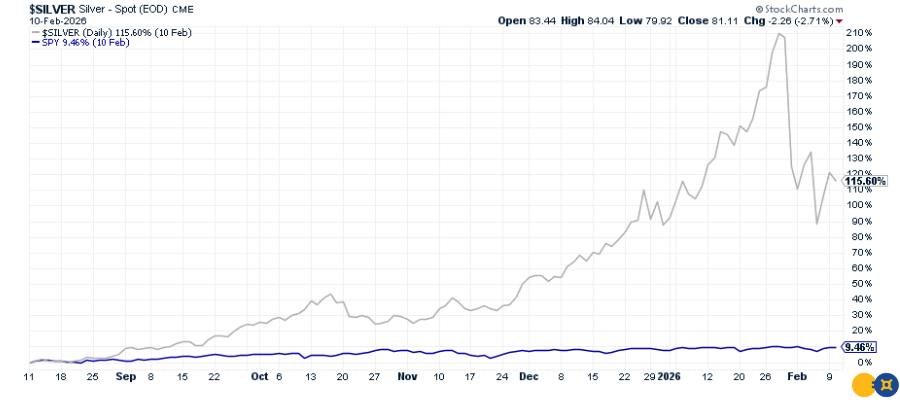
Since then, prices have stabilized, suggesting the liquidation wave has largely passed. In fact, at the time of this writing, silver is up nearly 5% on the day — a reminder of how quickly the metal can snap back once selling pressure fades.
That’s the nature of the metal. Silver tends to exaggerate gold’s moves, falling harder during liquidity squeezes but often rebounding more aggressively once pressure subsides. Right now, the January jobs report and gold prices are sending mixed signals — short-term strength versus longer-term uncertainty.
Ultimately, the choice comes down to temperament. Gold typically offers steadier protection. Silver brings higher volatility — and with it, greater upside potential for those willing to endure the swings.
Investing in Physical Metals Made Easy

Governments Stockpile Commodities as Risk Rises
Governments around the world are increasingly treating commodities as strategic assets, not just economic inputs. According to Goldman Sachs, countries are expanding stockpiles of critical resources — including energy, industrial metals, and gold — amid rising geopolitical tension and supply chain fragmentation.
This shift marks a departure from the era of hyper-globalized trade. Sanctions, trade disputes, and regional conflicts have prompted policymakers to prioritize security of supply over pure market efficiency. Strategic reserves are being built as insurance against disruption.
When governments absorb supply into national reserves, less material circulates freely — potentially tightening markets and increasing volatility. Gold, already buoyed by central bank purchases, stands out as a key beneficiary of this structural demand shift.
In a world increasingly defined by economic blocs and resource competition, commodities — especially gold — are becoming tools of national risk management.
Lebanon’s Gold Reserves Take Center Stage Amid Banking Collapse
As Lebanon’s financial crisis drags into its sixth year, the country’s gold reserves are drawing renewed attention. With banks restricting withdrawals and the local currency largely wiped out, many citizens see the nation’s roughly 286 tons of gold as one of the few remaining pillars of stability.
The reserves — among the largest in the Middle East — have so far been left untouched. Lawmakers have resisted selling the gold, viewing it as a last line of defense in a country where trust in financial institutions has eroded.
It’s a stark reminder of gold’s enduring role. When banking systems falter and currencies collapse, physical gold often becomes the asset of last resort.