 Silver Rises Over 120% YTD




- Gold is monetary insurance, not a stock. Measure it by purchasing power preservation over decades — not quarterly performance against the S&P 500.
- Paper gold ≠ physical gold. Only physical ownership — coins or bars you hold outright — removes counterparty risk from your position.
- Don't time the market. Dollar-cost averaging beats waiting for the "perfect" entry over any 5–10 year horizon.
- Know your all-in cost before you buy. Spot price, dealer premium, storage, and insurance all affect your real break-even.
Buying gold for the first time feels deceptively simple. You've read about governments printing money, watched gold hit $5,589 an ounce in January 2026, and decided it's time. You open a brokerage account or find a dealer online — and that's where the mistakes begin.
These mistakes don't announce themselves. Instead, they look like common sense: buy when it's cheap, sell when it's expensive, pick the most convenient product. The logic sounds reasonable. However, the execution is where real money gets left on the table — or lost entirely.
The good news: every mistake here is predictable and fixable. Here's what to watch for, starting with the one that causes the most long-term damage.
Mistake #1: Treating Gold Like a Stock
A new investor buys gold at $4,100. Three months later it's at $4,000. They've "lost 2.4%" and they're frustrated. They check the price daily, compare it to the S&P 500, and start second-guessing themselves.
Wrong frame — but an easy one to fall into. All of investing language — returns, benchmarks, performance — trains people to think in short-term percentages. Gold doesn't work that way.
Benchmark gold against stocks and you'll always be disappointed at some point. Gold pays no dividends. It doesn't compound. It has no earnings growth. By stock-market metrics, it will look like a loser in plenty of years — even years when it's doing exactly what it's supposed to do.
What gold actually is: Gold is monetary insurance. Its job is to hold purchasing power across decades and protect wealth when the systems people depend on — currencies, bonds, banking — come under stress. Think of it less like a stock pick and more like a seat belt. You don't measure a seat belt's "return" on ordinary drives. You're just glad it's there when something goes wrong.
Since 1971, when the Bretton Woods gold standard ended and the dollar became fully fiat, the dollar has lost roughly 88% of its purchasing power. (U.S. Bureau of Labor Statistics, CPI-U, series CUUR0000SA0) In that same period, gold went from $35 an ounce to $4,000+. That's not a coincidence. That's the mechanism.
For a full walkthrough on positioning your first purchase correctly, see our step-by-step guide for first-time gold buyers.
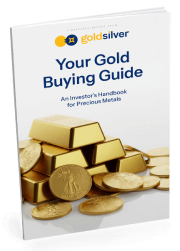
Your Gold Buying Guide Most investors overpay when they buy gold. Then overpay again when they sell. This guide shows you exactly what to own — and why.
Mistake #2: Confusing Paper Gold With Physical Gold
A new investor buys a gold ETF — cheap, liquid, available in any brokerage account. They tell their friends they "own gold." They don't. They own shares in a fund that holds gold on their behalf. It sounds like a technicality. It isn't.
The entire case for physical gold rests on the absence of counterparty risk — the risk that someone else fails to deliver. A gold ETF reintroduces exactly that risk. The fund could face redemption pressure, regulatory changes, or operational problems. Gold futures go even further in the wrong direction — they're a bet on gold's price, not ownership of gold. Moreover, when gold matters most — in financial system stress, currency crises, or geopolitical disruption — paper gold may not behave the way you expect. Under severe market stress, it can temporarily decouple from physical spot prices.
There are two distinct things here: price exposure (ETFs, futures) and actual ownership (physical coins and bars). Both have their uses. However, only physical gold held in your hands or in a segregated, allocated account removes someone else from the equation entirely. That distinction matters far more than it seems on a quiet market day.
Mistake #3: Trying to Time the Market
"I'll wait until gold pulls back." Then it climbs $200. Then it drops. "Now I'll wait for $3,900." It never gets there. A year passes. The investor still owns zero gold.
Market timing is hard even for professionals with full research teams, real-time data, and risk models. For individuals tracking macro signals in their spare time, it's nearly impossible. In fact, waiting for the perfect entry is usually just a way of never entering at all. There's a deeper problem too: if you're trying to time gold, you're still treating it as a trading asset — a mental model that directly contradicts what gold is actually for in a long-term portfolio.
The fix is dollar-cost averaging. Set a regular purchase schedule — monthly, quarterly, whenever liquidity allows — and stick to it regardless of price. This approach removes the emotional decision-making that kills timing strategies. The difference between buying at $4,100 versus $4,300 is almost irrelevant over a 10-year holding period. What matters far more is whether you own it at all.
Mistake #4: Ignoring the Total Cost of Ownership
A new buyer sees gold quoted at $4,322 per ounce and expects to pay that price. Then the real numbers arrive: a reputable dealer charges a 3–5% premium over spot for common gold coins; shipping and insurance add another $20–30 per transaction; standard home insurance typically caps precious metals coverage without a separate rider; a proper safe runs $200–$2,000 upfront; and allocated vault storage at a professional facility runs approximately 0.5–1.5% annually.
None of these is unreasonable on its own. Together, however, they push the true all-in cost per ounce meaningfully above spot — and add an ongoing carrying cost most first-time buyers don't plan for.
Investors who miss these costs get surprised — then make poor choices. They buy from cut-rate dealers to dodge premiums, store metal improperly to avoid fees, or sell too early because they calculated their break-even wrong.
The fix: Map the full cost before you buy. Your real cost basis is spot + premium + transaction costs. Budget for storage and insurance from day one.
Mistake #5: Buying From Unverified Dealers
A first-time buyer searches for the cheapest gold online, finds a seller offering 1% under spot, and places an order. Weeks later: a counterfeit coin, a delayed shipment, or no product at all.
Precious metals attract fraud for obvious reasons — high value, superficially easy to fake, hard for new buyers to authenticate. Counterfeit gold is not rare. Tungsten-filled bars, gold-plated silver, and outright fakes have all surfaced on major resale platforms.
Buy from established dealers with verifiable track records, transparent pricing, clear buyback policies, and proper insurance. Look for industry credentials from bodies such as the Industry Council for Tangible Assets (ICTA) or the Professional Numismatists Guild (PNG). If a price seems too good to be true, it is.
Mistake #6: Confusing Numismatic Coins With Bullion
A new investor visits a coin shop, falls for a beautiful antique gold coin with "historical significance," and pays a $1,500–$2,000 premium over spot — believing it will appreciate as an investment. That premium is for rarity, collector appeal, and artistry. Not for the gold.
Numismatic premiums aren't guaranteed to hold. Collector markets are illiquid, subjective, and require genuine expertise to navigate. A new investor buying numismatic coins as a gold investment has unknowingly entered two markets at once — with only one in mind.
For investment purposes, stick to bullion — coins and bars priced close to spot. Recognized products include American Gold Eagles, Canadian Gold Maple Leafs, South African Krugerrands, and bars from PAMP Suisse. Premiums are low, pricing is transparent, and liquidity is high.
Mistake #7: Going All-In on Gold, Ignoring Silver
A new investor reads about gold as the "ultimate safe haven" and puts their entire precious metals budget into gold. Silver doesn't get a look. Most new investors don't think twice about it. They should.
Silver is gold's more volatile, more industrial, and historically undervalued sibling. In precious metals bull markets, it has regularly outperformed gold — sometimes dramatically. The gold-silver ratio sits at approximately 63:1 as of June 5, 2026. Historically, it has compressed toward 50:1 or lower during bull runs — meaning silver tends to gain more ground, faster, than gold in those periods. A gold-only portfolio misses that dynamic entirely and concentrates everything in the most expensive metal per ounce.
Consider a split allocation. Many investors use a 60–75% gold, 25–40% silver framework — though the right balance depends on your goals, time horizon, and risk tolerance.
Mistake #8: Overlooking the IRA Option
A new investor buys physical gold with after-tax dollars outside a retirement account, and misses a tax-advantaged structure that could meaningfully improve their long-term return.
A self-directed IRA can hold IRS-approved physical gold and silver — coins and bars meeting minimum purity standards, stored with an approved custodian. Contributions to a traditional gold IRA are made pre-tax. Growth compounds without annual tax drag.
Time is the hidden cost. Every year outside a gold IRA means tax-deferred growth foregone and lost compounding on the deferral itself. With gold up substantially over the past decade and IRA contribution limits rising, that gap widens with every year of inaction. Before your first gold purchase, ask whether a gold IRA fits your situation. If you have earned income and aren't yet at retirement age, it almost certainly deserves a serious look.
Stay On Top of Gold & Silver Prices
Get important market alerts sent straight to your inbox.
People Also Ask
How much of my portfolio should I put in gold?
Most financial advisors recommend allocating between 5% and 15% of total investable assets to gold. The World Gold Council's portfolio research across a 20-year USD dataset found that even a 2.5% gold allocation improved the Sharpe ratio by 12%, with the benefit scaling through the 10–15% range. (World Gold Council, Gold as a Strategic Asset, 2025 edition) Five percent is roughly the floor at which gold's volatility-reduction effect becomes material. Ten percent is the common balanced starting point. Above 15%, you're making a directional bet on gold rather than a diversification decision. The right number depends on your other real asset exposure, your time horizon, and how much currency risk you want to offset. Zero is the only wrong answer.
What's the safest way to store physical gold at home?
Start with a quality safe bolted to a structural wall or floor — weight matters because lighter units can simply be removed. Look for a UL burglary rating (TL-15 or TL-30), not just a fire rating. Fire ratings measure heat resistance; they say nothing about forced entry. Standard homeowners and renters policies typically cap precious metals coverage at $1,000–$2,500 — a scheduled personal property rider or a standalone fine arts and collectibles policy can cover the full replacement value. (Insurance Information Institute, Special Coverage for Jewelry and Other Valuables) For holdings above roughly $25,000–$50,000, professional vault storage at an allocated, segregated facility tends to become more cost-effective and secure than home storage.
Does gold perform well during deflation, or only during inflation?
Both — but for different reasons. During inflation, gold preserves purchasing power as paper currency loses value. During deflation, it holds nominal value while other asset prices fall. In the Great Depression, after President Roosevelt revalued gold from $20.67 to $35 per ounce under the Gold Reserve Act of 1934, gold effectively appreciated against a basket of deflating goods while equities and real estate collapsed. (Federal Reserve History, Gold Reserve Act of 1934) The common thread isn't inflation or deflation. It's a loss of confidence in paper money — and that can show up as too much of it (inflation) or too much debt unwinding at once (deflation).
Can I sell physical gold easily, and what should I expect when I do?
Yes — physical bullion is liquid — but it comes with costs most new buyers don't plan for. Reputable dealers post live buyback prices at a small discount to spot; that spread is how they earn their margin. Common bullion coins — American Gold Eagles, Canadian Maple Leafs — command the tightest spreads and sell the fastest. Less-recognized products like private mint bars or obscure foreign coins may attract steeper discounts or take longer to sell. The IRS classifies most physical precious metals as collectibles under Internal Revenue Code Section 408(m) — long-term gains are taxed at a maximum federal rate of 28%, not the 20% maximum that applies to equities. (IRS, Topic No. 409, Capital Gains and Losses; IRS Publication 544) Plan your net proceeds accordingly.
What happens to physical gold when it's inherited — is there a tax advantage?
Yes, and it's a significant one. Physical gold held outside a retirement account receives a stepped-up cost basis at death under Internal Revenue Code Section 1014. (26 U.S.C. § 1014) The heir's cost basis resets to the fair market value on the date of death — not the original purchase price. Any gain accumulated during the original owner's lifetime escapes capital gains tax entirely. For example, buy gold at $1,500 per ounce and pass it on when it's worth $4,322 — your heirs inherit at $4,322.
This benefit applies only to physical gold in taxable accounts. Gold inside an IRA doesn't qualify: IRA withdrawals are taxed as ordinary income regardless of the underlying asset. (IRS, Publication 590-B, Distributions from Individual Retirement Arrangements) Estate tax may still apply to large estates, but for most investors, physical gold held outside an IRA is one of the more tax-efficient assets to leave behind.
The One Question That Ties All Eight Together
Every gold investing mistake on this list has the same root: treating gold like a speculative asset instead of a monetary one.
Stocks are priced on future earnings. Real estate generates rental income. Bonds pay interest. Gold does none of these things. Its value doesn't come from earnings or yield. It comes from a simple, durable fact: every government in history that has controlled its own currency has eventually expanded it. Gold sits outside that system entirely.
These gold investing mistakes are easy to avoid once you understand what gold actually is. Since the US abandoned the gold standard in 1971, the dollar has lost roughly 88% of its purchasing power. (U.S. Bureau of Labor Statistics, CPI-U, series CUUR0000SA0) Over that same period, the world's central banks purchased over 1,045 tonnes of gold in a single year (2024), part of three consecutive years above 1,000 tonnes annually. (World Gold Council, Gold Demand Trends Full Year 2024) They're not buying gold because they expect a good quarter. They're buying it because they understand what monetary debasement looks like across decades.
New investors who approach gold with the same long-term, mechanism-first thinking — and who avoid the eight gold investing mistakes above — are not speculating. They're positioning. That's not fear. That's clarity about how money actually works.
1. U.S. Bureau of Labor Statistics — Consumer Price Index for All Urban Consumers (CPI-U), Series CUUR0000SA0
2. World Gold Council — Gold as a Strategic Asset: 2025 Edition
3. Insurance Information Institute — Special Coverage for Jewelry and Other Valuables
4. Federal Reserve History — Gold Reserve Act of 1934
5. Internal Revenue Service — Topic No. 409, Capital Gains and Losses
6. Internal Revenue Service — Publication 544, Sales and Other Dispositions of Assets
7. Cornell Law School Legal Information Institute — 26 U.S.C. § 1014, Basis of Property Acquired from a Decedent
8. Internal Revenue Service — Publication 590-B, Distributions from Individual Retirement Arrangements
9. World Gold Council — Gold Demand Trends Full Year 2024


