Silver Rises Over 120% YTD  Invest Now  arrow small top right

close

How Much Silver Is in a Solar Panel?

In this article
Key Takeaways
Key Takeaways
  • A modern panel holds an estimated 4 to 6 grams of silver, worth roughly $8 to $11 at $55 an ounce.
  • According to UNSW researchers and the ITRPV, silver per watt fell from almost 60 milligrams in 2010 to about 10 milligrams in 2025.
  • Thrifting means using less silver per cell. Substitution means replacing it with copper, which is still at pilot stage.
  • According to the Silver Institute, primary mines supply only about 28% of silver mine output in 2026. Supply cannot chase the price the way makers can cut their use.

Last verified October 2026.

The silver in a solar panel is the fine metal grid printed on each cell. That grid carries current out of the cell, and it makes solar one of silver's biggest industrial customers.

How much silver is in a solar panel? A modern solar panel holds about 4 to 6 grams of silver, or roughly 0.14 to 0.20 troy ounces. A 430-watt rooftop panel carries about 4.3 to 4.8 grams. A 580-watt utility panel carries about 5.8 to 6.3 grams. These are estimates built from industry averages, not weighed panels.

The International Technology Roadmap for Photovoltaics (ITRPV) tracks silver use by cell design. Its 17th edition shows TOPCon cells averaging about 10 milligrams of silver per watt in 2025. TOPCon is now the dominant cell design. Multiply that figure by a panel's rated watts, and you have its silver. As a result, the number tracks panel size and cell design, not a fixed constant. Meanwhile, makers have cut silver per watt about sixfold since 2010, according to UNSW researchers.

You may have seen claims of 15 to 20 grams of silver per panel. However, those figures do not reconcile with roadmap data. The ITRPV puts a modern cell at under 0.1 gram. This guide shows the multiplication, explains why the number fell, and says what it means for silver.

How Much Silver Is in a Solar Panel?

Start with the cell. According to the ITRPV's 17th edition, launched June 23, 2026, the average M10 TOPCon cell held about 88 to 90 milligrams of silver in 2025. A rooftop panel with 108 half-cut cells holds the equivalent of 54 full cells. A utility panel with 144 half-cells holds 72. In other words, multiply the cells by silver per cell, and you have the panel.

The Knowledge That Changes Everything
Your Gold Buying Guide and The Everything Fiat Experiment
2 Free Guides

Two essential guides — yours free. Understand why gold matters and why fiat currencies always fail.

Two routes give the answer, and they agree within about 10%. Specifically, the first multiplies rated watts by about 10 milligrams per watt. The second multiplies cell count by silver per cell. Both appear in the table, priced at around $55 an ounce, near the low end of October 2026 trading.

Estimates from industry averages, not weighed panels. Silver value assumes a round $55 per ounce.
Panel typeRated powerSilver by wattsSilver by cellsSilver value at $55/oz
Rooftop, 108 half-cells430 W4.3 g4.8 g$7.60 to $8.40
Utility, 144 half-cells580 W5.8 g6.3 g$10.30 to $11.20

Products vary by design, and the value moves with the silver price. In addition, the gram figures are our arithmetic from published averages. Module sizes follow pv magazine's March 14, 2023 report on a 182 mm TOPCon series. It lists 108-half-cell panels at 415 to 435 watts and 144-half-cell panels at 560 to 580 watts.

Where Does the Silver Sit Inside a Solar Cell?

Silver does one job in a cell. It forms thin lines, called fingers. Specifically, they collect the current the silicon makes and carry it to wider strips, called busbars. Silver is the best electrical conductor among the metals. As a result, the lines can stay very thin without wasting power.

Most of the metal sits in those fingers. According to UNSW researchers in 2023, fingers held more than 75% of the silver in industrial screen-printed cells. Their measured finger widths ran from 22 micrometers on PERC cells to 35 micrometers on heterojunction cells. In fact, that is finer than a typical human hair. Therefore, shaving a few micrometers off each line saves silver across billions of cells.

What Is Silver Thrifting, and How Far Has It Gone?

Thrifting means using less silver per unit of power with the same design. Engineers print finer lines, add more busbars, and gain efficiency. As a result, each watt needs less metal. Substitution is different, because it would replace silver with copper.

In fact, the size of the change is large. According to UNSW researchers citing a 2022 peer-reviewed study, average silver use per watt fell about sixfold since 2010. It dropped from almost 60 milligrams to around 10 milligrams. Earlier ITRPV results, as cited by UNSW, showed TOPCon cells at 17 milligrams per watt. The 17th edition puts them near 10 for 2025.
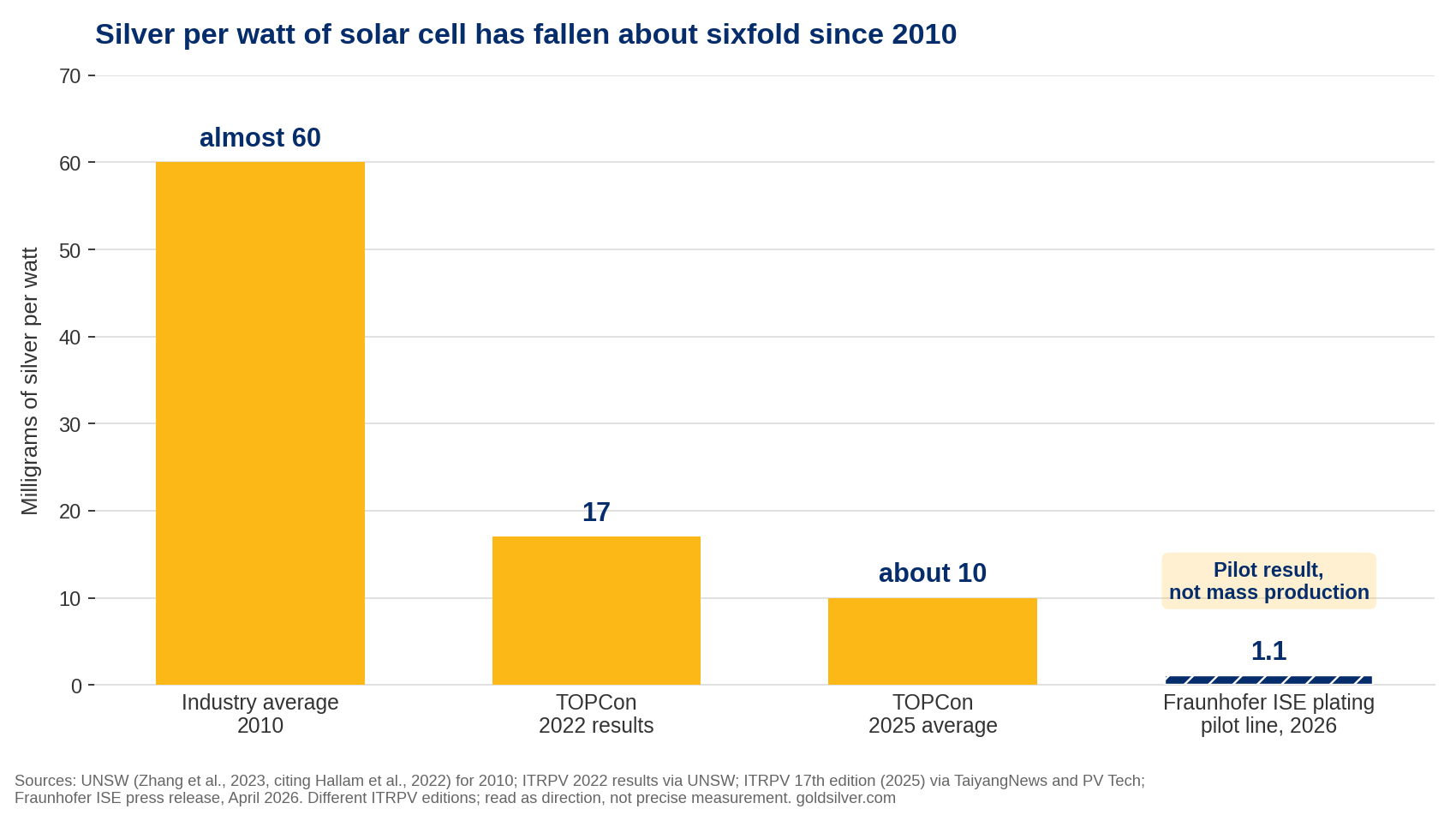
Chart showing silver use per watt in solar cells falling from almost 60 milligrams in 2010 to about 10 milligrams in 2025

Those two readings come from different ITRPV editions. For that reason, treat the gap as a direction, not a precise measurement. Even so, the direction is clear. Silver per watt fell for TOPCon, heterojunction and PERC cells between the editions. Moreover, the ITRPV roadmap expects further cuts. It projects TOPCon cells at roughly 57 to 60 milligrams per M10 cell by 2036.

Why Do Solar Manufacturers Thrift Silver?

Price drives it. In March 2026, pv magazine reported that silver paste accounted for more than 20% of total solar cell costs. In April 2026, it reported Silver Institute analysis that put paste at roughly 10% to 20%. The exact share depends on cell type and the silver price.

That share explains the engineering effort. At 10 milligrams per watt and $55 an ounce, silver costs about 1.8 US cents per watt of cell. The 60 milligrams per watt used in 2010 would cost about 10.6 cents at the same price. Makers compete on cents per watt. Therefore, every milligram saved lowers cost.

This is the price mechanism doing its job. A scarce input gets more expensive. So its users find ways to use less. Nobody ordered thrifting. Instead, the price signal produced it.

Why Do Two Counts of Solar's Silver Disagree?

Two respected sources count solar's silver differently, so you will see two different totals quoted. The Silver Institute and Metals Focus published the World Silver Survey 2026. It put solar silver demand at 186.6 million ounces in 2025, down 6%. It forecasts about 151 million ounces for 2026, down 19%.

According to pv magazine and PV Tech, the ITRPV counted about 7,244 metric tons of silver in 2025. That covered 706 gigawatts of shipped modules, or roughly 233 million ounces. PV Tech put it at 21.4% of world silver supply, against about 17% in the Survey.

Dividing each total by 706 gigawatts shows the difference. The ITRPV total implies about 10.3 milligrams per watt, matching its own cell average. The Survey total implies about 8.2. Different counting bases explain part of the gap. We cannot say how much. Both sources agree on direction: less silver per watt, and falling solar demand for the metal in 2026.

What Could Cut Solar's Silver Use Next?

Copper plating is the leading candidate. The Fraunhofer Institute for Solar Energy Systems ISE tested it in April 2026. Its team reported a plated process that cut silver to 1.1 milligrams per watt-peak. Notably, the cells were M10 TOPCon and reached 24% efficiency. That is about 89% below the 10 milligrams per watt industry average. Copper carries the current, nickel blocks copper from entering the silicon, and a thin silver cap protects against oxidation.

Treat it as a pilot-line result, not a production fact. According to Fraunhofer's Dr. Sven Kluska, the method could be established in the market within two to three years. However, Fraunhofer says makers would need to add plating equipment as an upfront cost. It also says printed copper for TOPCon cells is still in the testing phase.

Two outcomes are possible. Thrifting is likely to continue, because the roadmap expects further cuts. Meanwhile, substitution is possible too. Its timeline belongs to engineers and factory budgets.

What Does Thrifting Mean for Silver as Sound Money?

Silver does two jobs. First, it is an industrial input. Second, it is a monetary metal people have held for thousands of years. Thrifting trims the first demand pool. However, it does not touch the second.

Supply is the other half of the story. According to the Silver Institute's February 2026 outlook, primary silver mines supply only about 28% of mine output. The U.S. Geological Survey describes silver as mainly a byproduct of lead-zinc, copper and gold mines. For instance, a zinc mine expands when zinc pays, not when silver does. So makers can cut their silver use within a few years. Miners cannot add silver on the same schedule.

That asymmetry explains why the market can run a deficit while solar demand falls. According to the World Silver Survey 2026, the deficit was 40.3 million ounces in 2025. It forecasts 46.3 million for 2026. For the market-level argument, see our analysis of solar's silver cutback and the widening deficit. For the market-level argument, see our analysis of solar's silver cutback and the widening deficit. For the full balance of supply and demand, see the supply and demand guide.

Over a three-to-five-year horizon, silver per watt matters more than panel count. Watch whether plating moves from pilot lines to gigawatt factories. If you hold physical silver as a store of value, watch both signals. They show how much industrial demand you can count on.

People Also Asked

How many grams of silver are in one solar panel?

A modern solar panel holds about 4 to 6 grams of silver. Rooftop panels rated at 430 watts carry roughly 4.3 to 4.8 grams. Utility panels rated at 580 watts carry roughly 5.8 to 6.3 grams. These estimates multiply panel watts by the ITRPV's 2025 average of about 10 milligrams per watt. They also cross-check against about 88 to 90 milligrams per cell. Individual products vary, for example, with cell design and manufacturer.

How much is the silver in a solar panel worth?

At $55 an ounce, near the low end of October 2026 trading, the silver in a rooftop panel is worth about $7.60 to $8.40. A utility panel's silver is worth about $10.30 to $11.20. However, the value changes with the silver price. Using ITRPV data, we calculate about 1.8 US cents of silver per watt of cell output at 10 milligrams per watt.

What is the difference between thrifting and substitution?

Thrifting means using less silver per cell while silver stays the main conductor. Substitution means replacing silver with another metal, usually copper. According to UNSW researchers, thrifting cut silver per watt about sixfold since 2010. Copper plating reached 1.1 milligrams per watt-peak at Fraunhofer ISE in April 2026. However, that is a pilot-line result, not standard mass production.

Which solar cell type uses the most silver?

According to the ITRPV 17th edition, TOPCon-based back-contact cells used about 12.2 milligrams per watt in 2025. Silicon heterojunction cells used 12.0. TOPCon averaged about 10, and PERC about 8.9. N-type designs use more because they print silver on both faces of the cell. Since the ITRPV's 2022 results, silver per watt has fallen for TOPCon, heterojunction and PERC cells.

Can solar panels run without silver?

Not yet at industrial scale. Fraunhofer ISE cut silver to 1.1 milligrams per watt-peak in a pilot, but a thin silver cap remains. According to Fraunhofer's Dr. Sven Kluska, the method could be established within two to three years. Until factories install the tools, standard panels use silver paste. Silver therefore stays part of solar's supply chain.

What happens to silver demand if solar thrifts further?

According to the World Silver Survey 2026, solar silver demand falls to about 151 million ounces in 2026 from 186.6 million in 2025. Meanwhile, other demand pools offset part of that. Mine supply responds slowly, because the Silver Institute puts primary mines at only about 28% of output. The same survey still forecasts a deficit of 46.3 million ounces for 2026.

Disclaimer: This article is for informational purposes only and does not constitute investment advice. Past performance is not indicative of future results. Always consult a qualified financial advisor before making investment decisions.

Up next in this path

Gold vs Silver vs Platinum vs Palladium: Which Metal to Choose?

Step-by-Step Guide to Buying Physical Metals
Reading progress 0%

In This Article

In This Article

Ready to own physical gold or silver?

GoldSilver makes it easy to buy, store, and manage precious metals.

Mary

Samantha is wonderful. I was nervous about spending a chunk of money. I asked her to `hold my hand’ and walk me through making my purchase.  
She laughed and guided me through, step by step. She was so helpful in explaining everything... 

A. Howard

Travis was amazing! I was having difficulty with a wire transfer of my life’s savings, and I was very worried that I might not be able to receive it all. My husband just passed away and I’ve been worried about these funds along with grieving for 8 months. As soon as I got connected with Travis, my concerns were immediately addressed and he put me at ease. The issue was resolved within days. He even called me back with updates to keep me in the loop about what was going on with the funds. I am so grateful for a customer representative like Travis. He really cares for his clients.

Sam was also very helpful! I called and was connected to Sam within 30 seconds. She helped me with a fee that was charged to my account. She had a great attitude and took care of the fee quickly.

talk to us

Get in Touch with GoldSilver Experts

    Michael G.

    Outstanding quality and customer service. I first discovered Mike Maloney through his “Secrets of Money” video series. It was an excellent precious metals education. I was a financial advisor and it really helped me learn more about wealth protection. I used this knowledge to help protect my clients retirements. I purchase my precious metals through goldsilver.com. It is easy, fast and convenient. I also invested my IRA’s and utilize their excellent storage options. Bottom line, Mike and his team have earned my trust. I continue to invest in wealth protection and my own education. I give back and help others see the opportunities to invest in precious metals. Thank you.