Silver Rises Over 120% YTD




Published: 05-25-2026, 04:12 pm
Key Takeaways
- Gold is valuable because it combines physical scarcity (~218,000 tonnes above ground, growing ~1.7% per year), chemical near-indestructibility, and 5,000 years of cross-civilizational recognition as sound money [World Gold Council, 2026].
- Since 1971, gold has risen from $35/oz to ~$4,565/oz — a 130x increase — tracking the US dollar’s approximately 88% loss of purchasing power over the same period [Bureau of Labor Statistics CPI data].
- Central banks added 244 tonnes of gold in Q1 2026 alone. Moreover, China’s People’s Bank has now bought gold for 18 consecutive months [World Gold Council Gold Demand Trends Q1 2026].
So, why is gold valuable? Gold is valuable because it solves a problem as old as trade itself: how do you store purchasing power across time?
Every major civilization — from ancient Mesopotamia to modern central banks — has arrived at the same answer independently. Not because gold was declared valuable by decree, but because its physical properties make it uniquely suited to the job. As of May 2026, gold trades at approximately $4,565 per ounce [live spot price]. Central banks, furthermore, hold over 36,000 tonnes in official reserves [World Gold Council]. Across virtually every long-term time horizon in recorded history, gold has outperformed every major fiat currency.
However, understanding why requires looking beyond the price chart.
Your Gold Buying Guide Most investors overpay when they buy gold. Then overpay again when they sell. This guide shows you exactly what to own — and why.
What Does Chemistry Tell Us About Why Gold Is Money?
Chemistry eliminates every other element as a candidate for money. Gold is what remains.
Columbia University chemist Sanat Kumar demonstrated this on NPR by working through the periodic table systematically. Gases and liquids cannot serve as a physical medium of exchange. Radioactive elements are dangerous. Highly reactive metals — sodium and lithium — corrode, burn, or dissolve on contact with air and water. Additionally, rare earth metals were impossible to smelt with pre-industrial technology. Iron, copper, and lead are too abundant, and they rust.
Consequently, after stripping out everything gaseous, liquid, radioactive, violently reactive, too rare, too common, or too corrosion-prone, four candidates survive: gold, silver, platinum, and palladium [Kumar, as cited on NPR]. Of those four, only gold and silver were plentiful enough to serve as everyday money throughout history. Furthermore, only gold combines the rarity, durability, and density that make it the strongest long-term store of value.
This is not cultural preference. It is chemistry.
How Scarce Is Gold?
All the gold ever mined in human history would fit inside a cube roughly 72 feet per side — small enough to sit inside a single tennis court.
That above-ground stock stands at approximately 218,000 metric tonnes as of 2026 [World Gold Council]. In addition, annual mine production adds about 3,600 tonnes — roughly 1.7% of existing supply [World Gold Council Gold Supply Data, 2024]. As a result, the stock-to-flow ratio sits at approximately 60, meaning it would take 60 years of current mining to double what already exists.
No other commodity works this way. Oil gets burned. Wheat gets eaten. Silver, meanwhile, is consumed at scale in solar panels, electronics, and medical devices — fast enough to prevent the same stock accumulation. Gold, by contrast, is almost never destroyed. Nearly every ounce ever mined still exists somewhere.
In short, high existing stock, low annual additions, and near-zero consumption combine to make gold’s scarcity structurally unlike any other physical asset on Earth.
Why Doesn’t Gold Deteriorate?
Gold does not oxidize, rust, or corrode. It is one of the least chemically reactive elements in the periodic table.
It resists nearly every acid and corrosive agent. In fact, the only known substance that dissolves it is aqua regia — a mixture of hydrochloric and nitric acid first identified by medieval alchemists.
Archaeologists have recovered gold artifacts from Egyptian tombs 4,500 years old that are structurally intact today. As historian Peter Bernstein documented in The Power of Gold, you could bury gold and return 50,000 years later to find it virtually unchanged. That enduring durability is, therefore, one of the forces restoring gold’s monetary role in the modern financial system.
No other monetary material comes close. Seashells decay. Copper corrodes. Paper disintegrates. Digital records, moreover, depend on functioning infrastructure. Gold, however, just persists — and that single property is what separates it from everything else humans have ever tried to use as money.
Doesn’t the Dollar Work Fine as Money?
The dollar works well as a medium of exchange. However, it fails as a store of value — by design.
Since August 15, 1971, when President Nixon suspended the dollar’s convertibility to gold, the US dollar has lost approximately 88% of its purchasing power [Bureau of Labor Statistics CPI data]. As a result, a 1971 dollar buys about 12 cents worth of goods today. In other words, something that cost $100 then costs over $820 now [BLS CPI inflation calculator].
Over that same 55-year period, gold went from $35 per ounce to approximately $4,565 — a 130-fold increase. For a deeper look at the numbers, see our analysis of the dollar’s 87% purchasing power decline. Importantly, gold didn’t become more useful. Instead, the dollar became less valuable.
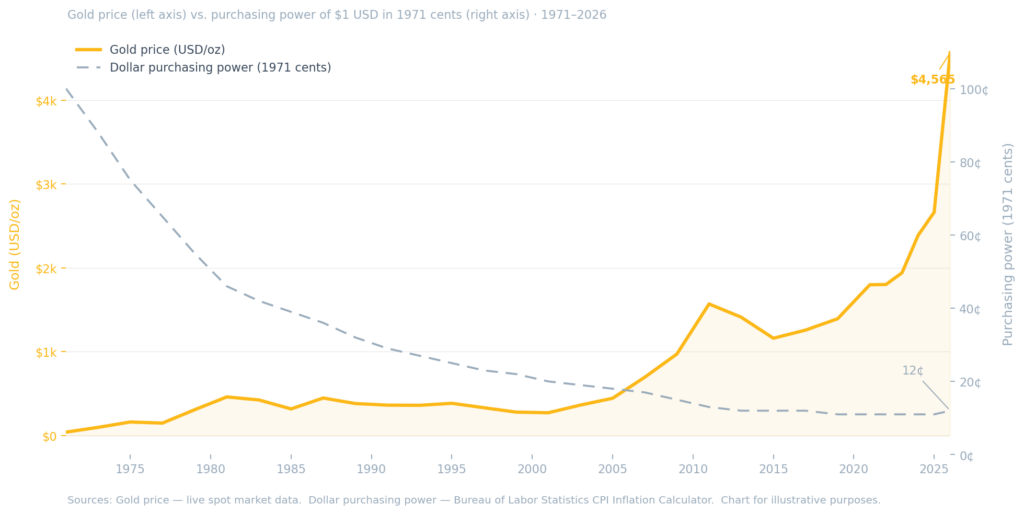
That is the insight most explanations miss. Gold is not valuable because it goes up. Rather, it is valuable because it stays — while everything denominated in fiat currency quietly goes down.
Why Are Central Banks Buying Gold at Historic Rates?
In 2022, 2023, and 2024, central banks bought over 1,000 tonnes of gold annually — more than double the prior decade’s average [World Gold Council].
In Q1 2026 alone, net purchases totaled 244 tonnes. Poland, Uzbekistan, and China led the buying [World Gold Council Gold Demand Trends Q1 2026]. Additionally, China’s People’s Bank has added to its official gold reserves for 18 consecutive months as of April 2026 [World Gold Council, May 2026].
The trigger was the 2022 freezing of approximately $300 billion in Russian central bank reserves held in Western institutions [G7 REPO Task Force]. That single event clarified something every reserve manager now factors into their strategy: foreign-held dollar assets are only as safe as the political relationship with the country controlling the clearing system.
As a result, gold held in a sovereign vault cannot be frozen, sanctioned, or devalued by another government’s decision. Reserve managers, therefore, didn’t just theorize that advantage — they watched it play out in real time. For a full breakdown, see our central bank gold analysis.
Is the Case for Gold Getting Stronger Over Time?
Gold doesn’t need a crisis. It needs only the conditions that have persisted since 1971.
The United States currently pays more than $1 trillion per year in interest on $39 trillion in national debt [CBO Budget Outlook, 2026]. Furthermore, US M2 money supply stands above $21 trillion. When governments run structural deficits financed by money creation, purchasing power erodes — not dramatically, but steadily, year after year.
Consider what that means in practice. Real interest rates remain below the true cost-of-living increase. Meanwhile, fiscal math continues to worsen rather than improve. Consequently, each year that passes, gold’s role as a purchasing power anchor becomes harder to argue against.
That is not a forecast. It is simply the ledger of how the system has run since 1971.
Stay On Top of Gold & Silver Prices
Get important market alerts sent straight to your inbox.
People Also Ask
Is Gold Actually Worth Anything, or Is Its Value Just a Belief?
Gold’s value is grounded in physical and chemical reality, not collective belief. It is scarce enough to be rare, chemically stable enough to last indefinitely, and divisible enough to function as a medium of exchange. These properties — not tradition or sentiment — therefore explain why every major civilization independently arrived at gold as its monetary standard [Columbia University chemist Sanat Kumar, via NPR].
Why Does Gold Go Up When the Dollar Weakens?
Gold is priced in dollars. When the dollar loses purchasing power, more dollars are needed to buy the same ounce of gold. As a result, the gold hasn’t become more valuable — the measuring stick has shrunk. This is why gold’s nominal price rise since 1971 closely tracks the dollar’s 88% purchasing power decline over the same period [BLS CPI data].
Is Silver Just as Good a Store of Value as Gold?
Silver shares gold’s monetary history but differs on one critical point. Specifically, silver is consumed in industrial applications at scale — solar panels, electronics, and medical devices — which prevents its above-ground stock from accumulating the way gold’s does. Consequently, gold’s stock-to-flow ratio of approximately 60 is roughly three times higher than silver’s [World Gold Council supply data], making it the stronger long-term store of value.
Why Can’t Governments Just Create More Gold?
Gold is a chemical element — it cannot be synthesized at meaningful scale. Therefore, new supply comes only from mining, which adds approximately 1.7% to existing stock per year, constrained by geology, not policy [World Gold Council, 2024]. Fiat currency, by contrast, can be created in unlimited quantities by central bank decision. That asymmetry is the structural basis of gold’s advantage over paper money.
How Much Gold Should an Individual Investor Hold?
There is no single right answer. However, the relevant question is this: how much of your savings is currently denominated in a currency that has lost 88% of its purchasing power since 1971 [BLS CPI] — and is that exposure intentional? Gold is not a growth asset; rather, it is a purchasing power anchor. Common allocations cited by financial advisors range from 5–15% of a portfolio.
So, Why Is Gold Valuable?
Gold is not a trade. It is not a bet on chaos. Instead, it is a deliberate allocation to an asset that does one thing extraordinarily well — preserve purchasing power — especially when fiat currencies are doing the opposite.
The dollar has lost 88% of its purchasing power since 1971 [BLS CPI data]. Meanwhile, central banks are buying gold at the fastest sustained pace in modern history. Furthermore, the fiscal conditions that make gold relevant are not improving. None of that requires a crisis to matter. It just requires time.
If the logic holds up for you, the next step is simple: start building your position in physical gold.
SOURCES
- World Gold Council — Gold Demand Trends Q1 2026
- World Gold Council — Gold Supply Data, Full Year 2024
- World Gold Council — Above-Ground Stock Data
- World Gold Council — China Gold Market Update, May 2026
- US Bureau of Labor Statistics — CPI Inflation Calculator
- Congressional Budget Office — The Budget and Economic Outlook: 2026 to 2036
- US Department of the Treasury — REPO Task Force Joint Statement
- NPR — A Chemist Explains Why Gold Beat Out Lithium, Osmium, Einsteinium
- World Gold Council — Central Bank Gold Reserves Survey
- Peter Bernstein — The Power of Gold: The History of an Obsession (ISBN: 978-0471252108)
Disclaimer: This article is for informational and educational purposes only. It does not constitute investment advice. Please consult a qualified financial adviser before making any investment decisions.
You may also like:
- 72% of Family Offices Hold No Gold. What They’re Missing.
- Gold Remonetization: Six Forces Restoring Gold’s Monetary Role
- Silver Industrial Demand: Solar, EVs, and the Supply Gap
- Bank of America’s $6,000 Gold Forecast Isn’t a Price Call. It’s a System Call.
- Silver IRA Complete Guide: Rules, Limits, and Custodians Explained
- Silver’s Tesla Moment: The Solid-State Battery Thesis
- Physical Gold vs. Digital Gold: Which Is the Ultimate Safe Haven?
- BRICS Is Hoarding Gold. Here’s What It Means for Your Portfolio.