 Silver Rises Over 120% YTD




- Spot price is your baseline. Every buyback offer should be a stated percentage of spot. Know it before you accept anything.
- Government-minted coins fetch the highest resale rates — typically 97–100% of spot. Private mint bars, rounds, and jewelry follow in that order.
- Online dealers generally outpay local coin shops by 2–5 percentage points. The trade-off: 3–5 days from shipping to payment instead of same-day cash.
- Get at least two quotes on any meaningful lot. A 2% difference on a $50,000 position is $1,000.
- Gold and silver are taxed as collectibles. Long-term gains are capped at 28% federally — higher than the rate on stocks. Know your liability before you sell.
- The structural case for holding remains intact. Selling to rebalance is sound. Selling out of panic rarely is.
If you want to sell gold and silver, you need more than a dealer's phone number. Gold is at $4,325 an ounce. Silver is at $67.82. If you've held either for any meaningful stretch, you're sitting on gains that were hard to imagine five years ago. You've earned the right to convert those gains into cash — efficiently, safely, and at a fair price — without leaving money on the table.
There's important context to have before you act. Both metals hit their nominal all-time highs in late January 2026 — gold at approximately $5,589 per ounce and silver at approximately $121, both on January 28–29. (StoneX Precious Metals; Investing News Network; TradingEconomics) Current prices represent a significant pullback from those peaks: roughly 20% down for gold and over 40% for silver. Whether that argues for holding or selling is your call. But acting without that framing means making a decision with incomplete information.
Most guides tell you to "call a dealer and compare prices." That's correct but incomplete. A good sale takes 30 minutes. A great sale requires understanding what spot price means for your payout, why the form of your metal matters, which channel suits your timeline, and what taxes look like before anything changes hands.
Selling gold or silver bullion means converting physical precious metals — coins, bars, or rounds — back into cash at a price as close to spot as the market allows. Done right, it pays within three business days of verified delivery. Done wrong, it costs you 5–15% of your metal's value.
The fastest route to sell gold and silver is an online dealer's buyback program. You lock in a price, ship insured, and receive payment by check or wire within three business days of verified delivery. Most reputable dealers offer 95–100% of spot on standard products. (GoldSilver.com; World Gold Council) Local coin shops are a legitimate alternative for same-day cash — typically at a 2–5% lower payout.
The Knowledge That Changes Everything
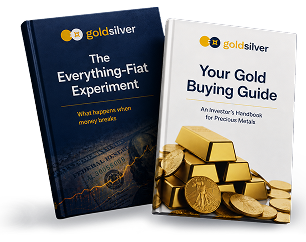
Two essential guides — yours free. Understand why gold matters and why fiat currencies always fail.
What Is Spot Price, and Why Does It Determine What You're Paid?
Understanding spot price is the single most important thing you can do before you sell gold and silver. Spot price is the real-time global market price for one troy ounce of gold or silver. It is the baseline from which every dealer buyback offer is calculated. Product type, lot size, and the dealer's margin all adjust from there.
Here's what most first-time sellers miss. Spot is a wholesale price, not a retail one. When you bought, you paid spot plus a retail premium — typically 3–8% for standard coins. When you sell, you receive spot minus the dealer's margin. The gap between those two figures is the true round-trip cost of ownership.
Because of that gap, long-term holders have the upper hand right now. Anyone who bought gold in the $1,600–$2,500 range — the trading band for much of 2021 through 2024 (TradingEconomics; World Gold Council) — is sitting on a substantial profit, even after accounting for spreads on both sides.
Which Type of Bullion Fetches the Highest Resale Price?
| Product Type | Typical Buyback Rate | Notes |
|---|---|---|
| Government-minted coins (Gold Eagles, Silver Eagles, Maple Leafs, Britannias) | 97–100% of spot | Highest liquidity; government purity guarantee means dealers can resell immediately |
| Private mint bars & rounds (PAMP, Valcambi, Perth Mint) | 95–99% of spot | Strong rates when original assay packaging and serial certificate are intact; broken or missing assay card lowers the offer |
| Bullion jewelry (.999 fine gold or silver) | Varies | Pieces at fine purity sell similarly to coins and bars; costume or mixed-component pieces do not — most bullion dealers won't buy them |
| Scrap metal | Below spot | Requires smelting and refining; go directly to a refinery, not a bullion dealer |
Pro tip: Before you sell gold and silver, write down the product name, mint, weight in troy ounces, and purity. A dealer who knows exactly what you have quotes faster and firmer.
Where to Sell Gold and Silver: Channels Ranked by Payout
Online buyback programs consistently offer the best prices. Lower overhead means dealers can pass more value to the seller. The trade-off is time: you ship your metal, it gets verified, and you receive payment within three business days of receipt — roughly 3–5 days total depending on transit. Most reputable programs pay 95–100% of spot on standard products. (GoldSilver.com; Metals Focus)
Local coin shops are the right call when you need cash today. Expect a payout 2–5 percentage points below online rates, reflecting storefront costs. That gap narrows when a dealer needs specific inventory you happen to have. Always call ahead to confirm they're buying what you've got, and check spot before you walk in.
Traveling gold buyers — "we buy gold" pop-ups at hotels and convention centers — are the channel most sellers regret. They target people who don't know the spot price and capitalize on urgency. Expect payouts 20–40% below what a reputable dealer would offer.
Auction platforms and peer-to-peer marketplaces can theoretically fetch above-spot prices for numismatic or rare coins. For standard investment bullion, however, the fraud risk, authentication burden, and uncertainty make them the wrong channel.
Pawn shops are a last resort. They typically offer the lowest payouts in the market, and staff may lack the expertise to accurately assess what you have.
What Does a Fair Buyback Price Look Like When You Sell Gold and Silver?
Most reputable dealers offer 95–100% of spot for standard investment-grade products — American Gold Eagles, Silver Maple Leafs, 1-oz bars from recognized refiners. (GoldSilver.com; Metals Focus; World Gold Council) When a dealer is short on specific inventory, payouts can reach or exceed spot.
The math at current prices: With gold at $4,325, a dealer at 98% of spot pays $4,238.50 for a 1-oz Gold Eagle. A dealer at 95% pays only $4,108.75 — a $129.75 difference on a single coin. Two or three quotes take 15 minutes and can pay for themselves many times over.
For silver at $67.82, a 100-oz bar at 98% of spot yields $6,646.36. At 95%, it's $6,442.90. On a larger silver position, the spread between dealers adds up fast.
Lot size also matters. Selling 10 or more coins — or a significant weight in bars — qualifies you to ask for better terms. Many dealers adjust for volume, so mention it upfront.
Should You Sell Gold and Silver Right Now, or Wait?
The structural case for holding remains intact. The forces that drove this bull market — central bank buying, de-dollarization, sovereign debt concerns — have not reversed. Central bank gold demand has been historically elevated for four consecutive years. The World Gold Council reported 863 tonnes purchased globally in 2025, with Q1 2026 coming in at a further 244 tonnes. (World Gold Council, Gold Demand Trends Full Year 2025; Q1 2026)
The old rulebook no longer applies. Gold used to fall when real interest rates rose. That relationship broke down in 2022 and hasn't recovered — gold ran from $1,800 to an all-time high above $5,500 even as real yields climbed past 2%. The bull market ran on fundamentals, not cheap money. (World Gold Council; PIMCO; RBC Wealth Management)
Selling still makes sense for the right reasons. If precious metals now dominate your portfolio beyond your long-term plan, trimming is discipline — not capitulation. If you have a real obligation to fund — a home, tuition, a medical expense — your gains are there to be used. Selling a defined portion while holding the rest is a perfectly defensible approach at any stage of a bull market.
Context matters, though. Gold has already pulled back roughly 20% from its January 2026 all-time high of approximately $5,589. Silver has pulled back more than 40% from its January 2026 high of approximately $121. (StoneX Precious Metals; LiteFinance; Finance Magnates) These are not near-peak prices — they reflect a significant correction within a larger uptrend, exactly the kind of pullback bull markets routinely produce. A further move from $4,325 toward $4,000 would still represent an extraordinary return for anyone who bought below $2,500.
The worst reason to sell gold and silver is panic. Fear that the pullback will deepen — or fear that a recovery signals a top — tends to produce the same outcome: selling at the wrong time.
Finally, consider what happens to the proceeds. Cash loses purchasing power over time in an environment where M2 money supply keeps expanding. (Federal Reserve H.6 Money Stock Measures) "Is this a good time to sell?" and "is this a good time to hold cash instead?" are two different questions. The second one deserves just as much thought as the first.
Before You Sell: Shipping, Documentation, and Tax
How do I ship gold and silver safely to an online dealer?
Pack at home — not at a commercial shipping location where staff can see what you're sending. Insure the package for its full replacement value. The metal is your responsibility until the dealer verifies receipt, so follow their packaging and documentation instructions exactly. When transporting locally, be discreet. Although the real risk of theft is low, the consequences of a mistake at today's prices make basic caution worth it.
What documentation do I need to sell bullion?
Keep records of your original purchase: the date, price paid, and weight. You'll need them for taxes and to establish provenance when you sell gold and silver to a reputable dealer. Bring any original certificates, assay cards, or purchase receipts — they speed things up and, in some cases, affect your offer.
How is gold and silver taxed when you sell?
When you sell gold and silver in the United States, both metals are classified as collectibles under the tax code. Long-term gains — on metal held over one year — are taxed at a maximum federal rate of 28%. That compares to 15–20% for stocks and bonds. Short-term gains are taxed as ordinary income. (IRS Topic 409; Kiplinger; Investing News Network)
For anyone who bought years ago at a fraction of current values, this distinction is material. Work with a tax advisor before a significant sale. Only sell through dealers who document transactions properly — any dealer who suggests they "don't report to the IRS" is not someone you want to work with.
Stay On Top of Gold & Silver Prices
Get important market alerts sent straight to your inbox.
People Also Ask
Does a dealer have to report my sale to the IRS when I sell gold and silver?
It depends on what you're selling and in what quantity. Dealers must file a 1099-B for certain transactions — primarily bars and rounds meeting defined weight and purity thresholds. For example, 25 or more 1-oz Gold Maple Leafs in a single transaction, or a 1-kilo gold bar, both trigger reporting. U.S.-minted coins — Gold Eagles, Silver Eagles, and similar — are explicitly excluded from 1099-B reporting requirements regardless of quantity. (IRS Topic 409; IRS Publication 544) That said, the absence of a 1099-B doesn't change what you owe. All capital gains from bullion sales must still be reported on your return. The exemption governs what the dealer files — not what you're liable for.
What happens if my coins or bars are damaged or worn?
Worn coins will still sell — dealers are buying metal content, not numismatic grade. Expect reclassification as secondary market product, which typically means a modestly tighter buyback rate. Damaged bar packaging is a bigger problem. A broken or missing assay card removes the manufacturer's authentication, which adds friction and can meaningfully lower your offer. Disclose it before you lock in a price. For heavily corroded or damaged metal, go to a refiner — not a bullion dealer.
Should I sell my gold and silver at the same time, or separately?
Two things are worth thinking through before you decide. First, consider tax: selling both metals in the same calendar year could push your total capital gains into a higher bracket — staggering the sales across years may reduce the bill, so a conversation with a tax advisor is worth it. Second, consider the gold-to-silver ratio. It measures how many ounces of silver one ounce of gold buys and fluctuates widely over time. When it sits at a historical extreme, it may argue for prioritizing one metal over the other. Neither factor requires selling separately — but both are worth knowing in advance.
I inherited gold or silver with no record of what it cost. How do I handle the taxes?
You likely owe less than you think. Inherited bullion receives a stepped-up cost basis under U.S. tax law: your basis resets to fair market value on the date of the original owner's death — not what they paid decades ago. (IRS Publication 550; IRS Publication 551) That often eliminates a large portion of the embedded taxable gain. To establish your basis, you need documentation of the metal's value at the time of inheritance — estate records or a period appraisal. If that paperwork doesn't exist, a tax professional can help reconstruct it.
Is it worth selling only part of my position, or should I sell all at once?
Most investors who want to sell gold and silver default to all-or-nothing when a middle path often makes more sense. Selling a defined portion — say, 25% of your position — locks in real gains and reduces concentration risk, while still keeping your long-term metals exposure intact. It also removes the pressure of an all-or-nothing decision. The mechanics are identical to a full sale: quote the quantity, lock in a price, and liquidate that portion only. Watch your lot size, though — a partial sale may not qualify for the volume pricing a larger transaction would. For smaller positions, consolidating into one transaction often secures better spreads.
Selling Gold and Silver Held in Allocated Storage
If you're looking to sell gold and silver that's already held in allocated professional storage, the process is simpler and faster than most investors expect. You can typically sell without shipping anything — no transit time, no packaging costs, and no authentication delay.
Because the metal is already weighed, authenticated, and registered to your account at a professional facility, you lock in a price and payment follows once the transaction settles. It's the shortest sell-to-payment timeline available to most investors.
Vault-held metal also tends to command the tightest buyback spreads. The dealer has continuous visibility into the product's condition and provenance — there's no authentication uncertainty to price in. Taking physical delivery of metal currently in storage adds a shipping step, and the costs and delays that come with it, to every future sale.
1. StoneX Precious Metals — Gold and Silver Market Commentary and Price Data
2. Investing News Network — US Capital Gains Tax Guide for Gold and Silver Investors
3. TradingEconomics — Gold Price Historical Data
4. GoldSilver.com — Sellback Program and Buyback Rates
5. World Gold Council — Gold Demand Trends, Full Year 2025
6. World Gold Council — Gold Demand Trends, Q1 2026
7. Metals Focus — Independent Precious Metals Research
8. PIMCO — Gold's New Era: Decoupling from Real Yields
9. RBC Wealth Management — Why Gold Has Decoupled from Real Yields
10. LiteFinance — Silver Price History and All-Time High Data
11. Finance Magnates — Silver Price Hits Record High Above $121
12. Federal Reserve — H.6 Money Stock Measures (M2)
13. IRS Topic 409 — Capital Gains and Losses; Collectibles Rate
14. Kiplinger — How Collectibles Are Taxed
15. IRS Publication 544 — Sales and Other Dispositions of Assets; Dealer Reporting
16. IRS Publication 550 — Investment Income and Expenses; Inherited Property
17. IRS Publication 551 — Basis of Assets; Stepped-Up Basis for Inherited Property


