Silver Rises Over 120% YTD




Published: 09-07-2026, 02:10 pm
Not every gold coin can go into a Gold IRA. The Internal Revenue Service (IRS) treats physical metal as a “collectible” by default. Buying the wrong product with retirement funds doesn’t just waste money; it triggers an immediate taxable distribution. This guide covers exactly which gold qualifies, why the rule exists, and how to avoid the mistake that catches first-time buyers.
What Makes Gold “IRA-Eligible”?
Gold is IRA-eligible if it meets a minimum fineness of 0.995, or 99.5% pure. It also has to be held in the physical custody of a bank or an IRS-approved non-bank trustee. Both conditions have to be true. A bar that’s pure enough but sitting in your home safe doesn’t qualify. Similarly, a coin held at the right custodian but below the purity threshold doesn’t qualify either. In other words, it takes both the metal and the custody arrangement to satisfy the rule.
The requirement comes from the Internal Revenue Code, not from any dealer or custodian. Under IRC Section 408(m) (IRS.gov, accessed September 2026), an IRA’s purchase of a “collectible” is treated as an immediate distribution equal to the item’s cost. That category includes most coins and bullion by default. However, Section 408(m)(3) carves out a narrow exception for gold, silver, platinum, and palladium bullion of a specified fineness. That exception only applies if a bank or approved non-bank trustee keeps physical possession of it. Miss either half of that test, and the IRS doesn’t see an investment. Instead, it sees a taxable withdrawal, plus a 10% early-withdrawal penalty if you’re under 59½.
The Knowledge That Changes Everything

Two essential guides — yours free. Understand why gold matters and why fiat currencies always fail.
What Fineness Does the IRS Require?
Gold must meet a minimum fineness of 0.995 (99.5% pure) to qualify, while silver is held to a higher bar of 0.999. Both thresholds track the same purity standards used by COMEX and NYMEX for contract-grade bullion. The logic holds throughout: the IRS wants retirement accounts holding metal valued for its weight and content, not its rarity or collector appeal.
Which Gold Coins Are IRA-Eligible?
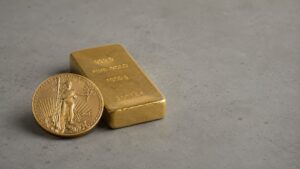
Government-minted bullion coins that meet the fineness thresholds above generally qualify. That includes the American Gold Buffalo, the Canadian Gold Maple Leaf, and the Austrian Gold Philharmonic. Each is .9999 fine, clearing the .995 floor with room to spare. Gold bars and rounds qualify too, provided they carry a fineness stamp and come from a refiner accredited to LBMA or COMEX delivery standards. Without that documented provenance, a bar is a compliance problem for your custodian, regardless of its actual purity.
The one statutory exception is the American Gold Eagle. At .9167 fine (22-karat), it falls well short of the .995 threshold. Still, Congress named it specifically in the code, so it’s eligible despite the lower purity. It’s the only coin that gets this treatment, and no other sub-.995 product is grandfathered in by association with it.
What’s excluded, regardless of gold content, is different: rare, graded, or professionally certified coins (PCGS- or NGC-slabbed) purchased for their numismatic premium rather than their metal content. The IRS’s collectibles rule doesn’t ask how much gold is in the coin. Instead, it asks whether the coin’s value comes primarily from something other than the metal. A rare coin that happens to be 24-karat gold, for example, is still a collectible in the IRS’s eyes if its price is driven by rarity rather than weight. Likewise, a proof coin bought at a heavy premium over spot fails the same test.
Why Can’t I Just Store IRA Gold at Home?
Because the statute’s second condition isn’t optional: physical possession has to sit with a bank or approved non-bank trustee. “Home storage IRA” structures that promise otherwise have already lost in Tax Court. In McNulty v. Commissioner, 157 T.C. No. 10 (Nov. 18, 2021), the court held that a taxpayer’s personal possession of IRA-owned American Eagle coins triggered a taxable distribution of the full $411,000 purchase price. That held true even though American Eagles are themselves eligible coins, and even though the coins were formally titled to an IRA-owned LLC. The metal being the right kind of gold didn’t save the structure; personal control over where it was kept did.
Practically, this means IRA-eligible gold moves through a chain that never includes the account holder’s own possession. First, a self-directed IRA custodian receives the funds. Next, the custodian coordinates the purchase of eligible coins or bars. Finally, those coins or bars ship directly to an IRS-approved depository, which holds the metal on the account’s behalf until a distribution is taken. That chain, custodian selection, eligible purchase, and depository placement, needs to be set up correctly before any metal is bought. A purchase made outside it generally can’t be corrected after the fact.
This custody rule applies specifically to IRA-held metal. If you’re holding physical gold outside of a retirement account, the rule is different: personal possession and private-vault storage are both legitimate options there. See private vault storage for how that compares.
What Happens If I Buy Ineligible Gold With IRA Funds?
The purchase is treated as an immediate distribution equal to what the IRA paid for it. That means it’s taxed as ordinary income in the year of purchase. A 10% early-withdrawal penalty also applies if the account holder is under 59½, regardless of whether anyone ever physically touched the metal. There’s no partial credit for gold that’s “close enough” to eligible. A 0.990-fine bar and a graded proof coin bought for its collector premium both fail. So does a piece of jewelry. All three count as collectibles under the same statute.
Stay On Top of Gold & Silver Prices
Get important market alerts sent straight to your inbox.
Frequently Asked Questions
No. A precious metals IRA holds physical bullion only. Gold ETFs are securities, and mining shares are equities. Both can sit in an ordinary brokerage IRA, but neither is what makes an account a precious metals IRA. Neither gives the holder a claim on physical metal.
No. A 1-ounce bar and a 100-ounce bar are equally eligible. Both just need to meet the 0.995 fineness standard and come from an accredited refiner. Size instead affects liquidity when a distribution is eventually taken.
No single list exists. Eligibility is defined by the fineness and custody standards in IRC Section 408(m), not a name-by-name catalog. That’s exactly why verifying a specific product against those standards, rather than trusting a dealer’s marketing claim, is the buyer’s responsibility.
A self-directed IRA structured to hold physical metal is required, since a standard brokerage IRA custodian typically won’t handle bullion custody. This is usually done through a direct transfer or rollover into a self-directed account, not by buying metal inside an existing brokerage IRA.
No. The 28% rate under IRC Section 1(h)(4) (current as of the 2026 tax year) applies to gains on collectibles held outside a retirement account. Instead, gold held inside a properly structured IRA grows under standard IRA tax treatment: tax-deferred in a traditional account, or tax-free in a Roth. That’s precisely because it qualifies as an exception to the collectibles rule, rather than as a collectible itself.
Yes. GoldSilver works with the custodian and depository chain a Gold IRA requires, rather than leaving buyers to verify product eligibility and paperwork on their own. Start with GoldSilver’s IRA setup guide to see how the transfer, purchase, and depository steps fit together before buying anything.
SOURCES
1. IRS.gov — Investments in Collectibles in Individually Directed Qualified Plan Accounts (accessed September 2026)
2. Cornell Law School LII — 26 U.S. Code § 408(m) (current as of the 2026 tax year)
3. Cornell Law School LII — 26 U.S. Code § 1(h)(4) (current as of the 2026 tax year)
4. Leagle — McNulty v. Commissioner, 157 T.C. No. 10 (Nov. 18, 2021)
Disclaimer: This article is for informational purposes only and does not constitute investment advice. Past performance is not indicative of future results. Always consult a qualified financial advisor before making investment decisions.
You May Also Like:
- The No-Home-Storage-IRA Myth: Why the IRS Requires a Depository
- What Is a Gold IRA? The Purity Rule the IRS Never Wrote
- What Is ZIRP (Zero Interest Rate Policy) and How It Changed Gold Forever
- How Much Is a Gold Bar Worth? Every Size, From 1 Gram to 400 Ounces
- What Happens to Your Gold If Your Storage Company Goes Bankrupt?
- Silver Price Prediction: One Bank Cut Its Target 30%, and the Reason Wasn’t the Fed
- Will Gold Go Down for the Rest of 2026? Six Banks Cut Their Targets, and the Cuts Trailed the Price
- SLV Holds Your Silver. It Just Can’t Give It Back to You.