Silver Rises Over 120% YTD




Published: 09-07-2026, 09:53 am
For two months running, China’s central bank has posted its largest monthly gold purchase since October 2023. Then it broke its own record the next month.
Gold is trading near $4,395 an ounce today, down about 0.8% in a session with no US market open for Labor Day. Silver sits near $65.63, off roughly 0.9%. Neither move is the story. The story landed a few hours ago out of Beijing.
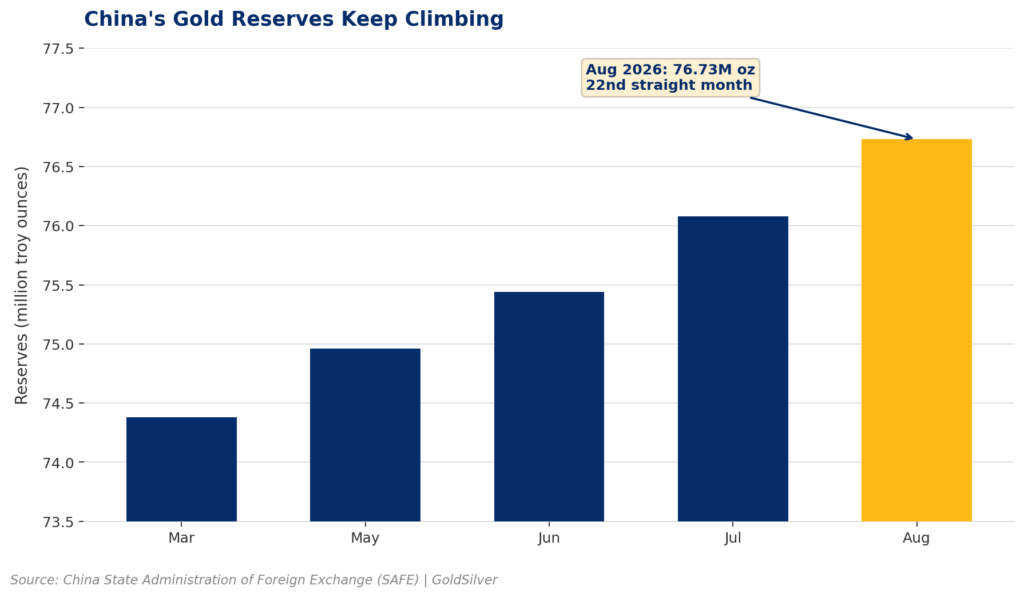
How Many Months Has China Been Buying Gold?
China’s State Administration of Foreign Exchange reported on September 7, 2026 that the People’s Bank of China added 650,000 troy ounces of gold in August. That extends its buying streak to 22 consecutive months, the longest run on record.
Total holdings now stand at 76.73 million troy ounces, roughly 2,386.57 tonnes. That’s up from 76.08 million ounces in July. August’s addition topped July’s own 640,000-ounce purchase, which had itself been the largest single month since October 2023.
The reported value of China’s gold reserves rose to $350.08 billion, up from $306.35 billion a month earlier. But that $43.7 billion jump is mostly the price of gold rising during August, not new buying. Twenty tonnes of physical metal, at any price, is still twenty tonnes.
The Edge Every Investor Needs Smarter precious metals investing starts here. The Nuggets Newsletter brings you essential market insights, Fed updates, global trends, educational videos, and much more.
Why Is China’s Central Bank Still Buying at These Prices?
Twenty tonnes a month is small on its own. Global mine production hit a record 3,672 tonnes in 2025, so one month’s purchase is under 1% of annual supply.
The number that matters is the streak, not the size. Twenty-two months without a single break, through a year when gold hit a record above $5,500 in January, fell nearly 30% to the low $4,000s by late June, and has since climbed back into the $4,300s.
Reserve managers don’t trade on that calendar. They buy on a diversification calendar instead. The dollar’s share of global central bank reserves has fallen from roughly 72% in 2000 to about 57% today, according to the IMF’s latest Currency Composition of Official Foreign Exchange Reserves (COFER) data, as gold and other assets absorb the shift. A cheap month and an expensive month look the same to a bank running a decades-long allocation plan. That’s exactly why the streak has survived both.
What Do Other Reserve Managers Think Is Coming?
Most of them expect the buying to continue. The World Gold Council’s 2026 Central Bank Gold Reserves Survey found that 89% of central bank respondents expect global official-sector gold reserves to keep rising over the next 12 months. A record 45% expect their own institution’s holdings to increase, the highest share since the survey began.
Gu Fengda, chief analyst at Guoxin Futures, has called China’s accumulation “a highly strategic and forward-looking deployment” of reserves, not a short-term trade. That framing matches a streak that hasn’t cared what gold’s price did this year.
What Does This Mean for Gold and Silver Investors?
It’s a validation, not a headline event. An individual weighing physical ownership against paper exposure is making a smaller version of the same decision China’s central bank makes every month.
The question is the same one: does an asset with no counterparty, and no exposure to another government’s balance sheet, belong in the reserve rather than just the trade? Central banks aren’t buying gold because they expect it to double next quarter. They’re buying it because a reserve asset immune to sanction, freeze, or another country’s monetary policy is worth owning regardless of price. The June streak update made the same point. August just reinforced it.
Beijing has also been relocating part of its holdings to a new Hong Kong vault. That’s a logistics move that only makes sense if the gold is meant to stay for decades, not quarters.
What Happens Next With China’s Gold Reserves?
The next SAFE release, covering September, is due in early October. It will show whether August’s acceleration continues or moderates.
Closer at hand, Thursday’s PPI print and Friday’s CPI report will shape gold and silver’s near-term price action, along with the odds of a September Fed rate move. Those two calendars run on different clocks. One follows Washington’s data schedule, month to month. The other follows Beijing’s reserve-allocation plan, year to year. Neither answers to the other. That’s the point.
Stay On Top of Gold & Silver Prices
Get important market alerts sent straight to your inbox.
SOURCES
1. PANews (citing Jinshi/China SAFE data) — China’s Central Bank Increases Gold Reserves for 22nd Consecutive Month, September 7, 2026
2. The Deep Dive — China’s Central Bank Buys the Most Gold Since October 2023, September 7, 2026
3. Bloomberg — China’s Central Bank Extends Gold Buying Streak to 21 Months, August 7, 2026
4. FX.co — China’s FX Reserves Rise More than Expected, September 7, 2026
5. CGTN — China’s Central Bank Extends Gold-Buying Streak to 19th Straight Month (Gu Fengda, Guoxin Futures, comment on accumulation strategy), June 7, 2026
6. World Gold Council — Central Bank Gold Reserves Survey 2026, Perspectives on Gold Reserves, June 16, 2026
7. International Monetary Fund — Currency Composition of Official Foreign Exchange Reserves (COFER), 2026 Q1 Data Brief, published June 30, 2026
8. World Gold Council — Gold Demand Trends, Full Year 2025 (Supply), January 29, 2026
9. GoldSilver — Gold and Silver Price Charts, September 7, 2026
Disclaimer: This article is for informational purposes only and does not constitute investment advice. Past performance is not indicative of future results. Always consult a qualified financial advisor before making investment decisions.
You May Also Like:
- The BLS Revised April Up 64,000, Then Down 31,000. Gold Traded the First Print.
- Gold’s Drop Was the Easy Story. The Bond Market’s Non-Reaction Is the Real One.
- Gold and Silver Drop as August Payrolls Blow Past Forecasts. Four Other Threads Moved Today Too.
- The Fed Just Priced Out Half a Rate Hike. Gold Barely Noticed.
- Gold Up, Silver Up. The Five Reasons Behind It Don’t All Agree.
- Barrick Just Delayed Its Biggest Move in Years. Gold Isn’t Why.
- Gold ETF Outflows Came From One Region. The Buying Came From Everywhere Else.