Silver Rises Over 120% YTD




Gold trades near $4,284 and silver near $63.18 on Tuesday. Both are little changed as investors wait on Wednesday’s Fed decision. But the Bank of Japan votes Friday too. For the first time in this tightening cycle, two of the world’s most consequential central banks are raising rates in the same eight-day span.
Why Is the Bank of Japan Rate Hike Decision Different This Time?
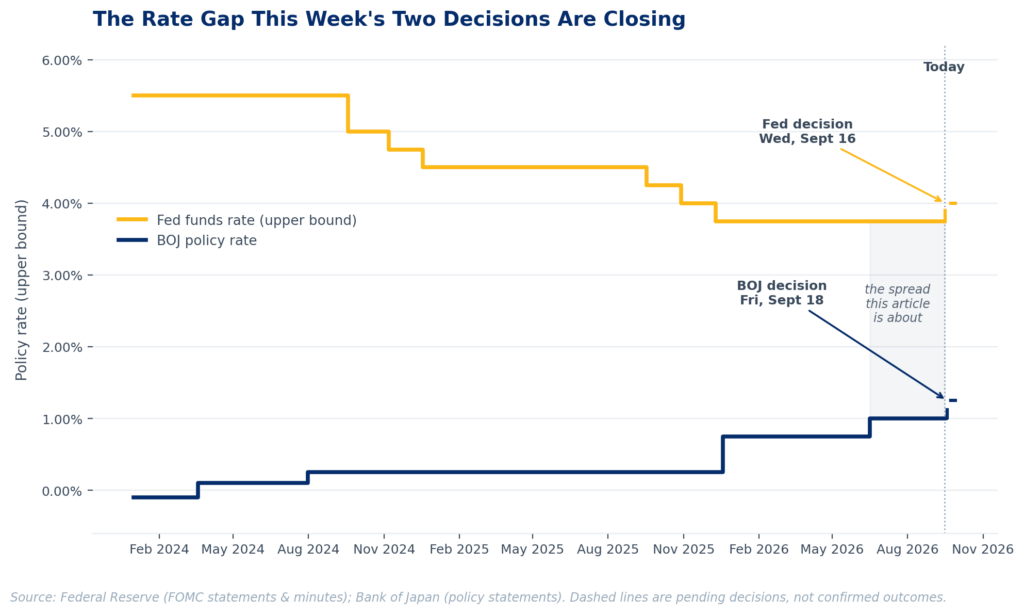
The Bank of Japan’s rate hike decision lands Friday, September 18. Economists expect a fourth rate hike since it exited negative rates in 2024. The policy rate would move from 1.00%, set in June, to 1.25%. That part isn’t seriously disputed. The odds depend on what you’re measuring. A Bloomberg survey of 52 BOJ watchers, published September 11, found all 52 forecasting a hike. That’s effectively unanimous among professional economists. Market-implied pricing reads lower. A TONA-futures model puts it near 62%. A separate overnight-index-swap estimate runs as high as 97%. Economist consensus and market pricing are different instruments. They disagree by a wide margin here, not because anyone doubts the direction, but because “will it happen” and “how is it priced” aren’t the same question.
Here’s the detail that actually matters, though. Every earlier hike in this cycle landed on its own, in March 2024, July 2024, December 2025, and June 2026. This is the first time the BOJ’s decision falls in the same calendar week as the Fed’s.
The dispersion behind Wednesday’s vote has been building for months. At the Fed’s June meeting, nine of eighteen officials projected at least one more hike before year-end. Chair Warsh withheld his own dot for the first time since the practice began in 2012. Friday simply adds a second, independent vote to a week that was already contested.
The Edge Every Investor Needs Smarter precious metals investing starts here. The Nuggets Newsletter brings you essential market insights, Fed updates, global trends, educational videos, and much more.
What Happens When Two Central Banks Tighten in the Same Week?
The mechanism is the yen carry trade. For years, traders have borrowed cheap yen to fund higher-yielding dollar positions. Treasuries, leveraged AI-chip stocks, growth trades of every kind. That trade only works while the rate gap between the US and Japan stays wide enough to cover the cost of borrowing yen. Each BOJ hike narrows that gap from the Japanese side. A Fed hike the same week doesn’t close the gap from the other side. But it does mean two economies are proving, at the same time, that the era of near-free borrowing is ending on more than one currency at once.
The immediate risk isn’t a gradual unwind. It’s a hawkish surprise from either bank forcing leveraged positions to close all at once. That happened in the last days of July and first days of August 2024. A Bank of Japan rate hike on July 31 landed within days of a weak US jobs report, and the combination triggered a rapid, global unwind of yen-funded positions by August 5. Gold sold off hard in the opening hours, since it’s the most liquid asset investors reach for first when they need cash fast. The panic ended within days, once the Bank of Japan signaled it wouldn’t immediately hike again.
What Does This Mean for Gold and Silver Before Friday?
Short term, a disorderly BOJ surprise could trigger the same reflexive selling that hit gold in 2024. That’s a liquidity event, not a verdict on gold’s long-term case. It tends to reverse within days once central banks signal stability.
Gold’s normal playbook says a stronger dollar weighs on the price. That relationship gets murkier this week. The shock is arriving through the yen, one of the dollar index’s own components, not through dollar strength on its own terms.
The medium-term mechanism cuts the other way. Every additional central bank raising the real cost of borrowed money makes the decade-long era of ultra-cheap liquidity harder to sustain. That isn’t a US-only story anymore. A second major economy is tightening away from zero the same week the Fed weighs its own hike. That’s confirmation the free-money order funding trillions in leveraged positioning is ending on more than one front at once, not a single week’s headline.
Sound money is currency nobody can arbitrarily create. Gold and silver’s supply grows roughly 1.5% to 2% a year, regardless of what any central bank decides. Interest rates, by contrast, can move overnight, and this week two of them will. The world’s largest economy and its fifth-largest are both raising the price of their own currency inside the same eight days. That’s real-time proof that even reserve currencies aren’t a fixed unit of measurement. It’s the entire case for owning a metal whose supply nobody can vote to change this Friday, or any other.
Stay On Top of Gold & Silver Prices
Get important market alerts sent straight to your inbox.
SOURCES
1. Bloomberg — BOJ Watchers See Follow-Up Hike by January After September Move
2. BoJ Watch Tool — market-implied BOJ rate-hike probability (TONA futures)
3. Tech Times — Bank of Japan September Hike Arrives With Fed: Yen Carry Trade Alert
4. CNBC — Fed Interest Rate Decision, June 2026 (dot plot, Warsh abstention)
5. CNBC — Bank of Japan Hikes Rates to 1%, Highest Since 1995
6. HDFC Mutual Fund — Yen Carry Trade Unwind Explained (August 2024 timeline)
7. CME Group / LBMA — benchmark spot gold and silver pricing
Disclaimer: This article is for informational purposes only and does not constitute investment advice. Past performance is not indicative of future results. Always consult a qualified financial advisor before making investment decisions.
You May Also Like:
- The Fed Vote Is Already Priced In. These Five Things Aren’t.
- The 10-Year Yield Just Hit an 18-Year High. Gold Isn’t Falling For It.
- Gold Fell 1.62% Today. Gold Miners Didn’t. Here’s the Math.
- Gold Fell to $4,271 Today. Five Bigger Stories Are Moving Underneath It.
- Gold Just Ignored a War. Here’s What It’s Actually Watching.
- Five Things Are Moving Gold and Silver Today. They All Point to the Same Argument.