Silver Rises Over 120% YTD




Published: 09-16-2026, 03:27 pm
The Federal Reserve just raised interest rates for the first time in three years. And sixteen of the eighteen policymakers who voted on it do not think one hike was enough.
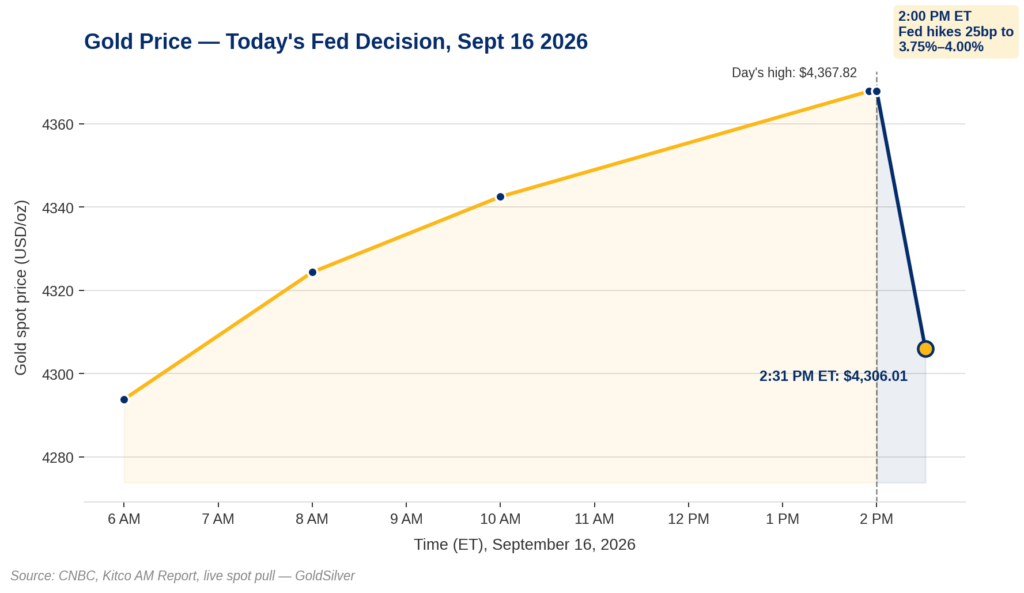
Gold was trading at $4,306 an ounce at 2:31 p.m. ET Wednesday, up just 0.3% on the day. That is down from a 1.2% gain earlier this morning. Silver was at $63.58, slightly negative on the session, off from a 1.6% morning advance. The FOMC voted unanimously at 2:00 p.m. ET to raise the federal funds target range by 25 basis points, to 3.75%-4.00%.
What Did the Fed Just Decide?
The FOMC raised its target range from 3.50%-3.75% to 3.75%-4.00%. That ends a hold that had stood since the December 2025 rate cut. The vote was unanimous, and that matters, because the July 29 meeting produced a 9-3 decision. Three regional Fed presidents dissented back then in favor of an immediate hike: Cleveland’s Beth Hammack, Minneapolis’s Neel Kashkari, and Dallas’s Lorie Logan. So Wednesday’s unanimity means the committee closed that gap. It did not paper over it. Chair Kevin Warsh’s statement described the economy as expanding “at a solid pace.” It also flagged that “uncertainty remains elevated owing, in part, to geopolitical developments.”
The Edge Every Investor Needs Smarter precious metals investing starts here. The Nuggets Newsletter brings you essential market insights, Fed updates, global trends, educational videos, and much more.
What Does the New Dot Plot Say About the Rest of 2026?
Warsh again withheld his own projection, a pattern he has followed since June. Back then, 9 of 18 officials favored at least one more hike, and the funds rate was held unanimously at 3.50%-3.75%. Wednesday’s dot plot moved further. Of the 18 participants who submitted a projection, 12 penciled in one more quarter-point increase before year-end. Their average landed at 4.125%. Four went further and projected a half-point of additional tightening. Only two see no more hikes in 2026. So while the vote itself was a coin flip won by the expected outcome, the committee’s own forecast says today’s move probably is not the last one.
Why Did Gold and Silver Give Back Their Gains?
Both metals rallied hard into the decision, because a fully priced hike removes uncertainty. But the immediate reaction was not a clean risk-off move. The S&P 500 and Nasdaq held their gains. The 10-year Treasury yield actually eased about five basis points right after the 2:00 p.m. announcement, to roughly 4.95%. Gold and silver’s fade looks more like profit-taking on an outcome the market had already bought ahead of. Chair Warsh sharpened that mood at his press conference. “This summer’s inflation readings do not tell me that underlying trends have meaningfully improved,” he told reporters. That language reinforced the dot plot’s hawkish lean instead of closing the door on more hikes. A fully priced event plus a chair unwilling to call inflation solved is enough to cool a rally. It does not need a fresh spike in real yields to do that.
Goldman Sachs has not moved its 2026 year-end gold target of $4,900 since hike odds began climbing. Neither has J.P. Morgan’s $4,500 fourth-quarter call, nor Bank of America’s $4,360 average. Those desks were already pricing in today’s hike. That is why a widely telegraphed 25 basis points did not change where gold is headed next year, only where it sits this afternoon.
What’s the Deeper Story Here?
The deeper story is not the 25 basis points. It is the direction. A year ago the debate was how many cuts the Fed would deliver in 2026. Today the debate is how many more hikes are coming, and that reversal happened in about nine months, with core inflation still above the Fed’s 2% target. A central bank forced to reverse its own path that fast is not demonstrating control over inflation. It is demonstrating how little room it had to begin with. Financial repression, keeping rates below the pace of inflation to manage a debt load, does not require flat rates forever. It only requires real yields to stay compressed against the scale of government borrowing, and a single hike inside a still-hawkish forecast does not undo that arithmetic.
Silver’s own supply picture sits entirely outside today’s decision, too. The Silver Institute’s 2026 World Silver Survey confirms a fifth consecutive annual deficit through 2025, with a sixth projected for 2026 near 46.3 million ounces. A Fed meeting can move silver by a dollar in an afternoon. It cannot fill a structural shortfall that has run for half a decade.
Watch the September 30 PCE inflation print, the Fed’s preferred gauge, for the next real test of whether today’s dot plot holds. The October 27-28 meeting comes next. Sixteen of eighteen officials are already penciling in a second hike, and that is the meeting where the committee could deliver it. If gold and silver hold recent support into that meeting the way they did into this one, today’s pullback will look like exactly what it was: a fully priced event getting priced, not a broken thesis.
Stay On Top of Gold & Silver Prices
Get important market alerts sent straight to your inbox.
SOURCES
1. Federal Reserve — September 2026 FOMC Statement & Summary of Economic Projections
2. CME Group — FedWatch Tool
3. Yahoo Finance — Fed Meeting Live Updates, September 16, 2026
4. Kiplinger — September Fed Meeting: Live Updates and Commentary
5. CNBC — Gold Gains With Fed Rate Decision in Spotlight
6. Federal Reserve Bank of St. Louis (FRED) — 10-Year Treasury Constant Maturity Rate
7. The Silver Institute — World Silver Survey 2026
Disclaimer: This article is for informational purposes only and does not constitute investment advice. Past performance is not indicative of future results. Always consult a qualified financial advisor before making investment decisions.
You May Also Like:
- $603 Million Left the World’s Biggest Gold ETF. It Didn’t Leave Gold.
- Texas Just Made Gold Legal Money. Four More Non-Fed Stories Followed.
- Silver Is Outperforming Gold by a Third This Morning. The Fed Hasn’t Even Voted Yet.
- The Fed Votes Wednesday. Gold’s Other Vote Lands Friday.
- The Fed Vote Is Already Priced In. These Five Things Aren’t.
- The 10-Year Yield Just Hit an 18-Year High. Gold Isn’t Falling For It.