Silver Rises Over 120% YTD




Gold investment demand surged 84% in 2025, hitting a record 2,175 tonnes — the highest level in over a decade [World Gold Council, 2025].
A lot of new buyers are entering the physical market for the first time. And most of them face the same immediate question: gold coins or bars? The answer is more consequential than it looks.
What Are Gold Coins and How Are They Different from Gold Bars?
Gold coins are minted by sovereign governments. They carry a face value, a recognized design, and a guaranteed purity. The American Gold Eagle, Canadian Gold Maple Leaf, and Austrian Gold Philharmonic are among the most widely traded gold coins in the world.
The American Gold Eagle was authorized under the Gold Bullion Coin Act of 1985 and first released by the U.S. Mint in 1986 [U.S. Mint]. Each coin contains its stated weight in pure gold — alloyed with small amounts of silver and copper for durability — and its weight, content, and purity are guaranteed by the United States government.
Gold bars — also called bullion bars or ingots — are produced by private refiners and government mints alike. They come in sizes ranging from 1 gram to 400 ounces. Bars are stamped with weight, purity, and the refiner’s hallmark, but they don’t carry a face value or national design.
The core distinction is simple. Gold coins are finished, sovereign-backed products. Gold bars are refined bullion in its most straightforward form. Both contain real gold. Both track the spot price. But the economics around each one diverge in ways that directly affect your bottom line.
Do Gold Coins Cost More Than Gold Bars?
Yes — almost always. Gold coins carry higher premiums over the spot price of gold than bars of the same weight.
Sovereign gold coins like the American Gold Eagle typically carry premiums of 4–7% over spot, while comparable 1 oz gold bars from recognized refiners tend to sit closer to 2–4% [Gainesville Coins]. That gap widens further when comparing fractional coins to larger bars. A 10 oz gold bar will almost always carry a lower premium per ounce than ten individual 1 oz gold coins.
Why the difference? Coins cost more to produce. Minting involves detailed engraving, anti-counterfeiting features, quality control, and limited annual production runs. That added craftsmanship and sovereign guarantee gets built into the price.
Here’s the key nuance: that higher premium on gold coins isn’t money lost. It’s money that typically comes back at resale — because buyers on the secondary market also pay those premiums. Coins hold their premium value in ways that generic bars sometimes don’t.
For investors focused on accumulating the most gold for the least money, bars win on pure cost efficiency. For investors who value recognition, liquidity, and resale strength, gold coins often justify the extra cost.

Perth Mint, PAMP Suisse Lady Fortuna, Royal Canadian Mint, and PAMP Suisse 1 oz bars — all from LBMA-accredited refiners.
Which Is Easier to Sell — Gold Coins or Gold Bars?
Gold coins have a clear liquidity advantage — particularly the most recognized sovereign issues.
An American Gold Eagle is instantly recognizable to any dealer, anywhere in the world. There’s no need for assay verification. No debate about authenticity. The U.S. Mint has sold more than 22 million troy ounces of Gold Eagles since the program launched in 1986, making them one of the most widely held bullion coins on the planet [U.S. Mint].
Gold bars are also liquid — but with a caveat. Larger bars (10 oz and above) may require assay testing before a dealer will buy them, especially if the bar comes from a less well-known refiner. That extra step can slow down a transaction or reduce your offer price.
Smaller bars from recognized refiners like PAMP Suisse or the Royal Canadian Mint trade nearly as smoothly as coins. But across the board, gold coins — especially sovereign coins — remain the most universally liquid form of physical gold. If speed and ease of resale matter to you, gold coins are hard to beat.

Your Gold Buying Guide Most investors overpay when they buy gold. Then overpay again when they sell. This guide shows you exactly what to own — and why.
How Does Storage Differ for Gold Coins vs Gold Bars?
Storage is where gold bars gain an edge. Gold bars stack efficiently. A 10 oz bar takes up far less space than ten individual 1 oz coins in protective capsules or tubes. For investors building large positions, bars offer a more compact, cost-effective storage footprint.
Gold coins require more space per ounce, especially those in protective packaging. Tubes and cases add bulk. For home storage in a safe — or for allocated vault storage where fees are assessed by volume or weight — that can add up.
That said, gold coins offer a different kind of storage flexibility. Because they come in smaller, standardized units, coins are easier to distribute across multiple storage locations. Many investors use this approach to reduce single-point-of-failure risk.
For sheer density and cost-efficiency in storage, gold bars win. For flexibility and diversification of storage locations, gold coins have the advantage.
Are Gold Coins Better for Resale Flexibility?
This is one of the strongest arguments for gold coins. Say you hold a single 10 oz gold bar and need to liquidate part of your position. You can’t sell half a bar. It’s all or nothing.
Now say you hold ten 1 oz gold coins. You can sell one, three, or seven — whatever fits your needs. That granularity gives you precise control over how much gold you sell and when.
Gold coins function almost like denominations of a currency. You can peel off exactly what you need without liquidating your entire position. For investors who view gold as a long-term savings vehicle they may draw on incrementally, this flexibility is enormously valuable.
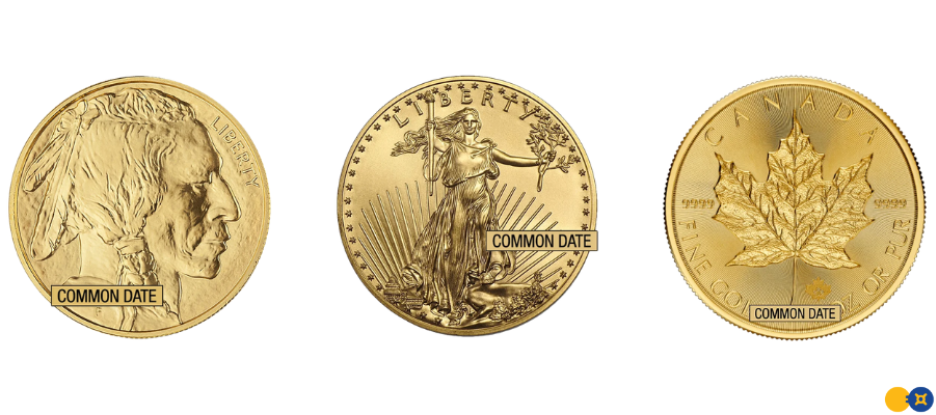
From left: American Gold Buffalo, American Gold Eagle, and Canadian Gold Maple Leaf. All three are IRA-eligible.
Bars do come in fractional sizes (1 gram, 5 gram, etc.), but those smaller bars carry disproportionately high premiums — often higher than coins of the same weight. At that point, the cost advantage of bars disappears.
For most investors, a stack of recognized gold coins offers the best balance of value and flexibility.
Can You Hold Gold Coins in an IRA?
Yes — but not all gold coins qualify. The legal foundation for holding physical gold in an IRA was established under the Taxpayer Relief Act of 1997, which amended IRC Section 408(m) to permit certain bullion coins and bars in tax-advantaged retirement accounts [Taxpayer Relief Act of 1997]. Under these rules, gold must be at least 99.5% pure (0.995 fineness) to qualify — with one notable exception.
The American Gold Eagle, despite being 91.67% pure (22-karat), is explicitly permitted by statute. Congress carved out this exception because the Eagle is the primary U.S. Mint bullion coin, backed by the full guarantee of the United States government [IRC §408(m)(3)(A); 31 U.S.C. §5112].
Other popular IRA-eligible gold coins include the American Gold Buffalo (99.99% pure), Canadian Gold Maple Leaf (99.99% pure), and Austrian Gold Philharmonic (99.99% pure).
Gold bars also qualify for IRAs — provided they meet the 99.5% purity threshold and are produced by a refiner accredited by NYMEX/COMEX or the London Bullion Market Association (LBMA). All IRA-held metals must be stored in an IRS-approved depository. Home storage is not permitted and can trigger a taxable distribution plus penalties.
If you’re considering a Gold IRA, working with a dealer who specializes in IRA-eligible products makes the process significantly simpler.
What About Collectible or Numismatic Gold Coins?
This article focuses on bullion gold coins — coins valued primarily for their gold content. But it’s worth addressing the collectible question directly.
Numismatic gold coins trade at premiums based on rarity, historical significance, condition, and collector demand. Those premiums can be substantial — and they can also collapse if collector interest shifts. The IRS classifies most numismatic and graded coins as “collectibles” under IRC Section 408(m)(2), which makes them ineligible for inclusion in an IRA [IRS.gov].
For investors focused on wealth preservation and portfolio protection, bullion gold coins are the straightforward choice. Their value tracks the gold price. You’re not speculating on collector markets.
Some dealers push numismatic coins aggressively because the markups are higher. That’s a red flag. If your goal is owning gold for financial protection, stick with widely recognized bullion coins from sovereign mints.
So Which Should You Buy — Gold Coins or Gold Bars?
There’s no single right answer. The best choice depends on your priorities.
- Instant worldwide recognition — sovereign coins sell to any dealer, anywhere
- Sell in small increments — liquidate exactly what you need, keep the rest
- IRA-eligible options — Eagles, Buffalos, Maple Leafs, Philharmonics
- Anti-counterfeiting features — government-backed weight & purity guarantee
- Ideal for 1–10 oz purchases — accessible entry point at any budget
One common framework: investors with positions under $25,000 lean heavily toward coins, while those above $50,000 begin shifting toward a majority bar position — maintaining a coin allocation for liquidity.
The most important decision isn’t coins vs bars. It’s whether you own real, physical gold at all. Both forms give you what matters most — genuine wealth outside the banking system, denominated in something that can’t be printed, defaulted on, or diluted.
Ready to Start?
Whether you’re leaning toward gold coins or gold bars, the key is buying from a trusted dealer with transparent pricing, secure storage options, and IRA support.
[Browse Gold Coins and Bars →]
Investing in Physical Metals Made Easy

People Also Ask
Do gold coins cost more than gold bars?
Yes. Sovereign gold coins typically carry premiums of 4–7% over the spot price of gold, compared to 2–4% for comparable gold bars. The higher premium reflects minting costs, anti-counterfeiting features, and sovereign government backing — but it is generally recovered at resale because secondary-market buyers also pay those premiums.
Which is easier to sell — gold coins or gold bars?
Gold coins, especially sovereign issues like the American Gold Eagle. They are instantly recognizable to dealers worldwide and typically require no assay verification. Larger gold bars may need authentication testing before resale, which can slow transactions and reduce offer prices.
Can you put gold coins in an IRA?
Yes. The Taxpayer Relief Act of 1997 amended IRC Section 408(m) to allow certain bullion coins and bars in tax-advantaged retirement accounts. Gold must be at least 99.5% pure to qualify, with one exception: the American Gold Eagle (91.67% pure, 22-karat) is explicitly permitted by statute.
What gold coins are IRA eligible?
The most widely held IRA-eligible gold coins are the American Gold Eagle, American Gold Buffalo (99.99% pure), Canadian Gold Maple Leaf (99.99% pure), and Austrian Gold Philharmonic (99.99% pure). All IRA-held gold must be stored in an IRS-approved depository — home storage is not permitted and can trigger taxes and penalties.
Are gold bars a better investment than gold coins?
Gold bars offer lower premiums per ounce, making them more cost-efficient for large purchases — particularly above $25,000. However, gold coins provide superior liquidity, easier resale in partial amounts, and broader worldwide recognition, which many investors consider worth the higher upfront premium.
Why do gold coins have higher premiums than gold bars?
Gold coins cost more to produce than bars. Sovereign minting involves detailed engraving, anti-counterfeiting security features, strict quality control, and limited annual production runs. That added cost gets built into the retail premium — but it also supports stronger resale value, since buyers on the secondary market pay those premiums too.
SOURCES
1. World Gold Council — Gold Demand Trends: Full Year 2025
2. U.S. Mint — Bullion Coin Programs
3. U.S. Mint — American Eagle Gold Proof Coin
4. Congress.gov — Gold Bullion Coin Act of 1985, Pub. L. 99-185
5. Congress.gov — Taxpayer Relief Act of 1997, Pub. L. 105-34, Sec. 304
6. IRS.gov — Investments in Collectibles in Individually Directed Qualified Plan Accounts
7. Gainesville Coins — Gold Coins vs Bars: Which Is Better for Investing in 2025?
This article is for informational purposes only and does not constitute financial or investment advice. Always consult a qualified financial advisor before making investment decisions.