Silver Rises Over 120% YTD




There’s a question that comes up constantly among new gold buyers: Does my jewelry count as a gold investment?
It’s a fair question. Gold is gold, right?
Not exactly — and the difference could save you thousands of dollars and a lot of frustration. Gold jewelry and investment-grade gold are two fundamentally different products: one is a consumer good priced around design, brand, and retail markup; the other is a financial asset priced as close to the global gold market as possible.
What Is Investment-Grade Gold?
Investment-grade gold refers to physical gold products — primarily bars and coins — manufactured to a standard purity of .999 (99.9%) or .9999 (99.99%) fine gold and priced in direct relationship to the live spot price. You’re buying the metal itself, with minimal premium beyond production and distribution costs [Investopedia].
Gold jewelry, by contrast, is a manufactured consumer product. Its price includes gold content — often at lower purity — plus design costs, manufacturing labor, retail overhead, and brand markup. The gold content is rarely the majority of what you’re paying for.
Gold Purity: The First and Most Important Difference
Not all gold products contain the same amount of actual gold. In the United States, most retail gold jewelry ranges from 10-karat to 18-karat, with 14K being the dominant standard. It accounts for approximately 90% of engagement and wedding rings sold in the U.S., chosen for its balance of durability and affordability [The Diamond Pro]. 14K gold is 58.3% pure gold — the remaining 41.7% consists of strengthening alloy metals such as silver, copper, and zinc [MetalCharts].
Investment-grade bullion is .999 or .9999 fine — meaning 99.9% to 99.99% pure gold. What you’re buying is almost entirely the metal itself [World Gold Council].
Here’s how the most common purities compare:
| Karat | Fineness | Gold Content | Typical Use |
| 24K | .999/.9999 | 99.9%+ | Investment bars, some coins |
| 22K | .916 | 91.7% | American Gold Eagle, some jewelry |
| 18K | .750 | 75.0% | Fine jewelry (European/Asian standard) |
| 14K | .585 | 58.3% | Most U.S. jewelry |
| 10K | .417 | 41.7% | Entry-level U.S. jewelry |
It’s also worth knowing that not all investment coins are .9999 fine. The American Gold Eagle — the most widely traded gold coin in the U.S. — is minted in 22K gold (91.67% gold content), with silver and copper added for durability.
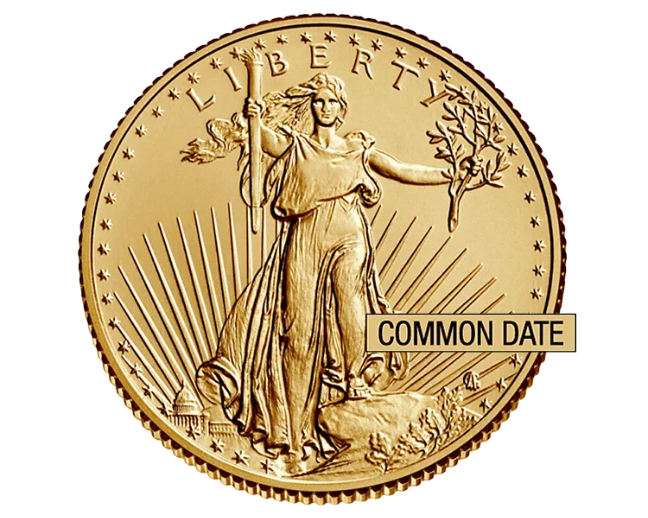
The American Gold Eagle — minted by the U.S. Mint in 22K gold, government-backed,
and the most widely traded gold coin in the United States.
Coins like the Canadian Gold Maple Leaf, American Gold Buffalo, and Austrian Philharmonic are struck in .9999 fine gold [U.S. Mint]. Both are recognized investment-grade products — the distinction is purity, not legitimacy.
You’re Paying for More Than Gold When You Buy Jewelry
When you walk into a retail jewelry store, the price tag on a gold piece includes the metal content — but also design fees, manufacturing labor, retail overhead, and brand premium.
Traditional jewelry retailers typically mark up finished pieces 100% to 300% or more above their wholesale cost — and luxury brands can go significantly higher [Abercrombie Jewelry]. That markup is applied on top of a product that’s already less than 60% gold by weight. A $2,000 bracelet at a mid-range retailer may contain as little as 20% to 30% of that price in actual gold content — the rest is everything that went into making and selling it.
Investment gold is priced differently. When you buy a coin or bar from a reputable dealer, the price is built around the spot price of gold — the live, globally traded market price per troy ounce — plus a dealer premium covering minting, distribution, and margin. Under normal market conditions, standard bullion products typically carry premiums of 3% to 10% above spot; 1 oz bars from recognized refiners often run lower, while sovereign coins run slightly higher [GoldSilver]. Fractional coins (1/4 oz, 1/10 oz) carry steeper premiums per ounce due to proportionally greater production costs — sometimes 15% to 25%.
The Resale Reality: Where Jewelry Loses Its Luster
This is where the gap becomes impossible to ignore. Investment-grade coins and bars from recognized mints and refiners are globally liquid. A 1 oz American Gold Eagle or a PAMP Suisse bar can be sold to any reputable dealer worldwide at a price closely tied to spot gold. On the sell side, dealers typically offer near spot for popular sovereign coins — meaning the round-trip cost of buying and selling standard bullion runs in the single-digit percentage range under normal conditions [World Gold Council / Fidelity].
Gold jewelry follows entirely different economics. When you go to sell a piece, dealers assess its melt value — the dollar value of the actual gold content based on purity and weight — not the retail price you paid. Pawn shops typically offer 40% to 70% of melt value [Maxferd.com]. Reputable specialist buyers and online platforms tend to do better: 60% to 90% of melt value, depending on purity, condition, and where you sell [The Alloy Market].
What none of them pay is the craftsmanship premium, brand value, or retail markup you paid at purchase. That $2,000 bracelet with $500 in gold content might yield $300–$450 when you sell it. The retail markup evaporates the moment it leaves the store.
Emotional Value vs. Financial Value
None of this means gold jewelry is worthless — it means the value operates on a different axis entirely. Jewelry carries emotional, cultural, and aesthetic worth that bullion simply doesn’t. In many cultures — particularly across India, the Middle East, and East Asia — high-karat gold jewelry (22K and 24K) is worn as adornment and held as wealth, purchased by weight with pricing tied closely to the spot market [World Gold Council]. In those markets, the line between jewelry and investment gold is genuinely blurry.
But the average consumer purchasing 14K gold at a U.S. mall retailer is in a different situation: paying a substantial retail premium for a product that’s 58% gold, priced with no connection to the spot market, and resalable only at melt value.
If your goal is financial, buy bullion. If your goal is sentimental, cultural, or aesthetic, buy jewelry — with realistic expectations about what you’ll get back.
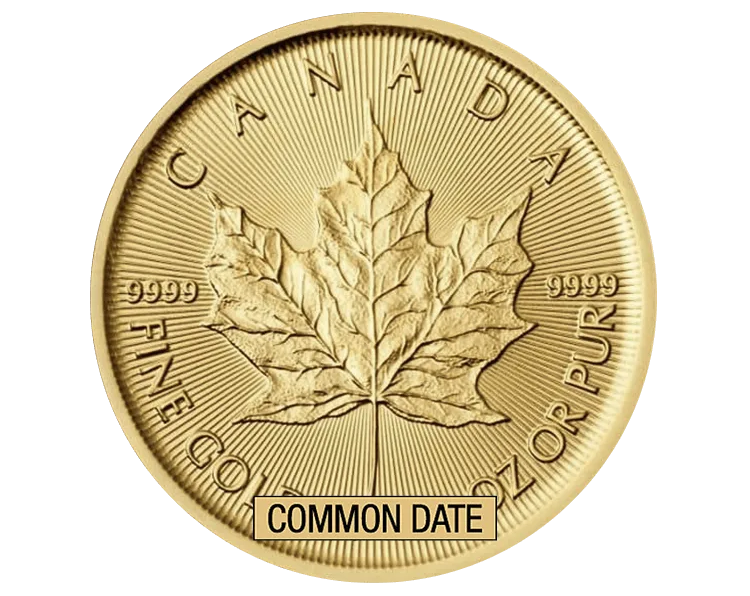
The Canadian Gold Maple Leaf — struck in .9999 fine gold by the Royal Canadian Mint,
one of the most recognized bullion coins in the world.
What Investment Gold Actually Looks Like
For investors building a position in physical gold, the most practical entry points are coins, bars, and — for those who prefer not to hold the metal directly — gold-backed funds.
Gold coins are the most liquid form of physical gold available to individual investors. Sovereign mint coins — the American Gold Eagle, Canadian Gold Maple Leaf, South African Krugerrand, and Austrian Philharmonic — are globally recognized and accepted by reputable dealers worldwide. Fractional sizes (1/10 oz, 1/4 oz, 1/2 oz) make entry accessible at smaller budgets, though at a higher premium per ounce.
Gold bars from accredited refiners such as PAMP Suisse, Valcambi, and the Perth Mint offer the lowest premiums per ounce at larger sizes — generally lower than sovereign coins at equivalent weights. The tradeoff is slightly less immediate retail liquidity, particularly for buyers unfamiliar with the bar market.
Gold ETFs and digital gold provide price exposure without the need for physical storage, and are efficient for trading purposes. What they don’t provide is direct ownership of the metal — a meaningful distinction if your reason for holding gold is insurance against systemic risk.
For most investors new to physical gold, sovereign coins are the natural starting point: widely recognized, easy to buy and sell, and available in sizes that work for almost any budget.
Beauty vs. Wealth: Know What You’re Buying
The difference between gold jewelry and investment gold isn’t a matter of degree — it’s structural.
Gold jewelry is a retail consumer product. You’re paying for design, craftsmanship, brand, and overhead on top of gold that’s often less than 60% pure. When you sell, you get melt value — typically 40% to 90% of the actual gold content depending on where you sell — not a return on what you paid at retail.
Investment gold — coins and bars from recognized mints and refiners — is purpose-built to store and transfer value. Transparent premiums, deep buy-and-sell markets, and sizes that work for nearly any budget make it a practical financial asset in a way that jewelry simply isn’t.
Buy jewelry for the right reasons: beauty, sentiment, meaning. Buy bullion when the goal is financial: wealth preservation, inflation protection, a store of value outside the banking system. Knowing which one you’re holding matters more than most new gold buyers realize.
Investing in Physical Metals Made Easy

People Also Ask
Is gold jewelry a good investment?
For financial return, generally no. Most U.S. gold jewelry is 10K to 18K purity and carries significant retail markup for design and manufacturing. At resale, dealers pay based on the jewelry’s melt value — typically 40% to 90% of actual gold content depending on the buyer — not on the original purchase price [The Alloy Market].
What is the difference between jewelry gold and investment gold?
Investment gold (coins and bars) is typically .999 or .9999 fine, priced against the live spot price with a small dealer premium for minting and distribution. Jewelry gold is lower purity, priced to include manufacturing and retail markup, and resells only at melt value. The gap between what you pay and what you recover is far wider with jewelry [World Gold Council].
What purity is investment-grade gold?
Investment-grade gold is typically .999 (99.9%) or .9999 (99.99%) fine. Common U.S. jewelry ranges from 41.7% (10K) to 75% (18K). The American Gold Eagle is an exception at 22K (91.67% gold) — still fully accepted as investment-grade due to its U.S. Mint backing and global liquidity [U.S. Mint].
Can I sell gold jewelry at spot price?
Rarely. Dealers assess jewelry based on its melt value and offer a percentage of that — not the spot price itself, and certainly not what you paid at retail. Pawn shops typically pay 40% to 70% of melt value; specialist gold buyers may offer 60% to 90% [The Alloy Market].
What’s the best way to start investing in physical gold?
Sovereign gold coins — American Gold Eagle, Canadian Maple Leaf, Austrian Philharmonic — are the most practical entry point for new investors due to their global recognition and strong resale liquidity. Gold bars offer slightly better value per ounce at larger sizes. Both are available through reputable dealers like GoldSilver.
How much of a gold jewelry purchase is actual gold?
It depends on the karat and the retailer. At a typical U.S. retail jeweler selling 14K gold, the metal is 58.3% gold by weight — but the gold content represents a far smaller fraction of the retail price, which also includes manufacturing and markup. Traditional jewelry retailers commonly mark up finished pieces 100% to 300% or more above wholesale cost [Abercrombie Jewelry].
SOURCES
1. The Diamond Pro — Full Comparison of 10K, 14K, 18K and 24K Gold
2. MetalCharts — 14K Gold Price Today & Per Gram
3. Investopedia — Bullion: Definition, How It’s Used to Invest, and Example
4. GoldSilver — Bullion Premiums Explained: How to Spot Reasonable Prices
5. World Gold Council — How to Invest in Gold
6. Fidelity — How to Buy Gold: 2 Ways to Invest in Gold
7. Maxferd Jewelry & Loan — How Much Do Pawn Shops Pay for Gold?
8. The Alloy Market — Is Now a Good Time to Sell Gold Jewelry?
9. Abercrombie Jewelry — What Is the Markup on Gold Jewelry?
10. Kuvera Jewelry — Understanding Gold Pricing: What You’re Actually Paying For
11. World Gold Council — Gold Demand Trends
12. U.S. Mint — American Gold Eagle
This article is for informational purposes only and does not constitute financial or investment advice. Always consult a qualified financial advisor before making investment decisions.