Silver Rises Over 120% YTD




Published: 01-25-2021, 05:00 am | Updated: 06-15-2026, 09:57 am
Silver didn’t just “do well” in 2025 — it rewrote the playbook.
The metal opened the year at $28.92 and ended just below $72 per ounce, marking an annual gain of approximately 144% — silver’s sharpest calendar-year advance since 1979. That move shattered a decade-long ceiling near $30 and left most institutional forecasts far behind.
What fueled the historic rise?
- A fifth straight year of structural supply deficits, with the cumulative shortfall from 2021–2025 approaching 820 million ounces [Silver Institute, November 2025]
- Strong industrial demand from solar, EVs, AI-driven data centers, and advanced electronics — even as silver consumption per unit declined slightly due to thrifting
- Growing recognition of silver as both an inflation hedge and a strategic industrial metal — a narrative that accelerated as real interest rates fell and dollar confidence weakened
The result: silver finally followed gold’s bull market and launched into its own, with price action many analysts now describe as a long-overdue structural repricing, not a one-off spike.
Silver Price Predictions for 2026
Leading financial institutions dedicate extensive resources to precious metals research. Their silver forecasts — built on macroeconomic analysis, technical indicators, and supply-demand data — guide investment decisions for institutional investors and wealth managers worldwide.
Important context: Many of the price targets below were published when silver was trading between $30 and $50. As prices climbed above $70 and then surged well past $80 in early 2026, several institutions have revised targets significantly higher. Where available, the most current published target is shown. Investors should treat all forecasts as approximations subject to rapid revision in a fast-moving market.
| Analyst/Firm | Silver Price Target | Time Frame |
|---|---|---|
| World Bank | $41 | 2026 |
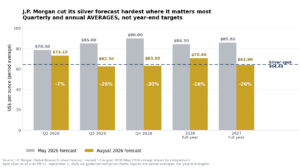
| JP Morgan | $58 | 2026 |
| Metals Focus | $60 | 2026 |
| Saxo Bank | $60 – $70 | 2026 |
| UBS | $60 | 2026 |
| Bank of America | $65 | 2026 |
| TD Securities | $65.50 | 2026 |
| HSBC | $68.25 | 2026 |
| Deutsche Bank | $100 | End of 2026 |
| Citigroup | $100 | March 2026 |
| Goldman Sachs (Research) | expects extreme volatility in 2026 (no public target) | 2026 |
| CPM Group | expects higher prices in 2026 (no published target) | 2026 |
| InvestingHaven | $75 | 2027 |
| InvestingHaven | Peak price: $88 | 2028 |
| Keith Neumeyer (First Majestic Silver) | $100+ | “next leg/coming cycle” |
| Robert Kiyosaki | $100 – $200 | 2026 |
Alan Hibbard’s Updated View for 2026
Silver’s 2025 breakout forced analysts to revisit their models, but GoldSilver’s Alan Hibbard believes the market still hasn’t fully priced in the structural deficits and explosive industrial demand building beneath the surface. His outlook for 2026 reflects a shift from short-term trading targets to a long-term value recognition moment.
As Alan explains:
“I’m expecting silver to perform better in 2026 than it did in 2025 (+147%). I wouldn’t be surprised to see the price of silver increase by over $100 per ounce (to $175+).”
Key Factors to Watch in 2026
Several powerful forces are converging to shape silver’s trajectory in 2026. After a historic surge in 2025, the market enters the new year with tighter supplies, evolving industrial fundamentals, and a rapidly shifting macro backdrop. Here’s what will matter most:
Industrial Demand: Solar, EVs, and AI Supercharge Silver’s Role
Silver’s industrial story is no longer a slow, steady trend — it’s a structural re-rating.
Solar remains the dominant driver, though the picture in 2025 was more nuanced than simple growth. Global solar installations set a new record in 2025 — but the amount of silver used per module declined due to technological thrifting, causing overall PV silver demand to ease roughly 5% year-over-year [Silver Institute, November 2025]. This distinction matters: surging panel deployment and declining silver intensity are competing forces, and which one wins will significantly shape silver demand through 2030.
Looking further ahead:
- Solar’s share of silver industrial demand has grown from just 11% in 2014 to approximately 29% in 2024 — a near-tripling in a decade [Silver Institute / Oxford Economics]
- By 2030, annual solar silver requirements could reach 10,000–14,000 tonnes, against a total projected global supply of roughly 34,000 tonnes — meaning solar alone could account for up to 40% of all silver consumed [Ghent University / Resources, Conservation and Recycling, 2025]
- New solar cell architectures — especially TOPCon and silicon heterojunction (SHJ) — use significantly more silver per unit than the older PERC standard, creating a potential demand re-acceleration even as thrifting continues
Electric vehicles and advanced electronics are also structurally supportive:
- A battery EV uses approximately 25–50 grams of silver — roughly double the amount in a conventional internal combustion vehicle — with demand rising further as vehicles add sensors, high-voltage connectors, and power-management systems
- AI infrastructure and data centers are an emerging but not yet well-quantified demand vector, using silver in high-efficiency electrical components, precision contacts, and thermal management systems
Industrial demand remained the largest single category of silver consumption in 2025, accounting for approximately 59% of total global demand at 665 million ounces — though that figure was down 2% from 2024’s record, reflecting the impact of tariff uncertainty and faster-than-expected thrifting in solar applications [Silver Institute, November 2025].
Monetary Policy: Rate Cuts, Fiscal Stress, and a Weakening Dollar
2025 shifted the monetary landscape dramatically.
After political instability around the Federal Reserve and weakening economic indicators, the market now expects multiple rate cuts through 2026. Lower real rates are historically bullish for precious metals — especially silver, which benefits from both safe-haven and growth-sensitive demand.
Key dynamics for 2026 include:
- A softer dollar increases global silver affordability.
- Falling real yields reduce the opportunity cost of holding silver.
- Rising fiscal deficits and election-driven spending add long-term inflation pressure.
Silver’s dual identity — part monetary metal, part industrial — positions it uniquely to thrive in this environment.
Investment Demand: A New Class of Buyers Joins the Market
2025 marked a turning point in investment demand. Exchange-traded product (ETP) inflows shifted dramatically, with global silver ETP holdings absorbing approximately 187 million ounces through the first ten months of the year — pushing total holdings to 1.13 billion ounces, within 7% of the all-time peak [Silver Institute, November 2025].
Russia’s formal inclusion of silver in its state reserve program also represents a structural shift. Russia’s 2025–2027 Federal Budget allocated approximately 51.5 billion rubles (~$535 million) for precious metals acquisition — explicitly including silver alongside gold, platinum, and palladium for the first time [Russia Federal Budget / Bloomberg, 2024]. While the allocation covers precious metals broadly rather than silver alone, the explicit inclusion of silver in a major sovereign reserve program has no precedent in the modern era and signals a new perception of the metal’s strategic value.
Institutional allocations to silver are rising alongside gold — a trend expected to accelerate in 2026, particularly as the gold-to-silver ratio — which reached above 100:1 earlier in 2025 — normalizes toward historical averages.
Stay On Top of Gold & Silver Prices
Get important market alerts sent straight to your inbox.
Supply Constraints: Structural Deficits Enter Their Fifth Year
The silver market recorded its fifth consecutive annual supply deficit in 2025 — but the size of that deficit was smaller than in prior years, at an estimated 95 million ounces, down from 148.9 million ounces in 2024 [Silver Institute, November 2025].
The cumulative deficit from 2021 through 2025 approaches 820 million ounces — a number that helps explain the persistent tightness in physical markets and the drawdown in exchange inventories.
On the supply side, 2025 actually saw production rise:
- Global mine supply is expected to reach approximately 844 million ounces in 2025 — an 11-year high — driven by new operations and ramp-ups in China, Canada, Chile, and Morocco [Silver Institute, January 2025]
- Mexico remained the world’s largest silver-producing nation, with output rising by roughly 5 million ounces in 2025 supported by mine restarts and expanded capacity [Silver Institute, November 2025]. (Note: the commonly cited narrative about Mexico regulatory disruptions was more relevant in 2022–2023)
The supply story is therefore mixed: production is growing, but not fast enough to close a demand gap that has now persisted for five consecutive years. Several major primary silver mines remain near end-of-life, and no large new projects are on a timeline to replace them. Inventories on the COMEX and LBMA drew down through 2024 and into 2025, and available “good delivery” bars tightened significantly — a physical market signal that contributed to the sharp price moves seen in 2025.
Geopolitical Factors: Tariffs, Energy Shocks, and Mining Risk
Global instability remaiGlobal instability remains a meaningful tailwind:
- U.S.–China and U.S.–India tariff disputes created supply chain volatility and dampened industrial demand in some categories through mid-2025, before partial resolutions
- Russia and Mexico, which together account for roughly 20–21% of global silver mine production, remain geopolitical and operational risk factors
- Mining nationalization trends in parts of Latin America create longer-term uncertainty for project development
- Middle East tensions — particularly around energy markets — add episodic safe-haven interest
Historically, silver has responded strongly to geopolitical crises. During the 2020 global disruption, silver surged approximately 47% in a matter of months. The 2025 price action showed similar sensitivity to macro and political shocks.
Market Outlook: What 2026 Could Bring
The setup for 2026 is structurally different from prior cycles. Silver enters the year with:
- Continued physical market tightness, even as mine supply grows
- An industrial demand base that, while facing near-term thrifting headwinds, is supported by irreversible long-term trends in solar, EVs, and AI infrastructure
- Bullish monetary conditions — falling real rates, dollar weakness, fiscal pressure
- A level of investor participation — across ETFs, futures, and retail — not seen since the early 2010s
Many analysts expect consolidation after 2025’s historic move. But strong hands in the physical market — particularly industrial buyers who cannot substitute away from silver — now have significant influence on pricing. If investment demand accelerates even modestly, the stage is set for further sharp upside, especially if the supply deficit persists or widens.
What Investors Should Watch Closely in 2026
- Solar cell architecture trends (TOPCon/SHJ adoption vs. silver thrifting rates)
- Federal Reserve policy and the trajectory of real interest rates
- Currency moves, especially the U.S. Dollar Index
- COMEX and LBMA inventory levels and “good delivery” bar availability
- Any additional sovereign or institutional silver reserve disclosures
- Geopolitical developments in major mining jurisdictions (Russia, Mexico, Peru)
Silver’s dual identity — indispensable industrial metal and monetary safe haven — makes it uniquely positioned to outperform in an environment where both inflation risk and industrial demand are rising simultaneously. Understanding the metal’s fundamentals, not just its price, will be key as silver enters the next phase of its bull market.
The Financial System Isn’t Safer — And You Know It As risks mount, see why gold and silver are projected to keep shining in 2026 and beyond.
People Also Ask
Will silver prices really hit $100 in 2026?
Many analysts now see a path to triple-digit silver, especially after the metal surged 147% in 2025. GoldSilver’s Lead Analyst Alan Hibbard expects silver to trade above $100 in 2026 as supply deficits deepen and industrial demand accelerates. For deeper context, watch the full breakdown in GoldSilver’s latest video or visit GoldSilver.com for ongoing updates.
Why did silver rise so fast in 2025?
Silver jumped from $28.92 to over $70 in 2025 due to record industrial demand, shrinking inventories, and a fifth consecutive global supply deficit. The move also reflected broader safe-haven buying during political tension and expected Fed rate cuts. You can explore the full 2026 outlook on GoldSilver.com.
Is industrial demand really driving the silver bull market?
Yes — industrial uses like solar, EVs, electronics, and AI hardware now make up over half of global silver demand. Solar alone is projected to consume more silver each year, pushing demand to new highs through the 2030s. GoldSilver’s article and videos explain why this structural trend is a major tailwind for prices.
Is there still a silver supply deficit in 2026?
The silver market remains in a multiyear structural deficit, with demand exceeding mine supply by roughly 160–200 million ounces in 2025. Limited new mining projects and tightening global inventories mean the deficit is likely to continue into 2026. Investors can track updated supply data through GoldSilver’s ongoing market coverage.
What are the biggest risks that could push silver higher in 2026?
Potential catalysts include continued Fed rate cuts, currency weakness, geopolitical shocks, and disruptions in major mining regions like Mexico and Russia. Any combination of these factors could amplify investment demand on top of strong industrial consumption. GoldSilver’s 2026 Silver Forecast video outlines the biggest risks and opportunities to watch.
SOURCES
2. Silver Institute — The Silver Market Is on Course for Fifth Successive Structural Market Deficit
3. Silver Institute / Oxford Economics — Silver: The Next Generation Metal (December 2025)
4. ScienceDirect / Resources, Conservation and Recycling — Forecasting Silver Demand and Supply by 2030: Impact of Silver-Intensive Photovoltaic Cells and Sectoral Competition
5. Silver Institute — Global Silver Market Forecast to Remain in a Sizeable Deficit in 2025
6. MineralPrices.com — Russia Reportedly Plans to Add Silver to State Fund Reserves
7. J.P. Morgan Global Research — How Will Silver Prices Fare in 2026?
8. Silver Institute — Silver Supply & Demand (World Silver Survey 2025)
9. LSEG / FTSE Russell — A Standout Year for Gold and Silver
You May Also Like:
Gold Price Predictions 2026: After a 60+% Surge in 2025, What Comes Next?
What Happens to Gold and Silver During Stagflation?
How to Read the Gold-Silver Ratio — And What to Do About It
Gold ETFs Are Booming. But Do You Actually Own Gold?
Silver Demand by Sector: Industry, Jewelry & Investment
Small Market, Big Swings: Why Silver Is More Volatile Than Gold