Silver Rises Over 120% YTD




Daily News Nuggets | Today’s top stories for gold and silver investors
March 11th, 2026 | Brandon Sauerwein, Editor
February CPI: A Pre-War Snapshot
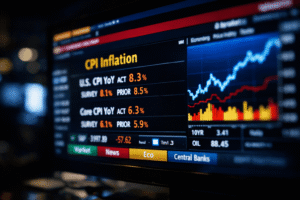
The February 2026 CPI report came in essentially as expected — and almost immediately beside the point. Headline inflation held at 2.4% year-over-year. Prices rose 0.3% on a seasonally adjusted basis. Core CPI (excluding food and energy) came in slightly cooler than forecast at +0.2% for the month, with the annual rate steady at 2.5%.
The sub-categories tell a familiar story. Food rose 0.4% on the month and 3.1% over the year. Shelter ticked up 0.2%. Used car prices continued their slide, falling 0.4%. Energy rose 0.6% — its first increase after January’s 1.5% drop — with natural gas up 3.1% and gasoline up 0.8% before seasonal adjustment.
Here’s the catch. All of this data was collected before the U.S.-Israel strikes on Iran began February 28. The oil shock that sent crude toward $100 a barrel? The 19% surge in gas prices? None of it shows up here. As analysts at Morningstar noted, that’s a March and April dynamic.
Goldman Sachs has warned that if elevated oil prices persist, headline inflation could climb from 2.4% to 3% by year-end. Today’s report is a clean pre-war baseline. The real inflation story is still coming.

Stay Ahead with Gold & Silver News The most important market insights, Fed updates, and global trends — everything investors need to make smarter, safer decisions.
Inflation’s Calm Before the Storm
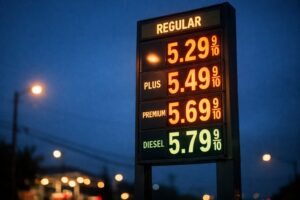
That calm may be short-lived. Gas prices have already jumped nearly 19% in a single month — and economists warn the worst is still ahead. The February 2026 CPI report was collected before the Iran war began. The March and April prints are where the oil shock actually shows up.
The core concern is the Strait of Hormuz. The chokepoint handles roughly three-quarters of Persian Gulf oil production, according to energy analytics firm Wood Mackenzie — and it has effectively shut down. Oil briefly spiked to nearly $120 a barrel before pulling back toward $85 after Trump called the conflict a “short-term excursion.” But as recently as Wednesday, a projectile struck a Thai cargo ship in the strait and set it ablaze. The situation remains fluid.
If elevated oil prices persist, headline inflation could hit 3% by year-end — reversing years of hard-won disinflation. That would land at a politically combustible moment. Congressional Republicans are already fielding voter anger over affordability heading into midterm elections.
For the Fed, the math is uncomfortable. A weakening labor market argues for rate cuts. An oil-driven inflation resurgence argues for holding firm. Neither tool fixes both problems at once.
The Bond Market’s Worst Week Since Liberation Day
The U.S. bond market just had its worst week since the Liberation Day tariff chaos — and oil is the culprit. When the U.S.-Israel strikes on Iran began February 28, Treasuries flipped overnight. Surging crude prices reignited inflation fears, and the safe-haven trade collapsed.
The 10-year yield climbed roughly 10 basis points to 4.03% in a single session — its biggest single-day jump since October. WTI crude posted a 35% weekly gain, the largest since oil futures trading began in 1983. Five-year inflation breakevens rose to 2.6%, up from 2.4% before the war.
The bond market is now caught between two competing forces. Oil-driven inflation pushes yields up. A weakening economy pulls them back down. There’s no clean resolution in sight — and major institutions are repositioning. BlackRock moved to underweight long-dated Treasuries. Pimco said it’s “on standby,” with a slight preference for the intermediate curve.
Amid the volatility, at least one legendary investor says the answer is simple.
Ray Dalio: “There Is Only One Gold”
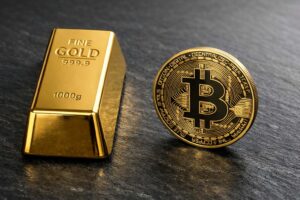
Ray Dalio doesn’t think the gold vs. bitcoin debate is close. Appearing on the All-In Podcast, the Bridgewater founder argued investors make a fundamental mistake by treating the two assets as interchangeable hedges — and the performance data backs him up.
Over the past year, gold is up roughly 80% while bitcoin is down about 10%. Hard to argue that the two assets act as safe havens with such drastically different performance.
Gold vs. Bitcoin: 1-Year Performance
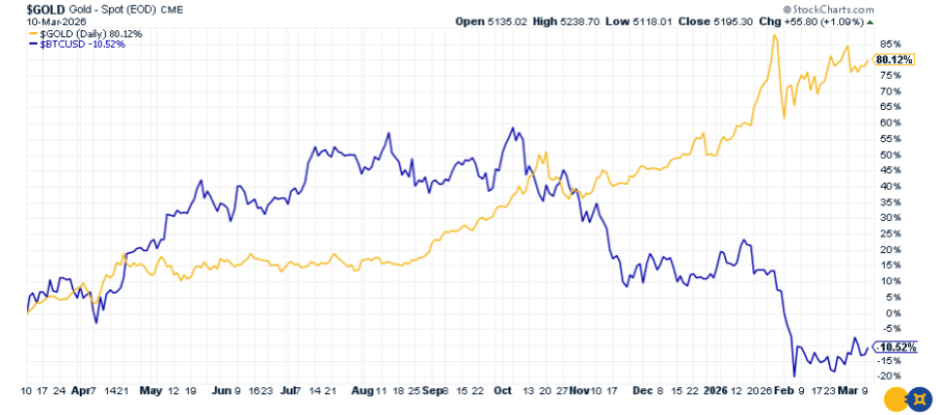
The distinction, Dalio argues, isn’t about price — it’s about institutional role. Central banks hold thousands of tons of gold in their reserve systems. They don’t accumulate bitcoin. That structural difference matters when markets deteriorate. Gold absorbs safe-haven flows. Bitcoin sells off alongside equities.
“There is only one gold,” Dalio said. The line cuts to the heart of his broader view: the global financial system is drifting toward a “capital war,” where assets tied to government balance sheets become vulnerable. In that environment, gold’s independence is the point.
His portfolio guidance is direct. He recommends allocating between 5% and 15% to gold — not as a trade, but as a permanent position. “When the bad times come along,” he said, gold “does uniquely well.” That’s the role. Not speculation. Diversification.
🗓️ Coming This Week
Thursday brings jobless claims. Friday delivers the Q4 GDP second estimate. And on March 18, the Fed decides — with markets pricing a 95.6% chance of no change.
But this week’s real question isn’t whether rates move. It’s what the Fed signals about a world where inflation is climbing back up just as the labor market softens.
For gold, that tension is exactly the kind of environment where the metal tends to outperform.
Investing in Physical Metals Made Easy