Silver Rises Over 120% YTD




🌆 Evening News Nuggets | Today’s top stories for gold and silver investors
March 19th, 2026 | Brandon Sauerwein, Editor
Gold’s price drop today surprised a lot of investors. Here’s what actually drove markets Thursday — and what it signals heading into the weekend.
Is This a Gold Selloff — or the Setup for the Next Leg Higher?
Today’s gold price drop has been sharp, sliding toward $4,650, — down roughly 3.5% on the day. On the surface, it looks like the metal is breaking down at the worst possible moment. Geopolitical risk is escalating. Yet gold is falling. Why?
The short answer is oil. The surge in crude is reigniting inflation fears, which pushes rate cuts further out. Higher-for-longer rates are a direct headwind for gold. That’s the mechanical explanation.
But there’s a deeper dynamic at work. When liquidity tightens fast, investors sell what they can — not what they want to. Gold is liquid. So it gets sold first. Sharp, counterintuitive pullbacks like this one are a feature of late-stage pressure, not a signal the bull market is over.
The structural case hasn’t changed. War-driven energy shocks, a national debt that just crossed $39 trillion, and a Fed boxed in by inflation — these aren’t temporary conditions. They’re the kind of slow-building pressures that eventually force a policy response.
And when that response comes, gold rarely drifts. It moves fast. This looks less like a breakdown — and more like a market waiting for its next catalyst.
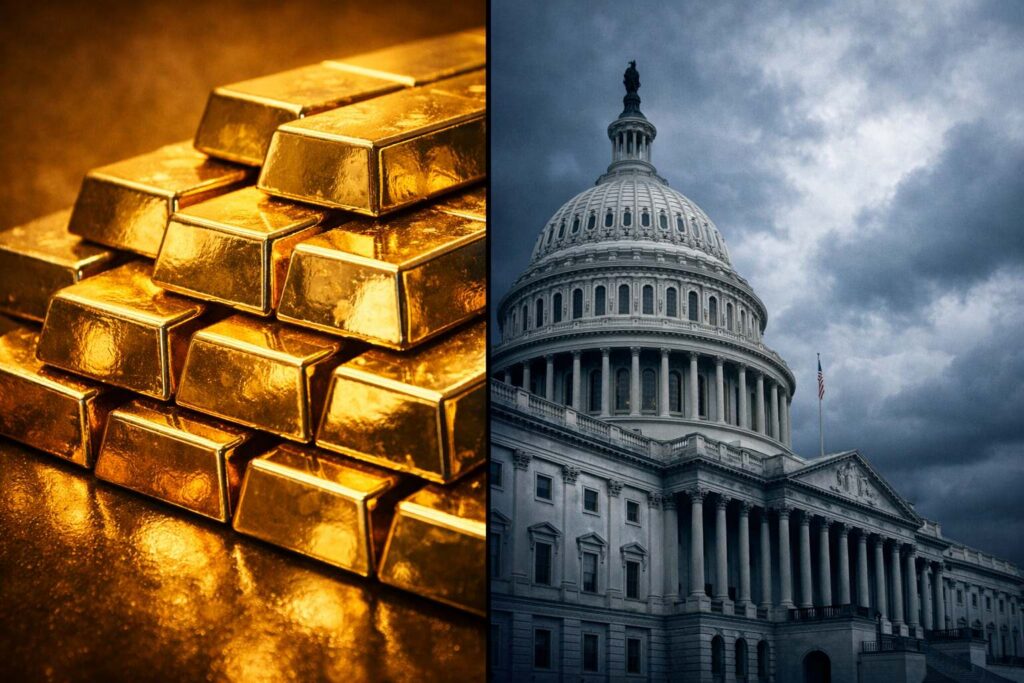
What Does a $200 Billion War Do to a $39 Trillion Debt?
This morning’s $39 trillion debt milestone aged fast. By afternoon, the Pentagon confirmed it had sent a request to the White House for more than $200 billion in supplemental war funding. Defense Secretary Hegseth didn’t flinch at the number — he said it “could move.”
The math is sobering. The first 100 hours of the conflict consumed $3.7 billion. At roughly $1 billion a day, the $200 billion request funds another 100 to 200 days of fighting. Asked when the war ends, Hegseth had no answer. “It will be at the president’s choosing,” he said.
For scale: $200 billion exceeds the entire annual defense budget of every country on Earth except the U.S. And it’s arriving on top of a debt load already growing at nearly $2 trillion a year.
Governments facing this kind of math have limited options. They can cut spending, raise taxes, or print money. The first two are politically painful. The third is historically bullish for hard assets.

Stay Ahead with Gold & Silver News The most important market insights, Fed updates, and global trends — everything investors need to make smarter, safer decisions.
Is the DOJ Investigation Into Powell a Threat to Fed Independence?
Trump doubled down Thursday on his support for the Justice Department’s criminal investigation into Fed Chair Jerome Powell. The stated reason: cost overruns on the Fed’s headquarters renovation. The real reason, according to a federal judge who reviewed the case, is pressure — the subpoenas were designed to force Powell to cut rates or step aside for someone who would.
The timing adds another layer. Powell held rates steady just one day earlier. His term expires in May. Trump has nominated Kevin Warsh as his replacement, but Republican Sen. Thom Tillis has vowed to block Warsh’s confirmation until the probe is dropped — leaving the transition in limbo.
The result is a paradox of Trump’s own making: his investigation may be keeping Powell in the chair longer than he wants. Powell made that clear Wednesday — he won’t leave until the matter is fully resolved.
Central bank credibility erodes slowly, then collapses fast. A Fed perceived to be setting rates under political pressure is a fundamentally different institution. That’s the kind of institutional risk that has historically driven sustained demand for hard assets.
Silver Crashed 10% Today. Retail Investors Bought More.
When silver dropped more than 10% Thursday, retail investors didn’t panic — they pulled out their wallets. VandaTrack data showed small investors picked up over $19 million in the iShares Silver Trust in just the first two hours of trading. That put SLV on pace for its best buying day since March 3. At the same time, they were selling gold — GLD net selling was tracking toward its biggest day since late February.
The split is striking. And it isn’t new behavior. When silver futures posted their worst single day since 1980 in late January — a 31% plunge — retail buyers stepped in then too. They’ve done it repeatedly throughout this correction.
Whether that’s conviction or just conditioned reflex is the real question. What’s clear is this: retail keeps buying silver on the way down, while quietly losing patience with gold. That divergence tells you something about sentiment — and about where the next volatile move could come from.
Investing in Physical Metals Made Easy