Silver Rises Over 120% YTD




Published: 07-23-2026, 09:19 am | Updated: 07-23-2026, 10:10 am
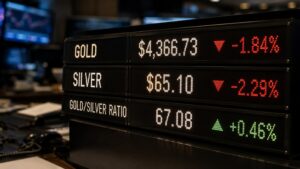
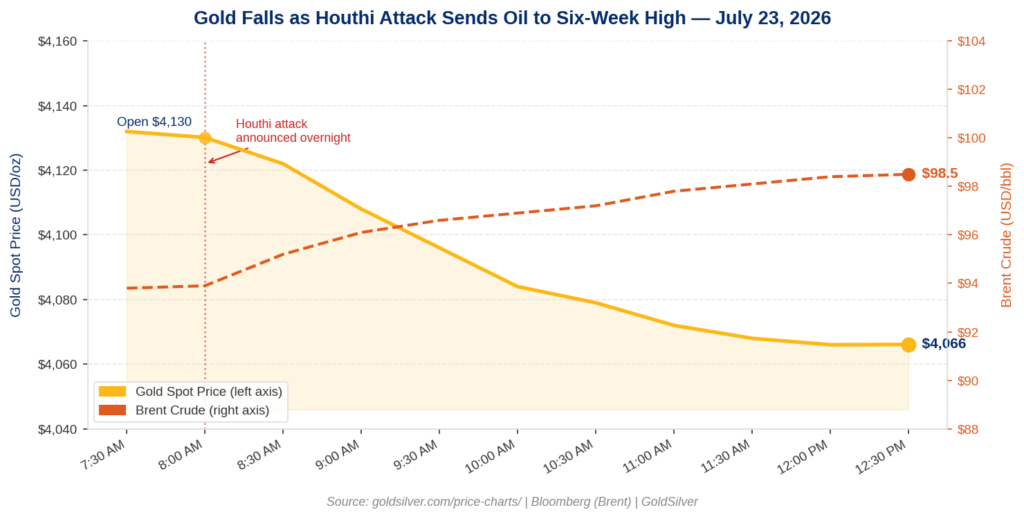
Gold is down about 1.6% today. [GoldSilver price charts, July 23, 2026]
That may seem strange. The Houthi militia announced attacks on two Saudi oil tankers in the Red Sea overnight. The United States completed its 12th consecutive night of airstrikes on Iran. Secretary of State Marco Rubio said Iran is “not ready to make a deal.” By the old rules, all of that should push gold higher.
It did not. And the reason why tells you something important about how gold actually works in this environment — and what it means for investors who hold the physical metal.
How Does a Shipping Attack Push Oil Higher?
The tankers targeted overnight — the Encelia and the Layla — are Saudi-flagged vessels. [Reuters] The Houthis said they fired ballistic missiles, cruise missiles, and drones at both ships after accusing the vessels of violating a naval blockade the group imposed on Saudi Arabia earlier this week. Saudi Arabia’s state news agency confirmed the Encelia caught fire and that all crew members were safe. The Houthis also said they struck the Layla, though that claim remained unconfirmed at publication time. Brent crude surged as much as 2.5% to near $96 a barrel, reaching a six-week high. [Bloomberg, July 23, 2026]
The geography matters here. The Strait of Hormuz, where the bulk of this war’s disruptions have occurred, connects the Persian Gulf to the Arabian Sea. The Bab el-Mandeb Strait, where these attacks took place, is a separate chokepoint at the southern tip of the Arabian Peninsula, linking the Red Sea to the Gulf of Aden. According to UNCTAD, roughly 10% of global seaborne oil trade passes through Bab el-Mandeb in normal times. [UNCTAD, via EastPost, July 14, 2026]
Saudi Arabia began rerouting exports through the Red Sea after Hormuz disruptions shut down normal Gulf shipping. Now that alternate route is also under attack. Several vessels have already changed course to avoid the area. [Reuters, July 22–23, 2026] When oil costs more to ship and more to buy, headline inflation stays elevated. That is exactly the problem the Federal Reserve is still trying to solve.

The Edge Every Investor Needs Smarter precious metals investing starts here. The Nuggets Newsletter brings you essential market insights, Fed updates, global trends, educational videos, and much more.
Why Does Oil Inflation Hurt the Gold Price Today?
This is the mechanism that most coverage misses.
The chain works in four steps. First, Houthi attacks on Saudi tankers push Brent toward $96 a barrel. Second, higher oil lifts headline inflation and keeps it sticky — US inflation came in at 3.5% in June 2026, down from a peak of 4.2% in May, but still nearly double the Fed’s 2% target. [BLS, July 14, 2026] Third, sticky inflation makes it harder for the Federal Reserve to justify rate cuts and easier to justify rate hikes. Fourth, markets reprice the September FOMC meeting upward: the probability of a September rate hike now sits above 60%, according to CME FedWatch as of this morning. [CME FedWatch, July 23, 2026]
Higher rate expectations raise real yields — the actual return investors receive after accounting for inflation. Gold pays no yield. So when real yields rise, gold becomes comparatively less attractive to institutional investors who hold it alongside yield-bearing assets. That is not a flaw in the case for gold. It is a short-term arithmetic shift that plays out in futures markets within hours.
For context, this is the same mechanism that drove gold’s largest absolute monthly decline on record in March 2026 — when oil-driven inflation flipped the Fed’s rate narrative and gold shed more than 10% in a single month. The metal recovered. The mechanism had not changed; the oil price had.
The ECB held its deposit rate at 2.25% this morning, as expected, after its first rate hike since 2023 in June. [ECB press release, July 23, 2026] Two major central banks are now in tightening or hawkish-hold mode simultaneously. Both point to the same driver: energy inflation from the Middle East conflict.
What Does This Mean for Physical Gold Holders?
Here is what the short-term mechanism misses.
Every Houthi missile that disrupts Saudi shipping adds to the fiscal cost of this war. Every barrel of oil that stays above $90 widens the US trade deficit, adds to import inflation, and puts more pressure on a federal budget already running annual deficits exceeding $2 trillion. [US Treasury Fiscal Data] The forces that suppress gold today are the same forces that build the long-term debasement arithmetic.
The investor who understands this is not worried. They are watching the four-step mechanism play out on a short timeline while holding a physical asset that operates on a much longer one.
Since January’s record high of $5,589.38 per ounce, gold has pulled back significantly. Yet it remains up roughly 20% year-over-year. The structural drivers — central bank buying, fiscal expansion, reserve diversification — have not reversed. What has changed is the short-term rate signal. That signal reversed once before this year when oil prices softened. It will reverse again.
What Should Gold and Silver Investors Watch Next?
Two catalysts will determine gold’s near-term direction.
First: June PCE on July 30. That is the Federal Reserve’s preferred inflation gauge, and it arrives the day after the July 29 FOMC decision. If core inflation comes in hotter than expected, September hike probability moves higher and gold faces continued near-term pressure. If it softens, the rate narrative shifts quickly in the other direction.
Second: any credible signal of diplomatic progress on the Iran conflict. A reduction in Hormuz and Bab el-Mandeb disruptions would pull oil lower, ease inflation pressure, and unwind the rate-hike arithmetic currently weighing on gold. Secretary Rubio’s framing today — suggesting the Houthis were “snookered” by Iran rather than acting independently — may be an early attempt to separate the two fronts diplomatically. [CNBC, July 23, 2026]
Until then, the physical metal holder’s position is straightforward. The same mechanism driving futures prices lower in the short term is the one making the long-term case for owning physical gold stronger, not weaker.
Stay On Top of Gold & Silver Prices
Get important market alerts sent straight to your inbox.
SOURCES
1. Reuters — Houthis say they attacked two Saudi tankers; Saudi Arabia confirms one ablaze, July 22–23, 2026
2. Bloomberg — Oil extends rally after Houthis attack two Saudi tankers in the Red Sea, July 23, 2026
3. CNBC — Houthis claim strikes on Saudi tankers; Rubio says Iran not ready to make a deal, July 23, 2026
4. EastPost / UNCTAD — Strait of Hormuz and Bab el-Mandeb put global trade under pressure, July 14, 2026
5. ECB — Rates held steady at 2.25%, July 23, 2026
6. GoldSilver — Gold Price Charts, July 23, 2026
7. CME Group — FedWatch Tool, September 2026 FOMC rate expectations, July 23, 2026
8. US Treasury — Fiscal Data: Debt to the Penny
9. US Bureau of Labor Statistics — Consumer Price Index, June 2026 (released July 14, 2026)
Disclaimer: This article is for informational purposes only and does not constitute financial or investment advice. Always consult a qualified financial adviser before making investment decisions.
You May Also Like:
- Gold Is About to Trade 24/7. A Prediction Market Just Filed to Make It Never Expire.
- Gold Hit a Two-Week High This Morning. Three Forces Arrived at Once.
- The Fed Meets July 29. Gold Says Hold Is Already Priced In. Silver Says Something Else.
- Silver Is Up Nearly 5% This Morning. Here Is Exactly Why.
- China Ends Paper Gold Trading July 24. For Physical Holders, That’s a Confirmation.
- Silver Is Up 1.5% Today. Oil Is Up 3%. Those Two Moves Shouldn’t Coexist. Here’s Why They Do.