Silver Rises Over 120% YTD




Published: 09-25-2026, 08:58 am
Last verified September 2026.
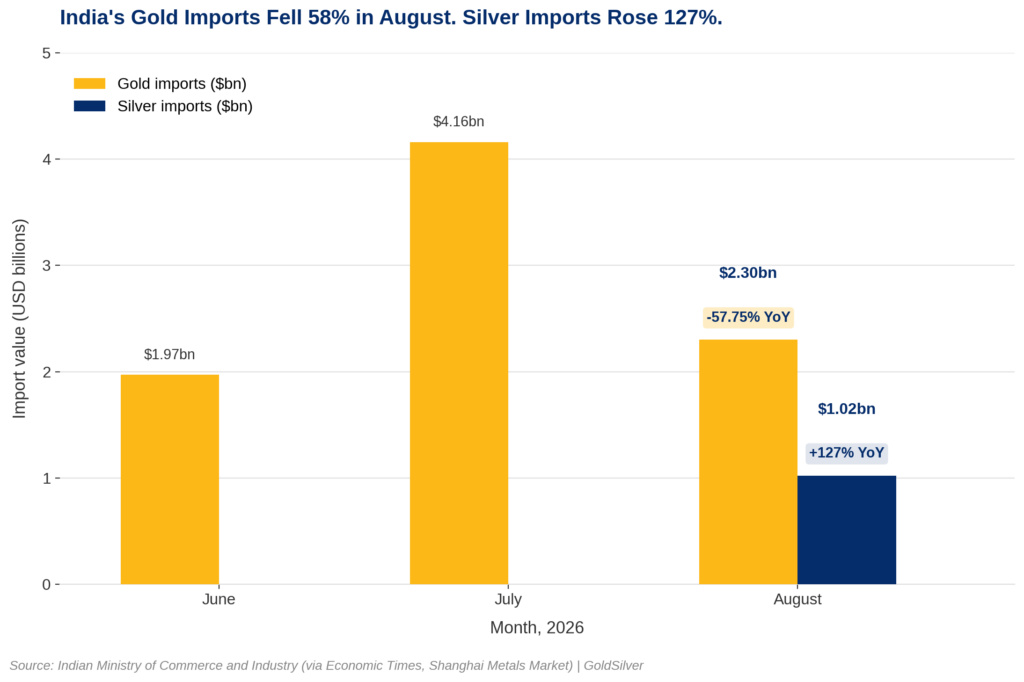
India’s gold imports didn’t dip in August. They fell off a cliff. Imports dropped 57.75% year-over-year to $2.3 billion, according to Commerce Ministry data reported by the Economic Times. Silver imports did the opposite. They rose 127% to $1.02 billion. Indeed, it’s the sharpest divergence between the two metals the world’s largest gold-consuming nation has recorded all year.
Gold is trading near $4,303 today, up 0.65%. It’s rebounding from yesterday’s slide as easing Hormuz tensions calm broader markets. Silver is up 1.53% to $64.81. Neither move is the real story this week. Instead, the real story is 8,000 miles away in New Delhi. India just gave the clearest data point yet on how high prices are changing saver behavior..
Key Takeaways:
- India’s gold imports fell 57.75% year-over-year in August to $2.3 billion. Silver imports rose 127% to $1.02 billion in the same month.
- Kotak Institutional Equities flags three possible explanations for the drop. However, only one is genuinely good news for India’s economy.
- April–August gold imports are still up 3.38% year-over-year. The August cliff is a one-month signal, not yet a trend.
Why Did India’s Gold Imports Collapse in August?
The cause is policy, not mood. India raised its import duty on gold and silver from 6% to 15%. The change took effect May 13, 2026. August was the first full month it hit landed cost, on top of gold prices above $4,300 an ounce. July’s imports had rebounded to $4.16 billion. As a result, August cut that by nearly half.
Kotak Institutional Equities laid out three explanations in a note reported this morning by Business Standard, and they don’t all point the same way. Firstly, the mild read: households are simply buying less gold, since the duty plus high prices make it too costly. That would ease pressure on India’s trade balance. Secondly, households may just be delaying purchases, with demand back by Diwali and wedding season. Thirdly, the gold trade may be shifting into unofficial, untaxed channels. If so, real demand didn’t fall by 58%. Instead, it just went dark in the official data.
The Edge Every Investor Needs Smarter precious metals investing starts here. The Nuggets Newsletter brings you essential market insights, Fed updates, global trends, educational videos, and much more.
What Happens to Demand That a Duty Can’t Kill?
That third option is the real mechanism at work here. A 15% duty doesn’t kill demand for an asset millions of Indian families have held as savings for generations. It just creates a price gap between the taxed route and the smuggled route. History says that gap gets filled. India ran a large unofficial gold market for decades under the 1962 Gold Control Act’s restrictions. Those controls were abolished in 1990. Savers found ways around the customs desk either way. Indeed, the pattern isn’t just historical. Customs seizures of smuggled gold nearly doubled in the six weeks after this May’s duty hike. That’s according to data presented in Parliament. In other words, a trade number built from duty-paid imports was always measuring tax compliance. It was never a clean read on real appetite for the metal.
Does China Show the Same Pattern?
GoldSilver has tracked the same pattern in China. China imported over 1,000 tonnes of gold in eight months, and its central bank accounted for only a small slice of that flow. The world’s two largest gold markets share one trait. In fact, official, headline numbers only catch part of what savers do with their money. The real signal sits in the gap.
Savers asking the same question at home can start with how to read a gold spot price chart. Then work out how a duty like India’s changes their own math. Likewise, live U.S.-dollar spot prices for both metals are unaffected by any import duty. They’re tracked in real time at GoldSilver’s price charts.
Why Did Silver Imports Rise While Gold Imports Fell?
The second corner isn’t the duty, and it isn’t the smuggling. It’s the nearly 185-percentage-point swing between gold and silver imports under an identical 15% tax. That gap isn’t India losing its appetite for precious metals. Instead, it’s price sensitivity. At $4,300 gold, the duty math stops household jewelry buying cold. At roughly $65 silver, the same households can still afford the metal. Sound money doesn’t have to mean gold. It just means an asset outside the fiat system that ordinary savers can afford. August’s data shows Indian households quietly picking the metal that still fits the budget.
Watch India’s September and October trade data next. The question is whether August’s plunge holds through Diwali and wedding season, the year’s heaviest gold-buying window. A rebound backs Kotak’s “postponement” read. A continued collapse, alongside reports of gray-market premiums, backs the harder “gone underground” read. Either way, the duty hike didn’t kill India’s appetite for gold and silver. It just made the government’s own numbers a worse way to measure it.
Stay On Top of Gold & Silver Prices
Get important market alerts sent straight to your inbox.
SOURCES
1. Angel One – India’s Gold Imports Plunge 57.75% to $2.3 Billion in August 2026; Silver Imports Rise 127%
2. CNBC – India Hikes Bullion Import Duties as the World’s Second-Largest Gold Market Faces a Declining Rupee
3. Business Standard – India’s Gold Imports Fall Sharply: Kotak Sees ‘Good, Bad and Ugly’ Outcomes
4. IBTimes India – India’s Gold Imports Plunge 57.7% to $2.3 Billion in August as Overall Imports Rise 14.1%
5. GoldSilver – China Imported 1,000+ Tonnes of Gold in Eight Months. Its Central Bank Bought Only 80.
6. World Gold Council – Bullion Trade: India Gold Market Series
7. The Print – India Gold Duty Changed 8 Times in 14 Years. What This Did to Smuggling
Disclaimer: This article is for informational purposes only and does not constitute investment advice. Past performance is not indicative of future results. Always consult a qualified financial advisor before making investment decisions.
You May Also Like:
- Municipal Bonds Just Broke a 15-Year Record. Gold Doesn’t Have This Problem.
- Washington Sold $70 Billion in Debt. Wall Street Only Wanted Part of It.
- Gold’s Price Barely Moved. Five Institutions Repositioned Anyway.
- Iran Repeated Its Hormuz Demand at the UN. The Market Already Priced It In.
- Today’s PMI Beat Cuts Gold Two Ways. Only One Side Has Been Priced In.
- Gold Fell 1.7% Today. Silver Fell 3.6%. Five Signals Point at the Dollar, Not Demand.
- Xi Lands in Washington. Gold and Silver Both Retreat, and Silver Falls Harder.
- Gold Fell 1.7% Today. Silver Fell 3.6%. Five Signals Point at the Dollar, Not Demand.
- UBS Holds Its Silver Target. The Market Already Got There First.