Silver Rises Over 120% YTD




Published: 09-02-2026, 03:01 pm
Gold rose 0.96% today to $4,370.27 an ounce. Silver gained 1.37% to $64.95. Both climbed off two-week lows as investors waited on this week’s labor data. But the more useful number is older. Across the first half of 2026, gold ETF investors in one region sold heavily while investors everywhere else bought.
Which Region Sold Gold ETFs in 2026?
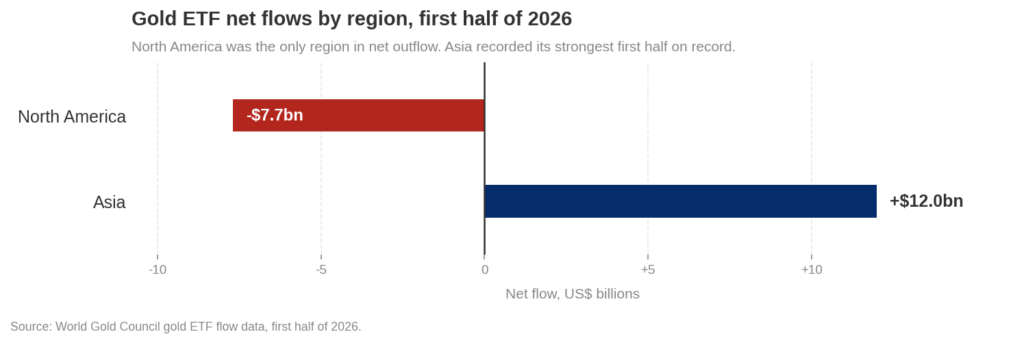
North America did, and notably it did so alone. Across the first half of 2026, it was the only region in net outflow. In total, it shed $7.7 billion. Those figures come from the World Gold Council’s gold ETF flow data. Over that same half, Asian-listed funds took in $12 billion. In fact, that was Asia’s strongest first half on record.
So this is not a market disagreeing about gold. Instead, one region left a trade while others entered it, through the same price decline.
As a result, July narrowed the gap without closing it. Global gold ETFs added $3 billion that month, according to the World Gold Council’s July report. In addition, holdings recovered 23 tonnes to 4,068 tonnes. That still sits below the record 4,176 tonnes reached on 27 February 2026. For the month, European funds led. North America did turn positive, but only by $71 million, or roughly a third of a tonne. The World Gold Council noted plainly that this did nothing meaningful to the region’s year-to-date deficit.
Year to date through July, global inflows reached $11 billion, or 39 tonnes. Yet North America stayed the only region in the red.
One housekeeping note, because it changes how much weight this deserves. July is the most recent month the World Gold Council has published. August figures are not out yet.
What Is the Disadvantage of Gold ETFs?
A gold ETF share is a claim on gold. Someone else holds the metal. Your entitlement to it runs through a custodian and a fund structure.
That arrangement is genuinely useful. For one thing, it is liquid. It is also cheap, and it tracks the price closely.
But it is not property. A coin or a bar in your name carries no counterparty risk. Above all, its value does not depend on any issuer’s ability to pay. By contrast, mining shares carry equity risk. Futures carry leverage and roll costs. Physical metal carries storage costs, and nothing else.
So when a region exits the ETF wrapper, the interesting question is not whether it turned bearish. Rather, it is whether the metal was replaced or simply released.

The Edge Every Investor Needs Smarter precious metals investing starts here. The Nuggets Newsletter brings you essential market insights, Fed updates, global trends, educational videos, and much more.
Are Investors Moving From Gold ETFs to Physical Bars?
Some are, though not the same investors who sold. The Financial Times reported last week on private vault operators in London and Switzerland expanding capacity. The reason given was wealthy clients moving out of gold-backed ETFs and into allocated and segregated bars.
Those are two different groups, measured two different ways. Therefore they should not be welded together. Still, both point in one direction, and it is not toward North America.
Is It Better to Invest in Physical Gold or an ETF?
In truth, that depends on what the holding is for. And there is a real argument on the other side right now.
The 10-year inflation-indexed Treasury yielded 2.44% on 31 August, according to Federal Reserve data. In other words, that is a positive real return available on a government bond. It is also the honest cost of holding an asset that pays you nothing. Consequently, it explains most of gold’s rough close to August.
The Federal Reserve has held its target range at 3.50% to 3.75% since December 2025. Heading into the 16 September meeting, the live question is a hike rather than a cut. On balance, none of that favors gold over the next few months.
But the structural case never rested on real yields staying negative. It rests on what a decade of deficit spending and money supply growth does to the purchasing power of savings. That is a slower argument, and a more durable one.
What the Regional Split Actually Tells You
A gold allocation is two decisions, not one: how much, and in what form.
For example, the first half of 2026 shows many American investors revisiting the first question. Meanwhile, the vault operators suggest investors elsewhere were quietly answering the second.
If the form question is the one on your mind, our vault storage page can help. In short, it explains how allocated and segregated storage differ, and what each costs. Current spot prices are on our price charts.
Stay On Top of Gold & Silver Prices
Get important market alerts sent straight to your inbox.
SOURCES
1. World Gold Council — Gold ETF Holdings & Inflows, first-half 2026 regional flows (published 8 July 2026; accessed 2 September 2026)
2. Federal Reserve Bank of St. Louis (FRED) — Market Yield on U.S. Treasury Securities at 10-Year Constant Maturity, Inflation-Indexed (DFII10) (data as of 31 August 2026)
3. World Gold Council — Europe’s Golden Heatwave: Gold ETF Flows, July 2026 (published 6 August 2026; accessed 2 September 2026)
4. Board of Governors of the Federal Reserve System — FOMC Meeting Calendars, 2026 (accessed 2 September 2026)
5. Financial Times — reporting on private vault capacity and the shift from gold-backed ETFs into allocated bars (published week of 24 August 2026)
6. Federal Reserve Bank of St. Louis (FRED) — Federal Funds Target Range, Upper Limit (DFEDTARU) (data as of 2 September 2026)
7. GoldSilver — Live Gold & Silver Price Charts (2 September 2026, 18:15 UTC)
Disclaimer: This article is for informational purposes only and does not constitute investment advice. Past performance is not indicative of future results. Always consult a qualified financial advisor before making investment decisions.
You May Also Like:
- Gold’s Sellers Are Trading Weeks. Its Buyers Are Counting Decades.
- The Iran War Just Got Worse. Gold Barely Noticed.
- Silver Is Falling Faster Than Gold Today. Its Deficit Didn’t Change.
- Wall Street Keeps Buying Gold. Washington Keeps Sending Mixed Signals.
- Iran’s Gold Sector Just Got Named in U.S. Sanctions. Gold Is Selling Off Anyway.
- Hike Odds Doubled This Week. Real Yields Didn’t.
- COMEX Registered Gold Just Fell Below 15 Million Ounces. It’s Still Refilling.