Silver Rises Over 120% YTD




Published: 06-17-2026, 09:03 am
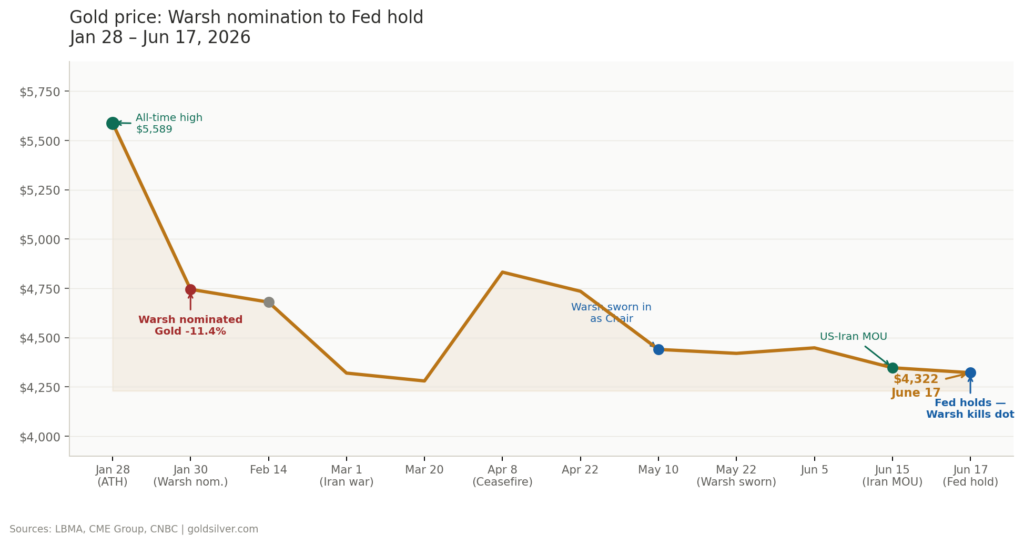
Gold is trading at $4,322 an ounce today. It barely moved on the news. That calm is the story.
The Federal Reserve held interest rates steady at 3.50% to 3.75% on Wednesday. Nobody was surprised. Futures markets had priced that outcome at 97% going in (CME FedWatch, June 13, 2026). However, what Chair Kevin Warsh did alongside that decision is what investors in physical gold need to understand.
Warsh withheld his personal rate projection from the Fed’s quarterly “dot plot.” In doing so, he became the first Federal Reserve chair in 14 years to sit out the forecasting tool that has guided markets since 2012 (Federal Reserve Board; San Francisco Fed, January 2025). He did not just skip a chart. He sent a message about how this Fed will operate going forward.
Who is Kevin Warsh, and why does his first meeting matter?
Warsh was sworn in as the 17th Federal Reserve Chair on May 22, 2026. His Senate confirmation vote was 54–45 — the most partisan in Fed history (U.S. Senate, May 13, 2026). Today was his first meeting in charge.
He inherited a divided committee. The April 2026 meeting under former Chair Jerome Powell produced an 8–4 vote. That was the most contested Federal Open Market Committee decision since 1992. Warsh walked in on day one managing that split.
He also walked in with a clear philosophy. During his April 2026 Senate confirmation hearing, Warsh stated directly: “Unlike many of my current and former Fed colleagues, I do not believe in forward guidance on interest rates tied to economic data” (CNBC, April 2026). That was not a throwaway line. It was a preview of Wednesday.
The Edge Every Investor Needs Smarter precious metals investing starts here. The Nuggets Newsletter brings you essential market insights, Fed updates, global trends, educational videos, and much more.
What is the dot plot, and why does it matter for gold investors?
The dot plot is a quarterly chart the Fed has published since January 2012. Each of the Fed’s 19 policymakers submits an anonymous projection for where interest rates should sit at year-end. Together, those dots form a visual map of where the Fed thinks it is heading (Federal Reserve Board, 2012).
Former Chair Ben Bernanke introduced the tool after the 2008 financial crisis. At the time, rates were near zero and the Fed needed to reassure markets about the future path of policy. The dot plot became the primary vehicle for what central banks call “forward guidance” — essentially, telling markets in advance what to expect.
That approach worked for years. Then it backfired badly.
In 2021, the Fed signaled rates would stay near zero “for an extended period.” Markets treated that projection as a guarantee. When inflation accelerated sharply, the Fed had to reverse course quickly. The result was one of the worst bond market sell-offs in modern history.
Warsh has cited that episode repeatedly. His position: the dot plot turns projections into promises, which limits the Fed’s flexibility and compounds its mistakes.
So on Wednesday, he opted out.
Does a less predictable Fed help or hurt gold?
This is the key question for long-term holders of physical gold. The answer requires understanding what actually drives gold prices.
Gold does not pay interest. That leads many commentators to say gold “struggles” when rates rise. However, the real driver is more specific. Gold moves with real yields — the return on US Treasury bonds after subtracting inflation. When real yields fall deep into negative territory, meaning inflation outpaces what savings accounts earn, gold becomes the rational choice for preserving purchasing power (Federal Reserve Economic Data, FRED).
Forward guidance reduced one source of uncertainty. When the Fed explicitly told markets that rates would stay at 4% for 18 months, savers could calculate exactly what their cash would earn. That certainty reduced the value of holding a non-yielding asset like gold. Put differently, a predictable Fed suppressed one of gold’s structural tailwinds.
A Fed that now refuses to forecast operates differently. Markets must instead read actual economic data — jobs, inflation, growth. Policy surprises become more possible. In that environment, uncertainty does not disappear. Instead, it gets priced into assets that have historically benefited from monetary ambiguity. Physical gold is one of those assets.
What did the dot plot itself show on Wednesday?
The other 18 committee members still submitted their projections. According to Bank of America economist Aditya Bhave, at least three members projected a rate hike in 2026 (Bank of America, June 2026). Markets now price a 66% probability of at least one hike by December (CME FedWatch, June 17, 2026). That is a sharp reversal from the start of the year, when two rate cuts were priced in.
On pure rate mechanics, higher rates are a headwind for gold. Higher nominal rates can push real yields upward, which raises the opportunity cost of holding non-yielding metal.
Is the hawkish Warsh discount already priced into gold?
Markets already priced in a hawkish Warsh months ago. On January 30, 2026 — the day Warsh was nominated — gold settled at $4,745 after opening near $5,594 (CME Group settlement data, January 30, 2026; CNBC). That single-session repricing wiped out the “dovish Fed” premium that had helped push gold to its all-time high. Gold at $4,322 today sits 23% below that January peak.
In other words, the hawkish discount is already in the price.
The question now is whether the actual Warsh — managing a committee, navigating inflation data, and working without a political mandate to hike — is as hawkish as the feared Warsh of January. His choice to skip his own dot suggests something different: not a chair who plans to force hikes, but a pragmatist who refuses to make commitments he cannot guarantee.
What does this mean for people holding physical gold?
The structural backdrop shifted today. It shifted in one direction: more uncertainty.
The Fed’s era of quarterly forecasts and forward guidance may be ending. What replaces it is a monetary environment where policy is harder to predict. That is not a comfortable thing for most assets. For gold, it is a tailwind.
Here is why. When the Fed issues explicit forecasts, it answers one of the key questions savers face: what will my cash earn? Remove those forecasts and that question goes unanswered. Savers must look elsewhere for an anchor. Physical gold has served that role for centuries — not because of what it earns, but because of what it cannot lose.
What are central banks signaling about gold right now?
Central banks bought 244 net tonnes of gold in the first quarter of 2026. That pace held steady even as prices fell 25% from their January peak (World Gold Council, Gold Demand Trends Q1 2026, April 2026). They did not sell into the correction. They bought through it. These are not momentum traders. They are sovereign institutions making multi-decade reserve decisions — and they are voting for physical gold during the most uncertain monetary transition in 14 years.
That is the signal beneath today’s news. A new Fed chair who refuses to forecast. Central banks accumulating at record pace through a correction. Real yields that now depend on data nobody can predict. Those forces are aligned. They point in the same direction.
Owning physical gold is not a bet on rates falling. It is a position on what happens when the monetary system becomes less legible. Today, it became a little less legible. That is the point.
Stay On Top of Gold & Silver Prices
Get important market alerts sent straight to your inbox.
SOURCES
1. LBMA — Precious Metal Prices
2. CME Group — FedWatch Tool, June 2026 FOMC Probabilities
3. Federal Reserve Board — FOMC Meeting Calendars and Statements
4. Federal Reserve Bank of San Francisco — Ben Bernanke: Solving a Crisis, Changing the Fed
5. U.S. Senate — Kevin Warsh Confirmation Vote, May 13, 2026
6. CNBC — Fed Chair Warsh Expected to Withhold Dot From Central Bank’s Interest Rate Outlook
7. Federal Reserve Bank of St. Louis (FRED) — 10-Year Real Interest Rate
8. CNBC — Gold and Silver Markets React to Kevin Warsh Fed Nomination, January 30, 2026
9. World Gold Council — Gold Demand Trends Q1 2026
Disclaimer: This article is for informational purposes only and does not constitute financial or investment advice. Always consult a qualified financial adviser before making investment decisions.
You May Also Like:
- Gold Holds at $4,347 While Stocks Hit All-Time Highs. Here’s Why.
- Why Is Silver Up Today? The Iran Deal Changed the Fed Math
- Gold Up 3%, Silver Up 4.7%: Five Forces Driving Metals Higher Today
- Iran Peace Deal Sends Oil Down 5%, Gold Up 3%
- Gold & Silver Surge on Iran Peace Deal — Then Pull Back
- Silver Fell 22% in 30 Days. Gold-Silver Ratio Hits 63.
- Every Bearish Catalyst Landed at Once. Gold and Silver Went Up Anyway.
- Gold at Seven-Month Lows: Why Geopolitical Fear Is Not Enough
- Gold Slides to $4,130 as Iran War Turns Inflation Against It
- May CPI Printed 4.2%. Core Inflation Beat. So Why Did the Gold Price Drop?