Silver Rises Over 120% YTD




Published: 06-16-2026, 09:05 am
Silver is up 1.4% today. Oil is down more than 5%. Most headlines are calling this a “peace trade.” That framing is backwards.
Understanding why it’s backwards is the most useful thing you can know about silver right now.
Why did silver fall during the US-Iran war?
When the conflict began on February 28, silver was trading around $84.50 per ounce. By early June, it had fallen to roughly $65. That’s a 23% decline during a period of active geopolitical risk.
If silver were simply a “fear metal,” it should have gone up. It didn’t.
The real driver wasn’t fear. It was the inflation chain the conflict created. Here’s how that chain works, step by step:
- The Strait of Hormuz partially closed, so oil prices spiked.
- As a result, energy costs drove more than 60% of May’s monthly CPI gain. Headline inflation reached 4.2% year-over-year — the highest reading since April 2023 (Bureau of Labor Statistics, June 10, 2026).
- Consequently, hot inflation reduced the Fed’s room to cut rates. By early June, the probability of a December 2026 rate hike had climbed above 71% — up from below 50% just days before the June 5 jobs report (CME FedWatch, June 10, 2026).
- Higher expected rates pushed real yields up. Treasuries started offering a meaningful return again.
- Silver has no yield. So when a money market fund pays 4%+, holding silver carries a real opportunity cost. That suppressed the price.
That’s not a fear story. That’s a real yield story.
The Edge Every Investor Needs Smarter precious metals investing starts here. The Nuggets Newsletter brings you essential market insights, Fed updates, global trends, educational videos, and much more.
How does the Iran peace deal affect silver prices?
On June 14, President Trump signed a preliminary memorandum of understanding with Iran. The Strait of Hormuz is set to reopen. Oil dropped more than 5% immediately — and is down roughly 5% again today, trading around $80.53 per barrel, a two-month low.
Lower oil means lower energy costs. Moreover, lower energy costs mean that May’s CPI print may represent the inflation ceiling of this cycle, not a floor. If inflation is rolling over, however, the Fed’s justification for hiking rates disappears with it.
Markets repriced this immediately. The implied probability of a December 2026 rate hike fell from near 90% to almost 60% in a single session on June 15, 2026 (CME FedWatch). That roughly 30-point compression in rate expectations is what moved silver. It was not a reduction in fear. Instead, it was a reduction in the real yield premium that had been holding silver down.
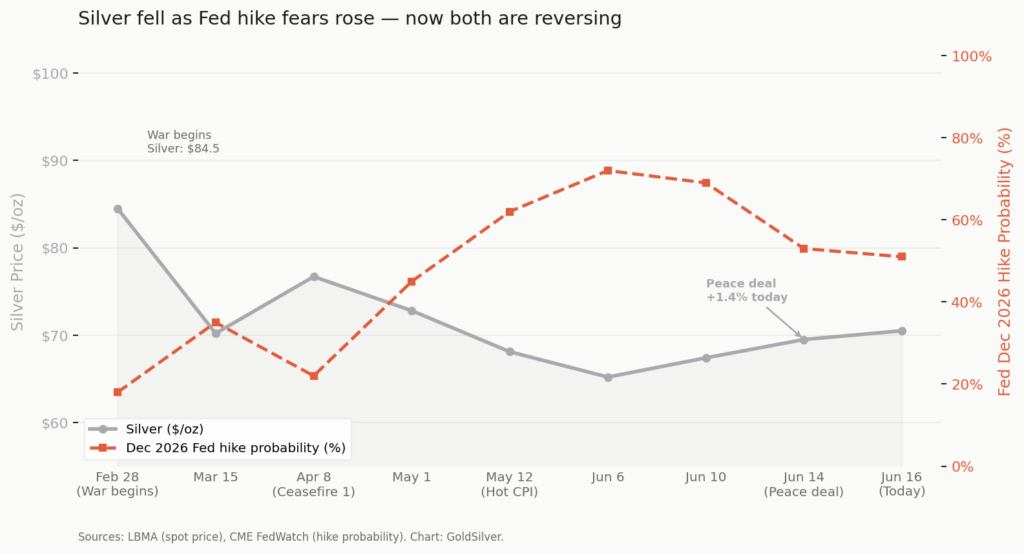
In short: the peace deal didn’t just remove the war premium. It dismantled the rate-hike thesis that was silver’s specific suppressor.
What are silver’s two demand drivers right now?
Silver is distinctive among precious metals. It runs on two separate demand engines at once. Right now, both are firing.
The monetary engine works the same as gold’s. Lower oil, easing inflation expectations, and a Fed that can hold rather than hike all compress real yields. Every force that makes Treasury yields less attractive makes silver more attractive as a store of value. This engine is firing now.
The industrial engine is silver’s alone. Over 60% of annual silver demand is industrial. Solar panels, electric vehicles, AI data center hardware, and consumer electronics all depend on it. The Strait of Hormuz closure didn’t just spike oil prices — it also disrupted global manufacturing. Energy-intensive production slowed. Supply chains rerouted. Industrial silver demand fell with it.
As the Strait reopens, however, manufacturing recovers and that industrial engine restarts. The structural backdrop is already tight. The Silver Institute’s World Silver Survey 2026 projects a sixth consecutive annual supply deficit of 46.3 million ounces — wider than last year’s 40.3 million ounce shortfall (Silver Institute, April 2026). Furthermore, the cumulative drawdown from above-ground stockpiles has reached 762.1 million ounces since 2021 (Silver Institute, World Silver Survey 2026). A market this structurally tight doesn’t need much of a demand recovery to feel the difference.
The result is that the monetary and industrial engines are now aligned. Gold is up 0.67% today. Silver is up 1.43% — roughly twice as much. That outperformance reflects the industrial engine adding momentum to the monetary tailwind.
What does the Warsh FOMC meeting mean for silver?
Kevin Warsh chairs his first FOMC meeting today and tomorrow. The rate decision itself is settled: a hold at 3.50–3.75% carries roughly 97% probability (CME FedWatch, June 13, 2026). However, what isn’t settled is Warsh’s press conference at 2:30 PM ET tomorrow and the updated dot plot.
The question that matters for silver is specific. Does Warsh frame energy-driven inflation as geopolitical and temporary — acknowledging that the Hormuz reopening removes the primary inflation driver? Or does he treat it as structural, requiring sustained restrictive policy regardless of oil prices?
If Warsh signals the former, real yield expectations fall further. Silver’s monetary engine gets an additional boost. If he signals the latter, rate-hike fear recalibrates upward and silver consolidates near current levels.
Either way, the structural setup doesn’t change based on one press conference. Six consecutive years of supply deficit. 762 million ounces drawn from above-ground stocks. Two demand engines now aligned.
The mechanism that suppressed silver for four months just had its primary fuel source cut off. That’s not a peace trade. That’s a real yield trade. For investors who understand the difference, that distinction matters.
Stay On Top of Gold & Silver Prices
Get important market alerts sent straight to your inbox.
SOURCES
1. Bureau of Labor Statistics — Consumer Price Index, May 2026
2. CME Group — FedWatch Tool
3. Silver Institute — World Silver Survey 2026
4. LBMA — Precious Metal Prices
Disclaimer: This article is for informational purposes only and does not constitute financial or investment advice. Always consult a qualified financial adviser before making investment decisions.
You May Also Like:
- Gold Up 3%, Silver Up 4.7%: Five Forces Driving Metals Higher Today
- Iran Peace Deal Sends Oil Down 5%, Gold Up 3%
- Gold & Silver Surge on Iran Peace Deal — Then Pull Back
- Silver Fell 22% in 30 Days. Gold-Silver Ratio Hits 63.
- Every Bearish Catalyst Landed at Once. Gold and Silver Went Up Anyway.
- Gold at Seven-Month Lows: Why Geopolitical Fear Is Not Enough
- Gold Slides to $4,130 as Iran War Turns Inflation Against It
- May CPI Printed 4.2%. Core Inflation Beat. So Why Did the Gold Price Drop?
- Gold Is Down 9%. The CPI Print That Could Either Extend the Drop — or End It.
- Gold Price News: Goldman, China, CPI, and the Fed Explained