Silver Rises Over 120% YTD




Most people think of hyperinflation as an economic problem. Mike Maloney argues it’s a political one.
In Episode 5 of Hidden Secrets of Money, filmed inside the Bundesbank Money Museum in Frankfurt, Mike connects a thread that mainstream historians rarely pull: currency debasement doesn’t just destroy savings — it destroys the social fabric that keeps free societies free.
What Does Currency Debasement Actually Do to a Country?
The damage starts with money but doesn’t stop there. When a government prints currency to pay its debts, purchasing power collapses. Prices double. Then double again. The middle class — roughly 70% of any country’s voting population — gets wiped out. Savings vanish. Wages buy nothing. Security evaporates.
What fills that vacuum is fear. And fear has always been the most powerful political weapon in history.

Get Expert Insights from Alan Hibbard Learn from Alan Hibbard, a trusted voice in precious metals delivering clear, actionable analysis on gold, silver and the global economy.
How Did Hyperinflation Bring Hitler to Power?
The Weimar Republic is the textbook case. After World War One, Germany suspended gold redeemability and faced crushing reparation payments to France and the Allies. Defaulting wasn’t an option. The government was surrounded, exhausted, and broke. So, the government chose currency debasement over default.
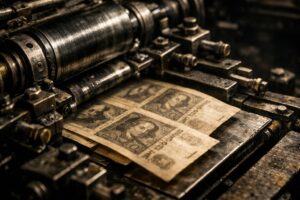
Notes climbed from thousands of marks to millions, then billions, then trillions. By 1923, prices were doubling every single day. 144 printing companies working around the clock couldn’t keep up. Printers resorted to wood, wool, and silk when paper ran out.
The chart below uses a logarithmic scale. Each gridline represents a tenfold increase — because a standard scale would make the entire collapse invisible until the very end.
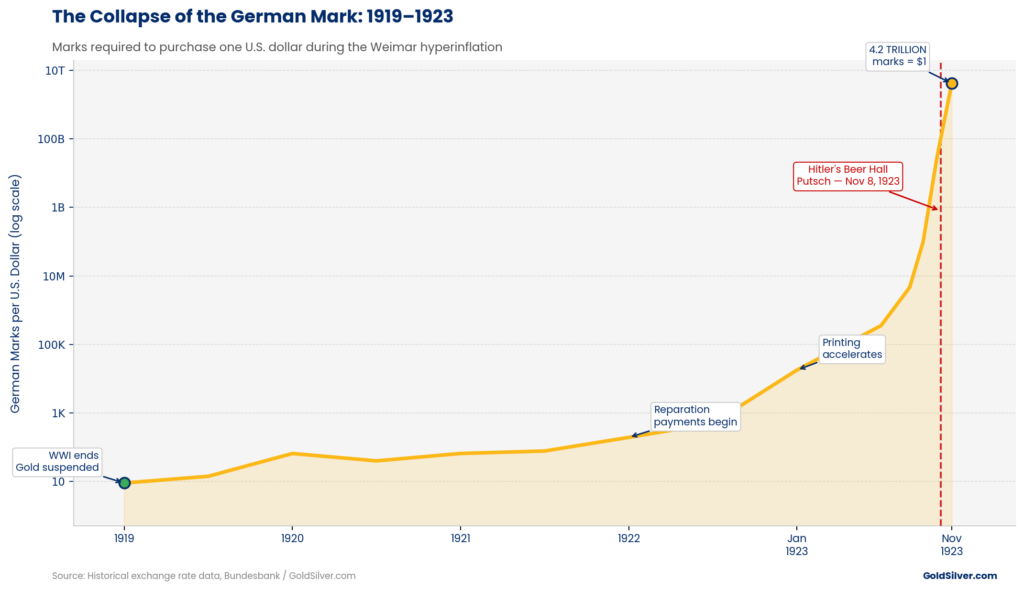
Just one week before the hyperinflation ended, Hitler made his first major public appearance. He walked into the Bürgerbräukeller — a beer hall holding 3,000 people — took the stage at gunpoint, and addressed an audience that had just been financially destroyed by their own government. He offered them a scapegoat and a way out. They listened.
The next day, they followed him in an attempted government overthrow. He was arrested and convicted of treason. But the seed was planted.
When the economy briefly recovered in the mid-1920s, Hitler lost his leverage. The Nazi Party fell to just 2% of the vote. Then the Great Depression hit. He seized the moment again — the first politician to campaign by aircraft, hitting multiple cities per day. The party surged from 2% to the second largest in Germany almost overnight.
Why Does Economic Fear Make Populations Vulnerable to Authoritarianism?
The mechanism is consistent across history. A currency crisis wipes out the middle class. Poverty breeds fear. Fear searches for someone to blame — and someone to follow. Demagogues provide both.
Once in power, the first targets are always the same: property rights, free assembly, privacy. Hitler didn’t seize those rights through chaos. He weaponized the legal framework of the Weimar Constitution itself, exploiting the fear his own government’s monetary policy had created.
As Ron Paul once told Mike: “The real thing we have to worry about is not the loss of our wealth. It’s the rise of a dictator. It’s the loss of our freedom.”
Is the Same Pattern Playing Out Right Now?
Mike’s concern isn’t academic. Every major central bank has been expanding its currency supply at historic rates. The same two choices that have faced every over-indebted nation throughout history — default or inflate — now face the United States. Default is politically impossible. Inflation is already underway.
What’s striking is that the warning comes from the museum itself. The Bundesbank, one of the world’s most respected central banks, displays century after century of fiat currencies that eventually collapsed. The pattern is right there on the walls. And yet the institution keeps doing the same thing. Currency debasement is the common thread in every one of these collapses.
The middle class is being squeezed. Complacency is high. Markets are pricing in a soft landing — the same way they always do, right up until they don’t. Gold sits near record highs, but most mainstream portfolios still treat it as a fringe asset. That gap between what history shows and what investors are actually doing is exactly what Mike has been pointing to for two decades.
How Has Gold Protected Wealth Through Every Monetary Crisis?
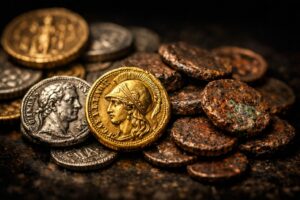
Gold coins minted 2,600 years ago still carry purchasing power today. No fiat currency in history can say the same. The wealth destroyed in a monetary reset doesn’t disappear — it transfers. The question is which direction it moves relative to you.
History doesn’t announce itself. It rhymes quietly, then arrives all at once.
Investing in Physical Metals Made Easy

People Also Ask
What is currency debasement and why is it dangerous?
Currency debasement happens when a government expands the money supply to pay its debts, eroding the purchasing power of every dollar already in circulation. Over time it wipes out middle-class savings, destabilizes societies, and historically has created the conditions for political extremism. Gold and silver have served as protection against debasement for over 2,600 years.
How did hyperinflation lead to the rise of Hitler?
Germany’s Weimar Republic printed money to pay WWI reparations, triggering one of history’s worst hyperinflations — prices doubled every single day by 1923. The resulting poverty and fear left the middle class desperate for answers, which Hitler exploited with his first major public appearance that same year. Mike Maloney breaks down this direct link between monetary collapse and political extremism in Episode 5 of Hidden Secrets of Money.
Does inflation cause political instability?
History shows a consistent pattern: currency crises destroy the middle class, widespread economic fear follows, and that fear makes populations vulnerable to authoritarian movements. It happened in Weimar Germany, and variations of the same pattern have appeared in economies across centuries.
What happened to savings during the Weimar hyperinflation?
The Weimar hyperinflation effectively zeroed out the savings of ordinary Germans — paper currency that could buy a house in 1921 couldn’t buy a loaf of bread by 1923. People who held gold preserved their wealth through the crisis while those holding paper currency lost everything. It remains one of history’s starkest illustrations of why physical assets matter when governments lose control of the money supply.
How does gold protect against currency debasement?
Gold cannot be printed, debased, or created out of thin air — which is precisely why it has preserved purchasing power across every major monetary crisis in recorded history. While fiat currencies eventually collapse, gold coins minted 2,600 years ago still hold real value today.
What can I do to protect my wealth from inflation?
The most time-tested approach is holding a portion of your savings in physical gold and silver, assets that sit outside the banking system and can’t be devalued by government policy. Diversifying away from paper assets before a monetary crisis — not during one — is the key lesson from every historical example.
Disclaimer: This article is for informational purposes only and does not constitute investment advice. Past performance is not indicative of future results. Always consult a qualified financial advisor before making investment decisions.