 Silver Rises Over 120% YTD




- The three largest US retail banks — Chase, Bank of America, and Wells Fargo — do not sell physical gold coins or bars to retail customers.
- What banks usually offer under the label "gold" is paper exposure: ETFs, mining funds, or structured products, all of which carry counterparty and custodial risk that metal does not.
- A handful of exceptions exist, including small licensed community banks, online precious metals platforms, and private wealth desks at a few large banks.
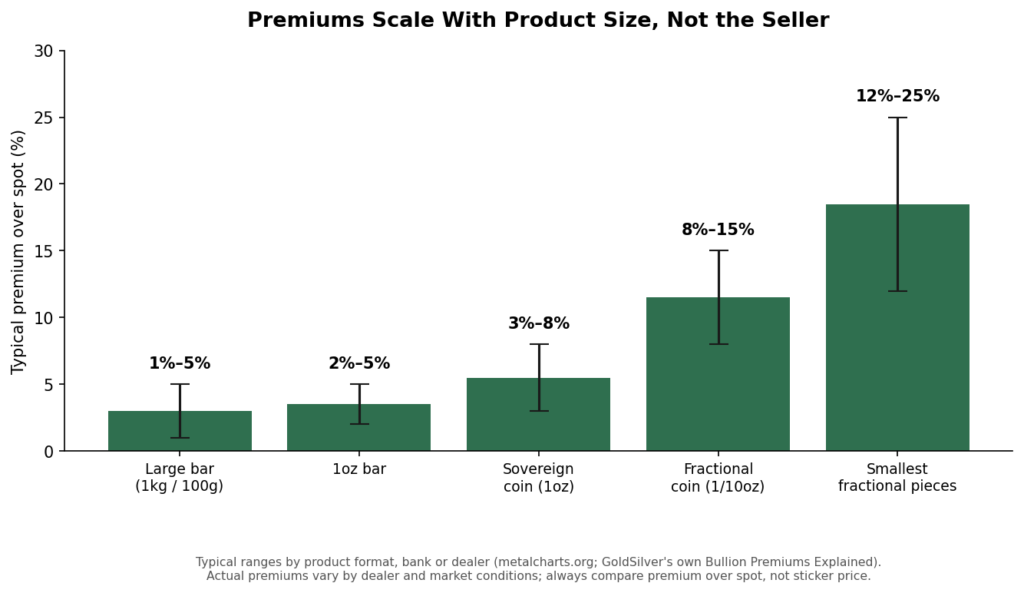
- Premium over spot is driven by product format, not by the seller. Large bars run roughly 1% to 5% over spot; the smallest fractional pieces can run into double digits.
- A precious metals IRA requires an IRS-approved custodian and an approved depository. An ordinary bank vault or safe deposit box does not qualify.
- Safe deposit box contents are generally not insured by the bank and are accessible only during branch hours, which is why many holders choose allocated, insured vault storage.
Walk into a Chase, Bank of America, or Wells Fargo branch. Ask for a one-ounce gold coin. The answer is almost always no. The three largest US retail banks do not sell physical bullion to retail customers.
What they sell instead is different. Through their brokerage arms, they offer gold funds and ETFs like GLD and IAU. That is paper exposure to the gold price. It is not the metal itself.
That single fact surprises a lot of people. It also matters more than it looks. If you searched "can you buy gold from a bank" and got inconsistent answers, here is the straight version. Along the way, it explains what bank premiums reveal about fair pricing anywhere, bank or not.
Why Did US Banks Stop Selling Physical Gold?
Banks are built to hold and move currency, not commodities. Storing physical bullion means secure vaults, insurance, transport, and trained staff. None of that is core to a retail banking business.
The Knowledge That Changes Everything

Two essential guides — yours free. Understand why gold matters and why fiat currencies always fail.
Here is the mechanism. A bank's balance sheet runs on leverage: it lends against deposits and earns the spread. A bar sitting in a vault does neither. It just sits there, earning the bank nothing.
There are exceptions, though they are narrow. Leader Bank, a Massachusetts community bank, sells small gold bars under license. EverBank runs a precious metals platform online. A few large banks go further still. JPMorgan, Citi, and Bank of America's wealth-management arm can arrange physical purchases for high-net-worth clients, through a relationship banker.
None of that is a retail branch service. And it is not what most people mean when they search "buy gold from bank."
Is the "Gold" Your Bank Offers Actually Physical Gold?
Usually, no. When a US bank does offer "gold investing," it is almost always paper. Think an ETF tracking the spot price, a mining equity fund, or a structured product.
These instruments move with the gold price. Even so, they carry counterparty and custodial risk that physical metal does not. An ETF share is a claim against a trust. The trust holds gold on your behalf, subject to its own terms. That is not the same as metal you can take possession of.
Paper claim vs. allocated physical ownership: An ETF share is a claim against a trust that holds metal under its own terms. Allocated physical ownership means specific metal, segregated and titled in your name. This distinction is the whole reason gold works as sound money outside the banking system — a promise to pay is not the same asset as the thing itself.
Which Banks Still Sell Bullion, and What Do Their Premiums Reveal?
Some banks outside the US do sell physical metal directly. TD Bank in Canada is one example. It offers bars and coins online, in branch, and through foreign exchange centres.
Even where a bank sells bullion, the format matters more than the seller. The pattern below holds at any dealer, bank or not.
| Product format | Typical premium over spot |
|---|---|
| Gold bar | Roughly 1% to 5% |
| Sovereign coin | Roughly 3% to 8% |
| Smallest fractional pieces | Can run well into double digits |
Premiums scale with handling, minting, and packaging relative to metal content. Larger, simpler formats, like large bars and standard sovereign coins, carry the smallest markups. Small fractional pieces carry the largest, because the fixed cost of making a tiny bar gets spread over very little metal.
See also: Bullion Premiums Explained — a full breakdown of what drives a "fair" markup regardless of the seller.
What Is a Fair Premium Over Spot for Gold or Silver?
Outside the bank channel, a reputable bullion dealer's premiums for standard products typically run 3% to 10% over spot. Large bars from recognized refiners sit at the low end. Small coins and fractional pieces sit at the high end.
If a quoted price falls far outside that band, something is off. Either the markup is heavy, or the product is not what it claims to be. Always compare premium over spot, not the sticker price, since spot itself moves throughout the trading day.
Gold traded near $4,363 an ounce this week; silver traded near $64. A "reasonable" 5% premium on a one-ounce coin is a very different dollar figure today than it was a year ago. That is exactly why the percentage, not the price tag, is the number worth remembering.
Can a Bank Hold Physical Gold Inside an IRA?
This question comes up constantly, and the IRS answer narrows the field further than most people expect.
IRS requirement: A precious-metals IRA requires an approved custodian and an IRS-sanctioned depository. The metal cannot sit in a personal safe deposit box, or an ordinary bank vault — even one at your own bank — and still qualify.
In practice, most major retail banks do not act as custodians for this structure at all. Specialized IRA custodians fill that role instead, working with dedicated depositories built for exactly this purpose.
See also: What Are the IRS Rules for a Precious Metals IRA in 2026?
Therefore, the same pattern repeats. Whether the account is taxable or tax-advantaged, the bank is not positioned to be where the metal itself lives.
If Not the Bank, Where Should Your Gold Actually Be Stored?
Once you accept the bank branch is not where physical metal comes from, a more useful question follows. What happens to the metal after you buy it? That is a custody decision, not a shopping decision. Specifically: does it sit at home, in a bank safe deposit box, or in an allocated, insured vault operated outside the banking system?
Safe deposit boxes are not insured: A bank does not insure the contents of a safe deposit box. Access is also limited to branch hours, which is a real constraint if you ever need the metal on your own timeline.
Home storage puts the entire position at risk to a single event.
See also: Bank Safety Deposit Box vs. Gold Vault Storage: Which Is Safer?
By contrast, professional allocated storage solves both problems. Each client's metal is segregated and titled in their own name, at an independent vault. For holdings above roughly $5,000 to $10,000, the annual cost is often lower than a properly insured home safe plus a bullion rider.
None of this changes the core mechanism that makes gold and silver worth holding in the first place. Every dollar in a bank account is a liability of that bank. It is also a claim on a currency central banks can expand at will. Physical metal, properly stored, is nobody's liability. That is the difference a bank teller cannot sell you, no matter how the question is phrased.
Stay On Top of Gold & Silver Prices
Get important market alerts sent straight to your inbox.
People Also Ask
Can you buy gold from a bank in the US?
Almost never as physical bullion. Major retail banks, like Chase, Bank of America, and Wells Fargo, do not sell gold coins or bars to retail customers. A small number of niche banks and private wealth channels are exceptions.
Does Bank of America sell gold bars?
No. Bank of America's gold-related offerings run through its brokerage and wealth-management arms. They come as ETFs, mining funds, or structured products, not physical bars or coins at the branch.
Is it a good idea to buy gold through a bank?
Where banks do sell physical metal, such as in Canada, premiums vary by product size. Large bars typically run 1% to 5% over spot, while the smallest fractional pieces can run well into double digits. The bank itself is not the problem. Product size and premium are what actually determine value.
What is a normal premium over spot for gold coins or bars?
For standard bullion products from a recognized dealer, 3% to 10% over spot is typical. Large bars sit at the low end; small or fractional pieces sit at the high end.
Can I hold physical gold in a bank safe deposit box?
Yes, but the contents are generally not insured by the bank. Access is also limited to business hours. That is why many long-term holders prefer independently insured, allocated vault storage instead.
If you decide allocated vault storage is the right fit, GoldSilver's vault storage program covers the segregated-versus-allocated distinction and current fees in more detail.


