Silver Rises Over 120% YTD




Published: 02-05-2026, 02:03 pm | Updated: 02-06-2026, 10:19 am
Most investors compare gold and silver by looking at price charts.
That’s a mistake.
The real differences between gold and silver don’t show up on a screen — they show up after you own them, which is why understanding gold vs silver storage and liquidity matters far more than guessing where prices go next.
That’s where many first-time precious metals buyers get surprised.
Gold and silver are both tangible, real assets with no counterparty risk. But in the real world, they behave very differently. One concentrates a large amount of value into a small, portable form. The other spreads value across weight, volume, and volatility.
If you’re considering owning physical metals — especially for long-term wealth protection — understanding storage and liquidity matters far more than guessing where prices go next.
In this guide, we’ll break down how gold and silver compare when it comes to:
- How easy they are to store
- How practical they are to hold in meaningful amounts
- How quickly and efficiently they can be sold
Not from a sales perspective — but from the standpoint of ownership realities that every serious investor eventually faces.
Why Storage and Liquidity Matter More Than Price
Most investors fixate on price because it’s visible, emotional, and easy to track.
But price is temporary. Ownership is permanent.
Once you buy physical gold or silver, your experience is shaped far less by daily price moves and far more by two practical realities: where it’s stored and how easily it can be converted back into cash when you need it.
These factors don’t matter much when you’re buying a few coins. They matter a great deal when metals become a meaningful part of your net worth.

The Financial System Isn’t Safer — And You Know It As risks mount, see why gold and silver are projected to keep shining in 2026 and beyond.
Price Is What You Pay — Ownership Is What You Live With
Spot prices tell you what gold or silver is worth today. They say nothing about:
- How much space your metals take up
- How easy they are to secure discreetly
- What it costs to store and insure them over time
- How quickly you can sell without sacrificing value
Those realities don’t show up on a chart — but they directly affect how useful your metals are in the real world.
An investor who understands storage and liquidity upfront avoids costly surprises later. An investor who doesn’t often learns these lessons under pressure.
The Questions Most Investors Ask Too Late
Nearly every experienced precious metals investor eventually confronts the same questions — often after they’ve already purchased:
- Where should I actually store this?
- How practical is this amount to hold physically?
- What happens if I need to sell quickly?
- Will I get a fair price, or will friction eat into my return?
Gold and silver answer these questions differently.
Both metals can play important roles in a diversified portfolio. But understanding how each behaves after purchase is what separates strategic ownership from impulse buying.
That’s why storage and liquidity deserve just as much attention as price — if not more.
The Key Storage Differences Between Gold and Silver
On paper, gold and silver are both physical assets you can hold outside the financial system. In practice, they behave very differently once you own them — especially as the dollar value increases.
The biggest difference comes down to one simple concept: value density.
Density and Space — Gold’s Quiet Advantage
Gold concentrates a large amount of value into a very small physical footprint.
Because gold is dense and expensive per ounce, even substantial investments can be stored discreetly in a compact space. This makes gold easier to:
- Secure at home
- Transport if necessary
- Store professionally at lower relative cost
For investors thinking in terms of wealth preservation, gold’s efficiency is one of its most underrated advantages. It doesn’t require much space, specialized containers, or logistical planning — even at higher dollar amounts.
This is one reason central banks, institutions, and long-term investors overwhelmingly favor gold for reserves.
Weight and Bulk — Silver’s Practical Challenge
Silver, by contrast, spreads value across weight and volume.
While silver is far more affordable per ounce, that affordability comes with a trade-off: it takes much more metal to represent the same dollar value. As holdings grow, silver becomes:
- Heavy
- Bulky
- Harder to store discreetly
- More expensive to vault relative to value
At smaller amounts, this may not matter. At larger allocations, it becomes impossible to ignore.
Silver’s bulk doesn’t make it a bad asset — but it does make it less efficient to store in meaningful size.
Storage Costs at Scale
Because silver occupies more space per dollar invested, it often costs more to store securely over time — especially in professional vaulting environments where pricing is based on:
- Volume
- Weight
- Insurance exposure
Gold’s compact nature typically results in lower storage costs per dollar of value, even though the metal itself is more expensive.
This difference rarely shows up in marketing conversations — but it shows up very clearly on storage statements.
Real-World Example: $100,000 in Gold vs. $100,000 in Silver
To see how storage differences play out in the real world, it helps to compare the same dollar value held in each metal.
Using approximate round prices for illustration:
- Gold at ~$5,000 per ounce
- Silver at ~$85 per ounce
Here’s what $100,000 looks like in physical form.
$100,000 in gold
- Roughly 20 ounces of gold
- Fits easily in a small pouch or compact container
- Can be stored discreetly in a home safe
- Simple to transport, insure, and inventory
$100,000 in silver
- Roughly 1,175–1,200 ounces of silver
- Weighs about 75 pounds
- Requires multiple tubes or boxes
- Still bulky and conspicuous compared to gold
- Often impractical for discreet home storage at scale
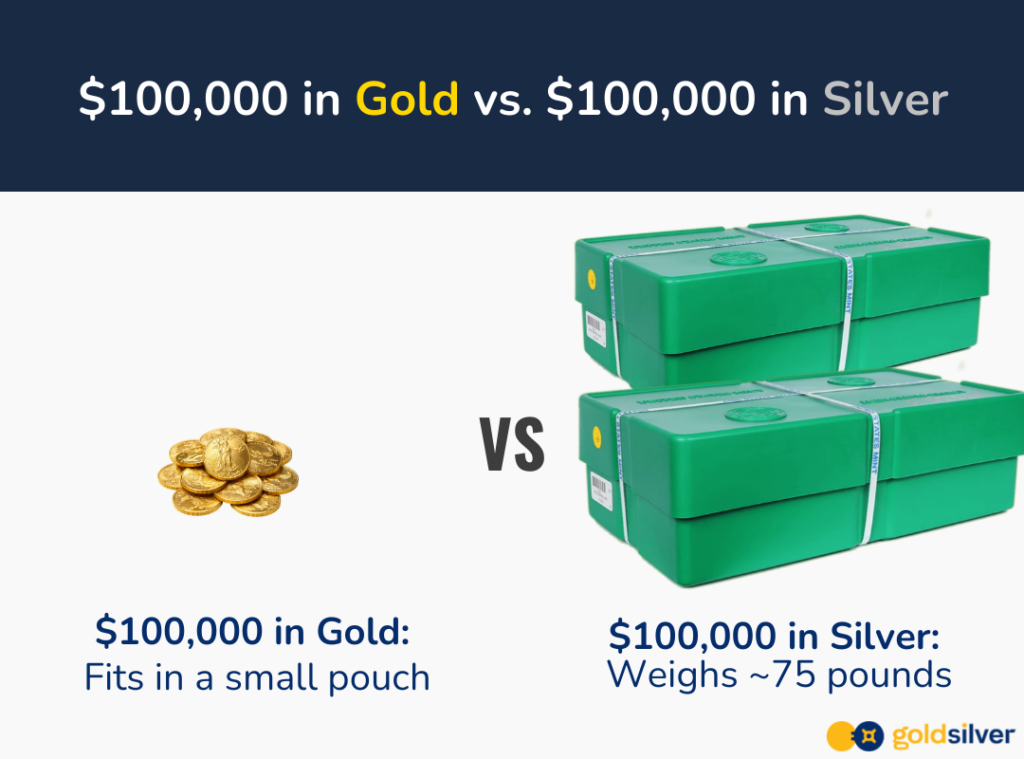
Both holdings represent the same dollar value. But from a storage standpoint, they remain fundamentally different assets.
Even at elevated silver prices, gold still concentrates far more value into far less space and weight.
Why This Difference Still Matters — Even With Higher Silver Prices
It’s tempting to assume that rising silver prices eliminate the storage problem. They don’t.
Silver may become less bulky as its price rises, but gold’s advantage in value density remains overwhelming. That structural reality doesn’t change with price cycles.
This is why:
- Gold continues to dominate large-value storage and reserves
- Silver remains better suited for smaller allocations and divisibility
- Investors who hold meaningful dollar amounts often gravitate toward gold for efficiency
The takeaway isn’t that silver is “bad.” It’s that gold and silver solve different problems, and storage efficiency is one of the clearest dividing lines.
This is why discussions around gold and silver shouldn’t stop at price performance. When investors evaluate gold vs silver storage and liquidity, they’re really deciding how practical each metal is to hold in meaningful size over time.
The Bottom Line
Gold and silver both have a place in a well-structured portfolio, but they serve different purposes once you actually own them.
Gold offers unmatched storage efficiency and ease of liquidation at scale. Silver provides affordability and divisibility for smaller positions. The “right” choice depends less on price predictions and more on how much you’re investing, where you’ll store it, and how quickly you might need to access that value.
Before you buy, think beyond the chart. Ask yourself: Where will this actually go? How much space will it take? And when I need to sell, how smooth will that process be?
Those answers matter more than any price forecast — because they determine whether your metals work for you or become a logistical burden you didn’t plan for.
Whether you’re leaning toward gold, silver, or a combination of both, the key is making an informed decision based on your specific situation — not just market hype.
Stay On Top of Gold & Silver Prices
Get important market alerts sent straight to your inbox.
People Also Ask
Why is gold easier to store than silver?
Gold is easier to store than silver because of its superior value density. Gold concentrates significantly more value into a smaller, lighter package. For example, $100,000 in gold equals roughly 20 ounces that fit in a small pouch, while the same value in silver equals about 1,175 ounces weighing approximately 75 pounds. This makes gold more practical for discreet home storage, professional vaulting, and transportation, especially as amounts increase.
What is the main storage challenge with physical silver?
The main storage challenge with physical silver is its weight and bulk relative to dollar value. Silver spreads value across much greater volume and weight compared to gold, making it heavy, bulky, and harder to store discreetly at scale. As holdings grow, silver requires more space, specialized containers, and often costs more to vault professionally since storage pricing is typically based on volume, weight, and insurance exposure.
Does storage matter more than price when buying precious metals?
Yes, storage and liquidity often matter more than price for long-term precious metals investors. While price is temporary and fluctuates daily, ownership is permanent. Once you purchase physical metals, your experience is shaped by practical realities like storage space requirements, security considerations, insurance costs, and how easily you can convert your holdings back to cash. These factors become increasingly important as metals represent a meaningful portion of your net worth.
How much does $100,000 in silver weigh compared to gold?
Using approximate pricing, $100,000 in silver weighs about 75 pounds (roughly 1,175-1,200 ounces), while $100,000 in gold weighs just over one pound (roughly 20 ounces). This dramatic difference means silver requires multiple tubes or boxes and often proves impractical for discreet home storage, while gold fits easily in a small pouch or compact container and remains simple to transport, insure, and inventory.
Will higher silver prices solve the storage problem?
No, higher silver prices do not eliminate the storage problem. While silver may become less bulky as its price rises, gold’s advantage in value density remains overwhelming regardless of price cycles. This structural reality doesn’t change with market conditions. Even at elevated silver prices, gold continues to dominate large-value storage and reserves, while silver remains better suited for smaller allocations and divisibility. Investors holding meaningful dollar amounts often gravitate toward gold specifically for its storage efficiency.