Silver Rises Over 120% YTD




Published: 03-23-2026, 11:45 am | Updated: 03-23-2026, 11:36 am
There’s a war unfolding in the Middle East. Oil has crossed $100 a barrel. The Strait of Hormuz — a chokepoint for roughly 20% of the world’s energy supply — has been partially closed. Inflation expectations are rising. And gold?
Mostly down.
Since U.S. and Israeli strikes on Iran began February 28, gold briefly spiked above $5,400 per troy ounce — then gave most of it back. To anyone watching the charts, this looks wrong. If there’s ever a time gold should be going up, it’s now. The headlines are screaming risk. The metal isn’t listening.
This isn’t a malfunction. It isn’t a warning sign. It’s a pattern — one that has played out before at major turning points in the gold market. Understanding why it happens may be the most useful thing a precious metals investor can know right now.
Why Is Gold Not Going Up During the Iran War?
The short answer involves three forces working against near-term price momentum — none of which touch the long-term thesis.
The dollar has strengthened. Oil shocks historically push the greenback higher. The energy surge has been reframed by markets — not as a geopolitical crisis, but as an inflation threat. That shift pushes real yields up and strengthens the dollar. Since gold is priced in dollars, both moves create short-term resistance.
Rate cut expectations have reversed. Markets that entered 2026 pricing in multiple Fed cuts are now pricing in a much more restrictive path. Gold pays no yield. When the opportunity cost of holding it rises, tactical money rotates out — temporarily.
Momentum trades are unwinding. Gold gained 64% in 2025 — its best year since 1979. That run pulled in generalist investors, systematic funds, and retail buyers with no long-term conviction. When Iran escalated and volatility spiked, that money sold to raise cash or rebalance portfolios. It’s positioning noise, not a verdict on gold.
None of these forces change what gold is. None change why long-term holders own it. They explain the quiet — they don’t justify ignoring it.
The Financial System Isn’t Safer — And You Know It As risks mount, see why gold and silver are projected to keep shining in 2026 and beyond.
Has Gold Ever Done This Before?
Yes. Consistently and historically, yes.
Gold is not a direct-war hedge. It’s a hedge against the broader economic fallout that wars produce. That’s a critical distinction. Acute escalation can actually pressure gold in the short run — it spikes the dollar, raises rate expectations, and forces leveraged holders to sell.
UBS chief investment officer Mark Haefele has made this point directly: gold is “more of a hedge against the wider impact of conflicts, rather than direct wartime threats.” The metal prices in consequences, not combat.
Deutsche Bank’s head of metals research noted the same pattern during last year’s shorter Iran-Israel conflict. Prices tend to be higher on average after a crisis — not during the most intense phase of it.
The old market proverb says to buy when the cannons are firing. What it doesn’t say is that the price will cooperate while you do.
Is It Too Late to Buy Gold?
This is one of the most common questions we hear. It’s also one of the most persistent myths in precious metals investing.
The “missed it” feeling tends to arrive at exactly the wrong moment. It shows up when prices have already run, short-term action is choppy, and the macro backdrop looks confusing. That description fits nearly every major inflection point in gold’s history — right before the next leg higher.
Consider the current setup: gold is still positive on the year, even after its worst weekly decline in over a decade. Investors measuring from the peak of a spike will feel late. Investors measuring from the structural demand floor beneath this market will see something different.
The forces driving this bull run haven’t reversed. They’ve deepened.
What Is Actually Driving Gold’s Long-Term Bull Case?
Three structural forces remain fully in place — and none of them care about short-term price action.
Central banks are still buying at historic levels. Consensus estimates project purchases of around 800 tonnes in 2026 — roughly 26% of annual mine output. These aren’t tactical trades. Sovereign institutions accumulate gold over years and decades, and several previously inactive central banks have re-entered the market. That’s not a trend that reverses on a news cycle.
De-dollarization continues to build. China has extended its gold purchases for at least 15 consecutive months. Private investors are adding physical bars and ETFs as a hedge against long-term fiscal risk. Goldman Sachs describes these as “sticky” positions — tied to structural macro concerns, not short-term sentiment. They don’t unwind when a conflict ends.
Supply isn’t keeping up. Global miners produced 3,672 tonnes in 2025 — a record, but only 1% more than the year before. Growth in 2026 is expected to be similarly modest. Structurally elevated demand against barely-growing supply creates one outcome over time: a higher price floor.
What Are Wall Street’s Top Banks Forecasting for Gold?
Recent price weakness hasn’t shaken institutional conviction. If anything, it’s strengthened it.
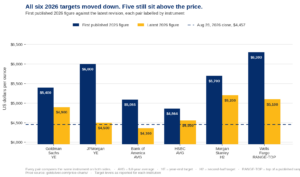
J.P. Morgan targets $6,300 per ounce by year-end. Deutsche Bank is holding its $6,000 call. UBS sees $6,200 by September. Société Générale expects $6,000 by December. These aren’t outlier views — they represent a rare convergence of major institutional forecasts pointing in the same direction. For a deeper look at where Wall Street sees gold heading, check out GoldSilver’s Gold Price Predictions 2026 article.
After gold’s worst single session since 1983 in January, J.P. Morgan didn’t flinch. The bank characterized the drop as positioning-driven — not a fundamental shift — and held its target.
That matters. Wall Street’s conviction here isn’t built on conflict optimism. It’s built on something slower and more durable: reserve diversification, monetary debasement, and a de-dollarization trend that has been compounding for years. Short-term volatility doesn’t move those needles.
If the Case for Gold Is So Strong, Why Isn’t Everyone Buying?
Start with one distinction: price and value are not the same thing.
Short-term price is driven by momentum traders, margin calls, and algorithms. These forces are loud and visible. Long-term value is driven by supply constraints, sovereign demand, and monetary debasement. These forces are quiet — and they’re the ones that matter.
When gold sells off during volatile periods, it’s rarely a verdict on the metal. It’s the mechanics of leveraged markets — positioning-driven selling that temporarily overwhelms structural demand. Physical gold buyers sit outside that mechanism entirely. They own the asset itself. Not a derivative. Not a futures contract. Not a leveraged fund.
That’s a meaningful distinction right now. StoneX analysts have described the current price level as “fair value for the uncertainty we face — with meaningful gains if the conflict worsens or stagflation forces a policy pivot.” A pullback from a recent peak, during a period of elevated geopolitical and monetary risk, with the long-term bull case intact — that combination doesn’t come around often.
The case for physical gold isn’t built on the next two weeks. It’s built on the next two decades. The Iran conflict hasn’t changed that. Dollar strength hasn’t changed that. The quiet in the price chart hasn’t changed that.
The fundamentals are where they were. The window is still open.
Stay On Top of Gold & Silver Prices
Get important market alerts sent straight to your inbox.
People Also Ask
Why isn’t gold going up during the Iran war?
Gold is facing short-term headwinds from a stronger dollar, rising rate expectations, and momentum traders unwinding positions after a historic 2025 rally. These are temporary market mechanics, not a signal that gold’s long-term value has changed. The structural forces driving this bull market — central bank demand, de-dollarization, constrained supply — remain fully intact.
Is it too late to buy gold in 2026?
Gold is still positive on the year even after its worst weekly decline in over a decade, and major institutions including J.P. Morgan, Deutsche Bank, and UBS are maintaining bullish year-end targets above $6,000. Investors who feel they’ve “missed it” are often measuring from a short-term spike, not from the structural demand floor beneath this market.
Does gold always go up during wars?
Not immediately — and not always during the acute phase of a conflict. Gold tends to price in the broader economic consequences of wars, such as inflation, currency debasement, and monetary policy shifts, rather than reacting directly to combat escalation. Historically, prices have often been higher after a crisis resolves than during its most intense period.
Why is the dollar strong when there’s a war going on?
Oil shocks tend to reinforce dollar strength because energy disruptions raise global inflation expectations, which pushes real yields higher and increases demand for dollar-denominated safe havens. This is one reason gold faces short-term resistance even as geopolitical risk rises — the dollar and gold are competing for the same fear trade. Over time, the inflationary consequences of energy disruptions tend to benefit gold more than the dollar.
What are banks predicting for gold prices in 2026?
Major institutions are forecasting significant upside: J.P. Morgan targets $6,300 per ounce by year-end, Deutsche Bank holds a $6,000 call, and UBS sees $6,200 by September. These forecasts held firm even after gold’s sharpest single-session drop since 1983 in January. For a full breakdown of where Wall Street sees gold heading, read our Gold Price Predictions 2026 article.
This article is for informational purposes only and does not constitute investment or tax advice. Please consult a qualified financial professional before making any investment decisions.