Silver Rises Over 120% YTD




Published: 07-13-2026, 05:19 pm
Silver is the only major financial asset that carries a full-time job in manufacturing. About 58% of every ounce mined goes straight into solar panels, semiconductors, and EV motors before a single saver ever sees it. [Source: Silver Institute, World Silver Survey 2026]
That structure is silver’s greatest long-term argument. Today, it is also why silver dropped nearly a full percentage point harder than gold.
Silver fell to $57.59 at the close on Monday, July 13 — down 3.8% on the day. Gold settled at $3,999, down 2.9%, briefly breaking through the psychologically significant $4,000 level intraday.
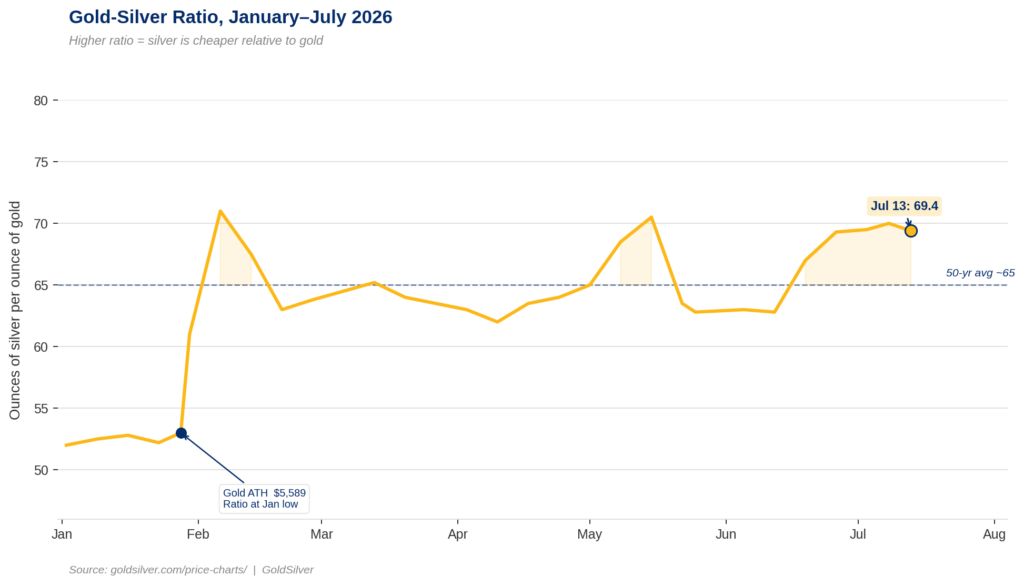
The gold-silver ratio consequently rose to 69.4. It now takes nearly 70 ounces of silver to buy one ounce of gold. The 50-year historical average sits at roughly 65.
Why Did Silver Fall More Than Gold Today?
Overnight on July 12–13, US and Iranian forces exchanged missile and drone strikes for the fourth time in a week. Tehran claimed it had closed the Strait of Hormuz. US Central Command dismissed the claim, but oil surged more than 4% regardless.
Higher energy prices feed into inflation expectations, and elevated inflation expectations push the Fed toward tighter monetary policy. Markets are now pricing approximately a 70% probability of a September rate hike, according to CME FedWatch data.
That single shift in rate expectations hit silver from two directions at once.
The Edge Every Investor Needs Smarter precious metals investing starts here. The Nuggets Newsletter brings you essential market insights, Fed updates, global trends, educational videos, and much more.
How Does Silver’s Dual-Engine Structure Work?
Think of silver as running two demand engines in parallel. The first is monetary: silver responds to real interest rates the same way gold does. When real yields rise, the opportunity cost of holding non-yielding silver increases. The second is industrial: solar panels, EV motor windings, and medical devices all require physical silver. When the Fed signals higher rates for longer, industrial buyers anticipate slower growth and reduce forward purchasing.
Gold runs on one engine. It has no industrial utility at scale, so rate expectations apply pressure through a single channel. Silver absorbs the same monetary headwind as gold — and then takes an additional industrial growth headwind on top.
That amplification cuts both ways. Silver falls harder in hawkish environments, and historically it rises faster when conditions reverse. In March 2020, the ratio hit 127:1. Over the following 12 months, silver outperformed gold by approximately 50 percentage points.
What Are Central Banks Doing While Silver Falls?
The short-term pressure on silver is real. The longer-term picture looks notably different.
The People’s Bank of China added 14.93 tonnes of gold to its reserves in June 2026 — the largest single-month purchase since October 2023 — extending its buying streak to 20 consecutive months, per Bloomberg and China’s State Administration of Foreign Exchange. The PBoC made that purchase while gold traded near its weakest level since November 2025.
Total Chinese gold holdings now stand at 2,346 tonnes, still less than 10% of total reserves according to the World Gold Council. The structural accumulation is far from finished.
Does Today’s Drop Change Silver’s Structural Case?
No. Silver has run a structural supply problem for six consecutive years, with annual demand outpacing mine production since 2021, per the Silver Institute. The FOMC minutes released July 8 confirming a hawkish split does not change that math.
Industrial demand grows because solar capacity and EV production grow. A Fed hike signal does not cancel a solar farm already under construction. Furthermore, the monetary component responds to real yields over months and years, not single trading sessions.
The same industrial demand that amplifies silver’s downside also drives its recovery. It pulls silver back harder once real yield pressure eases — typically faster and further than gold rebounds from the same turning point.
What Should Investors Watch Next?
Two catalysts arrive in the next 18 hours.
June CPI releases at 8:30 AM ET on Tuesday, July 14. Consensus expects a headline decline of about -0.1% month-on-month, driven by roughly 10% lower June gasoline prices after the mid-June ceasefire. However, core CPI is expected to hold near 2.9% year-on-year — and core is the number the Fed targets. A print at or above 2.9% keeps September hike odds elevated.
Ninety minutes later, Fed Chair Kevin Warsh delivers his first congressional testimony before the House Financial Services Committee at 10:00 AM ET. His read on whether the June energy dip is transitory or structural will directly shape how markets price the July 29 FOMC decision.
Watch the gold-silver ratio alongside the metals prices. A compression toward 65 on softer core CPI and a measured Warsh tone signals the market is beginning to price the dual-engine recovery.
Stay On Top of Gold & Silver Prices
Get important market alerts sent straight to your inbox.
SOURCES
1. Silver Institute — World Silver Survey 2026 (April 15, 2026)
2. Bloomberg — China’s PBOC Buys Most Gold Since 2023 as Bullion Swings (July 7, 2026)
3. South China Morning Post — China Extends Gold-Buying Binge to 20th Month (July 7, 2026)
4. Federal Reserve — FOMC Calendar and Rate Decisions
5. Bureau of Labor Statistics — Consumer Price Index Release Schedule (July 14, 2026)
6. Reuters — Fed Chair Warsh to Testify Before Lawmakers July 14 (June 22, 2026)
Disclaimer: This article is for informational purposes only and does not constitute financial or investment advice. Always consult a qualified financial adviser before making investment decisions.
You May Also Like:
- Trump’s Hormuz Toll Is an Inflation Tax. Here’s Why Gold Fell.
- Gold Fell 1.4% on an Iran Strike. One Number Tomorrow Morning Could Change Everything.
- Trump Declared the Ceasefire Over. Gold Barely Moved.
- HSBC Cut Its Gold Forecast by $304. Then Said Gold Will Hit $4,750 by Year-End.
- The Fed Named AI Its Top Inflation Risk. Gold Noticed.
- Five Days From Now, Two Numbers Will Decide Gold’s Second Half