Silver Rises Over 120% YTD




Published: 09-04-2026, 11:23 am
Gold and silver both fell within minutes of this morning’s US jobs report. That story already has its own headline. Four hours later, the more useful question isn’t what moved. It’s why the reaction was smaller than the news suggests it should have been. It’s also why one part of the metals complex fell three to four times harder than the other. Here are three threads from today’s session, each one answering a question a reader would actually ask.
Why Did the Bond Market Barely Move on a 3x Payrolls Beat?
August nonfarm payrolls came in at 162,000 against a consensus near 55,000 to 56,000. That’s roughly three times the expected number. Unemployment held steady at 4.1%. In short, a surprise that size should, on a simple model, send Treasury yields sharply higher. Instead, the 10-year yield rose only about 1 to 2 basis points, to roughly 4.77% to 4.78%. Meanwhile, the more rate-sensitive 2-year yield moved further, up about 5 basis points to near 4.39%.
The muted 10-year reaction has a specific explanation. It had already round-tripped through a wider range this week, touching as high as 4.82% intraday Tuesday before closing near 4.79%, on oil prices and hawkish Fed rhetoric. Then Fed Governor Christopher Waller’s more dovish remarks on Wednesday and Thursday pulled it back down to the 4.74% to 4.76% area. So today’s move looks like a partial unwind of that dovish repricing, not a fresh verdict on the economy. For gold owners, the mechanism matters more than the headline. Real yields, not payroll counts, set the medium-term price of gold, and real yields moved only modestly today, continuing the pattern this week’s rate-odds repricing already showed.

The Edge Every Investor Needs Smarter precious metals investing starts here. The Nuggets Newsletter brings you essential market insights, Fed updates, global trends, educational videos, and much more.
What Does Speculative Positioning Say About Why Gold Fell as Hard as It Did?
The latest CFTC Commitments of Traders data is dated to positions held on August 25. Specifically, it shows managed-money speculators net long 144,747 gold futures contracts, up from 141,648 the week before. In other words, speculators had already built a stretched, crowded long book. That happened heading into a data release that could have cut either way for the Fed’s rate path. When a hawkish surprise hits a market leaning that heavily in one direction, part of the resulting price move is simply positioning unwinding, not new information about the underlying asset.
September rate-hike odds tell a similar story of disagreement. CME’s FedWatch tool put the odds near 60% after today’s report, up from a 50-50 split the day before. Other trading desks, meanwhile, were citing figures anywhere from 62% to 70% off the identical data. Three different reads of the same number isn’t measurement error. Instead, it reflects a market that hasn’t settled what one payrolls print means for a Fed that has offered no forward guidance. A positioning-driven drop and a thesis-breaking drop are not the same event, and today looks far more like the former. That echoes the same cross-desk disagreement on hike odds flagged earlier this week.
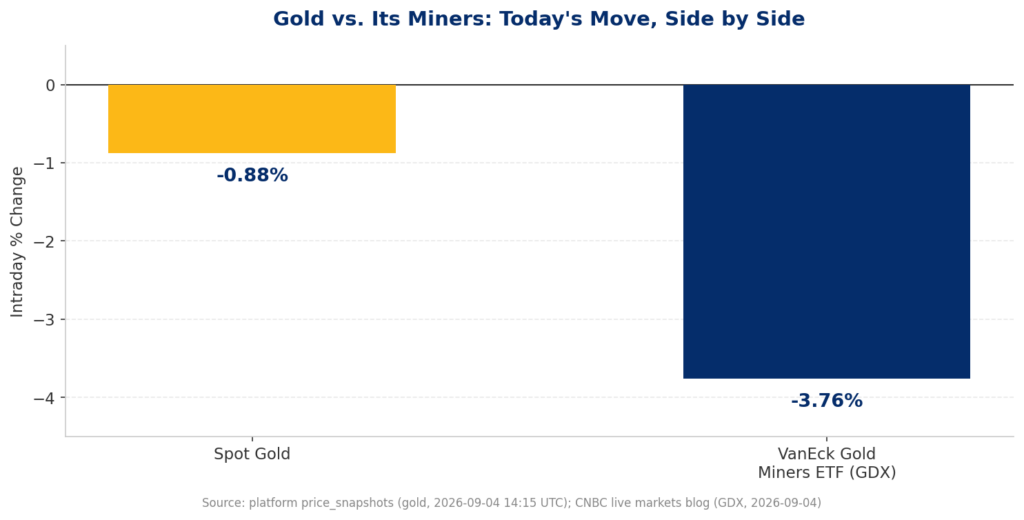
Why Did Gold Miners Fall Three to Four Times Harder Than Gold Itself?
Spot gold fell roughly 1% today. The VanEck Gold Miners ETF fell 3.76% intraday, its first red day in three sessions. Individual names followed the same pattern. Silvercorp Metals, Eldorado Gold, Franco-Nevada, and Kinross were all down more than 3.5% in premarket trading. That’s operating leverage at work.
A mining company’s costs are largely fixed in the short run. Labor, equipment, energy, and permitting don’t move with the gold price day to day. So a given percentage move in the gold price translates into a larger percentage move in the company’s profit margin. Consequently, the stock price then follows the margin, rather than the metal. As a result, miners have historically levered gold’s price moves by roughly two to one, and sometimes three to one, in both directions.
An investor holding physical bullion absorbed today’s move at something close to face value. An investor holding mining equities absorbed the same news through a balance sheet that amplifies it, and that happened before any company-specific operating risk even entered the picture. Notably, that distinction, between paper exposure to the mechanism and the mechanism itself, is the practical difference between owning the metal and owning a claim on a business that mines it.
None of this changes the structural case for gold and silver. Specifically, they still protect purchasing power against a government that spends more than it collects, and a central bank that has offered no fixed rule for its next move. Instead, it means today’s price action is better read as a repricing of stretched positioning against a genuinely ambiguous data print, not as new information about that structural case. Track the actual gold and silver spot prices as the picture develops through next week’s CPI print and the September 16 Fed decision.
Stay On Top of Gold & Silver Prices
Get important market alerts sent straight to your inbox.
SOURCES
1. Bureau of Labor Statistics — August 2026 Employment Situation report (nonfarm payrolls, unemployment rate)
2. CME Group FedWatch Tool — September 2026 rate-hike probability data
3. CFTC Commitments of Traders report — gold futures, week ending August 25, 2026
4. CNBC — “Dow falls after much stronger-than-expected jobs report: Live updates,” September 4, 2026
5. Federal Reserve Board — H.15 Selected Interest Rates, September 2026
6. VanEck — Gold Miners ETF (GDX) holdings and fund data
Disclaimer: This article is for informational purposes only and does not constitute investment advice. Past performance is not indicative of future results. Always consult a qualified financial advisor before making investment decisions.
You May Also Like:
- Gold and Silver Drop as August Payrolls Blow Past Forecasts. Four Other Threads Moved Today Too.
- The Fed Just Priced Out Half a Rate Hike. Gold Barely Noticed.
- Gold Up, Silver Up. The Five Reasons Behind It Don’t All Agree.
- Barrick Just Delayed Its Biggest Move in Years. Gold Isn’t Why.
- Gold ETF Outflows Came From One Region. The Buying Came From Everywhere Else.
- Gold’s Sellers Are Trading Weeks. Its Buyers Are Counting Decades.
- The Iran War Just Got Worse. Gold Barely Noticed.