Silver Rises Over 120% YTD




Published: 07-23-2026, 03:30 pm
Key Takeaways
- A correction does not automatically translate into a good buy. The premium you pay above spot price can erase most or all of the price discount — making product selection as important as timing.
- Gold bars from LBMA Good Delivery-accredited refiners carry the lowest premiums (typically 1.5–3% over spot for 1 oz), making them the most cost-efficient way to acquire gold ounces during a dip.
- Sovereign bullion coins — American Gold Eagles, Canadian Maple Leafs, Krugerrands, and Austrian Philharmonics — cost slightly more per ounce (3–7% typical) but offer the deepest global liquidity. You can sell them anywhere in the world, quickly.
- Silver’s higher base premiums change the math significantly. Generic rounds from established private mints are the best value for silver buyers on a budget. Larger bars (10 oz to 100 oz) offer even lower per-ounce premiums for those stacking aggressively.
- Avoid fractional gold, numismatic coins, and jewelry during a correction. Each carries structural markups that compound on top of the dealer premium and work against you.
Price corrections reveal who actually understands precious metals buying. When gold fell roughly 27% from its January 2026 intraday high of $5,589.38 [goldsilver.com/price-charts/] and silver dropped more than 52% from its all-time high of $121.67 [goldsilver.com/price-charts/], the instinct was right: buy more. What most buyers got wrong was the how.
During a sharp correction, retail demand surges. That surge drains dealer inventory, tightens supply chains, and pushes premiums — the markup you pay above the published spot price — sharply higher. Consequently, a buyer who waits for a 10% price dip but then buys the wrong product at a 12% premium has not bought the dip. They have bought at a net premium above where they could have bought before the correction.
This guide explains which physical products minimize that premium problem. Therefore, it answers the question that actually matters: given that you want to own physical metal, what form maximizes the ounces you receive per dollar spent?
Typical retail dealer premiums, mid-2026. Bars show the low-to-high range.
What Is the Difference Between Spot Price and the Price You Actually Pay?
Before addressing which products to buy, you need to understand why the price you see is never the price you pay.
The spot price of gold or silver represents the wholesale market rate for immediate delivery of a large standardized contract. For gold on COMEX that is typically 100 troy ounces; on the London Bullion Market it is a 400-troy-ounce Good Delivery bar. Those contracts move between central banks, bullion banks, and institutional traders. Retail investors never participate in that market directly.
When you buy a 1 oz gold coin or a 10 oz silver bar, the refiner must melt, assay, cast or press, inspect, package, insure, and ship that product. The dealer adds distribution overhead and a margin. All of that stacks on top of the wholesale spot price as the premium. As a result, no physical precious metals product can be purchased at the spot price. The question is never whether you pay a premium, but how much [GoldSilver].
In normal market conditions, gold bar premiums run roughly 1.5–3% over spot for a 1 oz bar, and gold coins run 3–7% [MetalCharts]. Silver premiums are structurally higher in percentage terms. The same absolute minting and shipping costs land on a coin worth far less per ounce, so those costs represent a larger share of the total price. Consequently, the average silver coin premium across tracked products runs near 19% over spot, while silver bars and rounds can compress to 5–10% [FindBullionPrices].
The Knowledge That Changes Everything
Two essential guides — yours free. Understand why gold matters and why fiat currencies always fail.
Are Gold Bars or Gold Coins Better to Buy During a Correction?
Both have a place. The correct answer depends on what you prioritize: cost efficiency or liquidity. Here is how to think through the tradeoff.
Gold Bars: Maximum Ounces Per Dollar
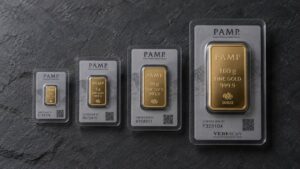
Gold bars from LBMA Good Delivery-accredited refiners carry the lowest manufacturing and distribution costs in the retail bullion market [LBMA]. They come without the legal-tender status, anti-counterfeiting infrastructure, or brand premium of government-minted coins. That difference translates directly into a lower premium.
A 1 oz gold bar from an accredited refiner such as PAMP Suisse, Valcambi, or Argor-Heraeus typically carries a premium of 1.5–3% over spot in normal market conditions [GoldSilver]. A 10 oz bar compresses further. A 1 kg bar is lower still — often 1–2% over spot [MetalCharts]. The premium rule is straightforward: the larger the bar, the lower the per-ounce cost.
During a correction, therefore, bars give you more metal per dollar than any other format. If your goal is to accumulate the maximum number of ounces at the lowest all-in price, start with bars. Stick to refiners on the LBMA Good Delivery List to avoid resale friction. Additionally, confirm the bar comes in sealed assay packaging — that card verifies purity and substantially reduces the friction of resale to a buyer who hasn’t seen the bar before.
Sovereign Bullion Coins: Deepest Liquidity, Slightly Higher Cost
Government-minted bullion coins carry premiums of roughly 3–7% over spot [MetalCharts]. The main options are the American Gold Eagle (22-karat, U.S. Mint), Canadian Gold Maple Leaf (.9999 fine, Royal Canadian Mint), South African Krugerrand (22-karat), and Austrian Philharmonic (.9999 fine).
That premium buys something specific: instant global recognition. Every coin dealer, pawnbroker, and bullion exchange on earth recognizes these coins without needing to test them. Their legal-tender status, standardized weights, and government backing eliminate authentication risk at the point of sale. Moreover, they also qualify for certain IRA accounts, which bars from non-IRS-approved refiners may not.
Among the sovereign options, the Canadian Maple Leaf consistently delivers the lowest premium in its class — typically 3–5% for the 1 oz coin [MintedMetal]. It offers .9999 purity and the Royal Canadian Mint’s radial line security features. Krugerrands often match or slightly undercut Maple Leaf premiums, making them attractive when the priority is sovereign liquidity at the lowest possible cost above bars [MetalCharts].
American Gold Eagles carry slightly higher premiums (typically 4–7%) due to their domestic demand dominance [MetalCharts], but their liquidity in the U.S. market is unmatched. If you may need to sell quickly through local channels — not a wire-transfer bullion dealer — Eagles remain the benchmark.
What to Avoid: Fractional Gold
Fractional gold coins (1/4 oz, 1/10 oz) carry premiums of 8–15% or more over spot [GoldSilver]. The manufacturing cost of a 1/10 oz coin is nearly identical to a 1 oz coin, but that cost is divided across one-tenth of the metal content. Furthermore, the premium compounds on the already-compressed spot price. A correction is precisely the wrong moment to buy fractional gold — your objective is maximum metal per dollar, and fractional products work directly against it. If the budget doesn’t support a full 1 oz purchase, generic silver rounds deliver far more metal efficiency at that price point.
What Silver Products Have the Lowest Premiums?
Silver premiums are structurally higher than gold premiums in percentage terms. This is not a market inefficiency — it is arithmetic. The fabrication, shipping, and dealer overhead costs are similar in absolute dollars for a silver coin and a gold coin, but silver’s lower per-ounce price means those costs represent a larger percentage of the metal’s value. Consequently, managing silver premiums requires a different strategy than managing gold premiums.
Silver Bars: Lowest Per-Ounce Premium for Stacking
Silver bars from LBMA-accredited refiners carry the lowest premiums in the silver market. A 100 oz silver cast bar from a recognized refiner offers among the lowest per-ounce premiums available in the retail market [GoldSilver]. The large format dramatically reduces the per-ounce fabrication cost — often making it substantially cheaper than any coin or round. A 10 oz bar is slightly higher but still well below sovereign coin premiums.
For an investor specifically trying to accumulate the maximum number of silver ounces during a correction, 10–100 oz bars from accredited refiners such as Asahi Refining, PAMP Suisse, or Valcambi represent the most cost-efficient path [GoldSilver, April 2026].
The trade-off with large silver bars is storage cost and resale flexibility. A 100 oz silver bar is a significant single asset (~$5,800 at July 2026 prices). Selling requires finding a buyer for the whole unit. As a result, bars work best for investors who plan to hold and who have secure, insured storage.
Generic Silver Rounds: Best Balance of Price and Flexibility
A silver round is a privately minted coin-shaped piece of .999 fine silver. It carries no legal-tender face value and no government backing — but it also carries no government-mint premium. Generic silver rounds from established private mints such as Sunshine Minting typically run 5–10% over spot, compared to 15–25% for American Silver Eagles [GoldSilver].
That spread — 10 to 15 percentage points below sovereign coins — matters a great deal during a correction when both are already trading at elevated premiums relative to calm-market conditions.
Rounds give you 1 oz units: divisible, widely recognized, and far easier to resell in partial amounts than a 100 oz bar. Most private mint rounds do not meet IRS sourcing requirements for self-directed IRAs. For a non-IRA physical accumulation strategy, however, they represent the best balance between premium efficiency and practical flexibility.
Stick to established private mints with documented track records. The resale value of a generic round depends entirely on the buyer’s ability to confirm its legitimacy — a round from an obscure mint with no established reputation may require assay testing at resale.
Sovereign Silver Coins: Pay Up for Liquidity
The American Silver Eagle, Canadian Silver Maple Leaf, Austrian Philharmonic, and British Britannia all carry government guarantees of weight and purity, instant dealer recognition, and the deepest resale liquidity in the silver market [GoldSilver]. They also carry premiums of 15–25% over spot — which in a demand-spike correction can push even higher [GoldSilver].
The premium you pay for sovereign silver coins is real money. Nevertheless, it buys something genuine: the ability to sell instantly, at any reputable dealer, without testing, anywhere in the world. For investors who hold silver partly as a convertible emergency asset, that liquidity justification holds. For pure cost efficiency during a dip, however, rounds or bars are the smarter buy.
Which Physical Precious Metals Should I Avoid During a Correction?
Three categories consistently disappoint investors who buy during corrections.
Numismatic and Rare Coins
Collectible coins carry value that derives from historical significance, condition, and collector demand — not metal content. They do not track spot price in either direction. When gold spot corrects 20%, a numismatic coin’s price depends on collector sentiment and auction market conditions, which may move completely differently. During a correction, stick exclusively to coins valued at or near their metal content — standard bullion coins with no collector premium.
Jewelry
Gold or silver jewelry carries a design markup, a retail margin, and sales tax in many jurisdictions. Together these can absorb 20% or more of the metal’s value above spot. Reselling jewelry typically returns melt value only — which is below spot — after refinement costs are deducted. Jewelry is not a bullion product. It is a consumption good with precious metal content.
Fractional Gold Coins in High-Demand Conditions
Beyond the structural 8–15% premium discussed above, fractional coins during a correction become scarce faster than full-ounce products, which pushes their premiums even higher. A correction is exactly when fractional premiums hurt you most. If the budget does not support a full 1 oz gold purchase, generic silver rounds deliver far more metal efficiency at that price point.
How Do I Calculate Whether I’m Getting a Fair Price?
The calculation is straightforward. First, pull the current spot price from a live source — not a price from earlier that day; spot moves continuously [goldsilver.com/price-charts/]. Then subtract the spot price from the dealer’s asking price and divide by the spot price. The result is your premium percentage.
For example: if gold spot is $4,042 and a 1 oz Eagle is quoted at $4,285, your premium is ($4,285 minus $4,042) divided by $4,042, which equals 6.0%. For that coin type and market conditions, 6% sits in the normal range. A premium above 8% for gold or above 20% for silver warrants checking at least two other dealers or moving to a lower-premium product format.
The broader check: if the combined cost — spot correction plus premium paid — exceeds what you would have paid in a calm market with normal premiums, you have not captured the correction.
Buy From Refiners With Established Resale Liquidity
Bars and rounds are only as good as the next buyer’s willingness to accept them. Ensure gold bars carry a stamp from a recognized LBMA Good Delivery refiner. That stamp is internationally recognized evidence of purity and weight. For silver, bars from Asahi Refining, Valcambi, PAMP Suisse, and similar accredited refiners eliminate assay requirements at resale [GoldSilver, April 2026].
Silver rounds carry no such institutional backing. However, established private mints with high production volumes — and products widely circulated in the secondary market — create de facto recognition that speeds resale without testing.
What Is the Sound Money Case for Buying Physical Metal During a Correction?
Why the Structural Case Survives a Price Drop
Precious metals corrections are not anomalies. They are the predictable consequence of short-term factors — a hawkish Fed pivot, a demand shock, profit-taking after a sharp run — acting on assets whose long-term value rests on something different: the structural erosion of fiat currency purchasing power over decades.
The Federal Reserve has held rates at 3.50–3.75% under Chair Kevin Warsh while running above $1 trillion in annual interest payments [U.S. Treasury Fiscal Data]. Global central banks purchased approximately 863 tonnes of gold in 2025 [World Gold Council]. The silver supply deficit extended to five consecutive years through 2025, with 2026 on track for a sixth [Silver Institute, World Silver Survey 2026]. None of those structural conditions reversed because spot prices fell.
The Constraint: Premium Management
A correction means you can acquire more of a scarce, historically proven monetary asset per dollar than you could six months ago. Physical gold and silver carry no counterparty risk — their value does not depend on any issuer’s ability to pay. The mechanism that makes the purchase valuable — monetary debasement, institutional demand, supply constraints — remains intact. Buying more at lower prices is not speculation. It is taking the structural thesis seriously.
The price advantage only survives if you minimize the premium. Buy the right product, verify the refiner, confirm the spot price before you transact, and capture the discount that the correction actually offers.
Stay On Top of Gold & Silver Prices
Get important market alerts sent straight to your inbox.
People Also Ask
Yes. The IRS classifies physical gold and silver as collectibles. Long-term capital gains are taxed at a maximum rate of 28% — higher than the 15–20% rate that applies to most other long-term investments. That rate applies regardless of whether you buy during a correction or at any other time. Short-term gains (metal held under one year) are taxed as ordinary income. Keep precise purchase records — date, price paid, and premium — to calculate your cost basis accurately at sale.
It depends on your goal. Gold is the lower-volatility choice: tighter premiums relative to spot, deeper institutional liquidity, and a more predictable resale market. Silver offers more ounces per dollar at current prices. Its gold-silver ratio has historically mean-reverted toward lower levels — but silver premiums are structurally higher and price swings are sharper. Many investors buy both, using bars or large-format silver for cost efficiency and sovereign gold coins for liquidity. Neither metal is wrong; the ratio at which you hold them is a personal decision.
Yes, and it has happened. During the COVID demand surge in March 2020, American Silver Eagle premiums briefly exceeded 40% over spot. That is more than double their normal range. Gold fractional coins saw similar spikes. A 10% drop in spot price paired with a 12–15% premium increase means the buyer actually pays more per ounce than before the correction. This is the core reason product selection matters as much as timing. Sovereign coins and recognizable bars hold their premium ranges better than fractional or obscure products during demand surges.
Spreading purchases — dollar-cost averaging — reduces the risk of buying at what turns out to be a temporary floor before prices fall further. Corrections do not always bottom in a single session. Gold’s 2026 correction unfolded over several months. A staged approach across two or three tranches lets you average into a lower cost basis if prices continue dropping, without sitting on the sidelines entirely. The tradeoff is logistical: multiple smaller purchases often mean paying a slightly higher per-unit premium than a single larger order, since many dealers offer volume discounts above certain thresholds.
For bars from established LBMA-accredited refiners in sealed assay packaging, the tamper-evident card is the primary verification. Breaking the seal to test destroys the packaging and reduces resale value. For bars outside sealed packaging, or when buying from secondary markets, two tools are widely used. An electronic precious metals verifier (such as the Sigma Metalytics) uses electromagnetic resonance to confirm metal composition without scratching the bar. A precision scale verifies stated weight within manufacturer tolerances. A magnet test rules out obvious fakes but does not confirm purity. Avoid dealers who cannot provide provenance documentation for bars arriving outside original packaging.
SOURCES
1. GoldSilver — Gold Spot Price vs. Premium Explained (June 2026), Best Silver for Liquidity (June 2026), Silver Bullion Buying Guide 2026 (April 2026)
2. LBMA — About Good Delivery; Good Delivery Current List
3. MetalCharts — Bullion Coin Premium Tracker (May 2026)
4. FindBullionPrices — Best Silver Prices — Live Premium Tracker (July 2026)
5. MintedMetal — Best Gold Coins to Buy in 2026 (April 2026)
6. World Gold Council — gold.org — 2025 central bank demand data (2025 annual data)
7. Silver Institute — World Silver Survey 2026 (2025 annual data)
8. U.S. Treasury Fiscal Data — fiscaldata.treasury.gov — Federal interest payments (accessed July 2026)
Disclaimer: This article is for informational purposes only and does not constitute financial or investment advice. Always consult a qualified financial adviser before making investment decisions.
You May Also Like:
- Gold Is Down 26%. Silver Is Down 51%. What Does the Stacker Do Now?
- Gold Allocation Calculator: How Much Should Your Portfolio Actually Hold?
- What Is the Gold Volatility Index (GVZ) — and What Does It Mean for You?
- Gold & Silver Market Correction: Is the 2026 Bull Market Over?
- JPMorgan Cut Its Gold Forecast by 25%. Here’s What Long-Term Holders Need to Know.
- Why HSBC Still Believes Gold Hits $4,750 by Year-End (And What the Mainstream Is Missing)
- State Street Predicts $5,500 Gold by Q1 2027: Is the Dip Over?