Silver Rises Over 120% YTD




Published: 09-22-2026, 09:50 pm
Last verified September 2026.
A one-gram gold bar carries a melt value of about $140 at today’s gold price. That number is the whole reason gram bars exist. A one-ounce coin runs well over four thousand dollars. A gram bar is the only common way to hold real, physical gold at a price most people spend on a nice dinner out.
The catch is the premium. Gram bars are the most expensive way to buy gold on a percentage basis. Understanding why is the difference between buying one on purpose and buying one by accident.
How Much Does a 1 Gram Gold Bar Cost?
The metal itself is simple math. Gold trades at $4,358.58 per troy ounce as of September 22, 2026, per goldsilver.com’s live price charts, and a troy ounce holds 31.1035 grams. Divide the two and one gram of gold is worth $140.13 in melt value alone.
Nobody sells it at melt value. GoldSilver’s own breakdown of premiums and pricing puts standard gold bars at roughly 2 to 4 percent over spot. Sovereign coins run roughly 4 to 8 percent. Gram bars sit well above both, commonly running into the mid-teens to low-twenties percent. Fabrication, assay certification, and packaging costs are largely fixed regardless of bar size, so a tiny bar absorbs the same costs as a big one. At the higher end of that range, a $140 bar can carry an all-in price approaching $175 to $180.
Why Do Small Bars Cost So Much More Per Gram?
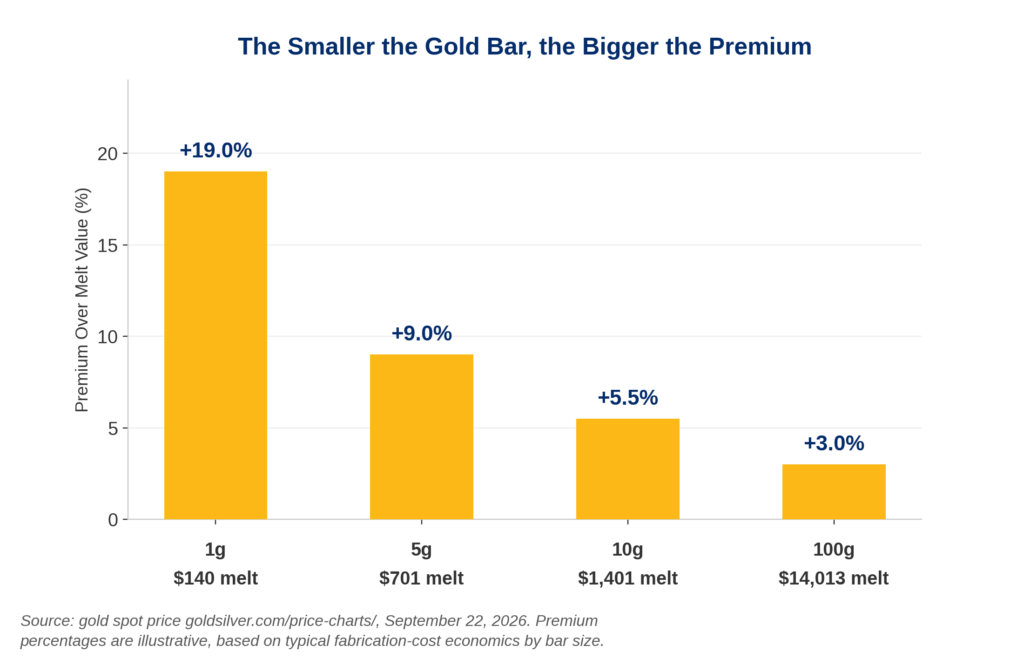
This is a fixed-cost problem, not a pricing trick. Stamping, assaying, and sealing a bar in tamper-evident packaging costs a refiner roughly the same whether the bar weighs 1 gram or 100 grams. Spread that fixed cost over 1 gram of metal and the premium is enormous. Spread the same cost over 100 grams and it nearly disappears.
That is also why a 100-gram bar and a 1-kilogram bar sit at the low end of the premium curve. There is more metal absorbing the same handful of fixed costs, so the percentage markup compresses toward the raw material price.
How Many Grams of Gold Can You Buy for $1,000?
At $140.13 per gram in melt value, $1,000 buys about 7.1 grams of gold before any premium. After a typical gram-bar premium in the mid-teens to low-twenties percent, that same $1,000 realistically buys closer to 5.8 to 6.2 grams. The gap between those two numbers is the fabrication cost you are paying for the privilege of owning gold in a very small, very liquid unit.
1 Gram vs. 5, 10, and 100 Grams: Where Does the Premium Flatten Out?
The pattern holds at every size checked:
- 1 gram: melt value $140.13. Highest percentage premium of any common bar size.
- 5 grams: melt value $700.66. Premium drops meaningfully; still elevated versus larger formats.
- 10 grams: melt value $1,401.32. Approaching the premium range of standard gold bars.
- 100 grams: melt value $14,013.16. Premium curve has mostly flattened; close to bulk bar pricing.
The practical takeaway: every step up in size buys you a lower cost per gram. That holds right up until the 100-gram to 1-kilogram range, where the curve goes mostly flat.
Is a 1 Gram Gold Bar Worth Buying?
It depends on what job you are hiring it to do. As a store of value measured by cost efficiency, it is the worst format available. As an entry point, it does something a 1-ounce coin cannot. For someone who has never owned physical metal, it makes ownership possible at a price almost anyone can afford this week, rather than after months of saving.
The tradeoff shows up again at resale. Gram bars are recognized worldwide and sell back close to spot. But the same fixed-cost math that inflated the purchase premium also means you are unlikely to recover it in full on the way out. A gram bar bought as a first step into gold ownership makes sense. It follows the same strategy laid out in GoldSilver’s guide to a first $1,000 in precious metals. A gram bar bought as your primary method of accumulation does not. You would pay a structurally higher toll on every gram for the life of the position. That is the same size-versus-premium tradeoff explored in GoldSilver’s breakdown of gold bar worth by size.
What Should You Look For in a Gram Gold Bar?
Whatever the size, three things separate a gram bar worth buying from one that will cost you at resale. First, purity. Legitimate investment-grade gram bars are stamped .999 or .9999 fine, with the weight and purity engraved on the bar itself, not just printed on packaging. Second, an assay card. Reputable refiners seal the bar in a tamper-evident card with a serial number. That lets a future buyer confirm the bar has not been opened or swapped since it left the mint. Third, refiner reputation. A bar from a refiner accredited by the London Bullion Market Association carries instant recognition anywhere in the world. An unaccredited or obscure refiner’s bar may require independent testing before a dealer will buy it back. That testing requirement erodes the liquidity that is the entire point of owning bullion.
A bar missing any of the three is not necessarily fake. But it is harder to sell, and a harder-to-sell bar effectively carries a second, invisible premium on top of the one you already paid.
The Knowledge That Changes Everything
Two essential guides — yours free. Understand why gold matters and why fiat currencies always fail.
Are Gram Gold Bars a Good Gift?
This is where gram bars solve a real problem that larger formats do not. A one-ounce coin at today’s prices is a four-figure gift. That is out of reach for most graduation presents, wedding gifts, or a child’s first introduction to owning something real. A 1-gram or 2.5-gram bar costs about as much as a nice bottle of wine or a piece of jewelry. It has also held its value against every fiat currency in history.
The mechanism is the same one that makes gram bars a weak accumulation strategy: high premium per unit of metal. For a gift, though, cost efficiency is not the point. Introducing someone to physical ownership, in a form they can hold, is.
Quick Answers
How much is a 1 gram gold bar worth today? At the September 22, 2026 gold price of $4,358.58 per troy ounce, one gram of gold carries a melt value of $140.13. The retail price runs higher, commonly $160 to $175 once a typical fabrication premium is included.
Is buying gold by the gram a good idea? For a first purchase, a gift, or simply testing the process of owning physical metal, yes. For building a meaningful position over years, look at larger formats instead. A 100-gram or 1-kilogram bar delivers more metal per dollar spent, because fixed fabrication costs are spread across far more grams.
Do gram gold bars hold their value? The metal inside a gram bar tracks the spot gold price exactly like any other bar or coin. The premium paid at purchase does not track as cleanly. That gap is why format matters more for gram bars than for any other size.
How many grams are in a troy ounce of gold? A troy ounce, the standard weight unit for precious metals, equals 31.1035 grams. That conversion is why a “1 ounce” coin and a “31 gram” bar contain the identical amount of gold.
Are gram gold bars a scam? No. Gram bars from LBMA-accredited refiners are legitimate, IRS-recognized bullion. The higher premium reflects real fabrication and certification costs, not fraud. It does mean gram bars are a poor vehicle for accumulating large amounts of gold efficiently.
What size gold bar has the lowest premium? Larger bars, generally 100 grams and up through 1 kilogram, carry the lowest percentage premium over spot. Fixed fabrication and assay costs get spread across far more metal per bar.
Why Does Any Amount of Real Gold Still Matter?
The premium conversation is really about efficiency, not about whether gold belongs in a portfolio. That underlying case does not change with bar size. Consider two facts side by side. The dollar has lost approximately 87 percent of its purchasing power since the gold window closed in 1971 (Bureau of Labor Statistics, CPI-U, 2026). Central banks purchased a net 863 tonnes of gold in 2025. That is 82 percent above the 2010 to 2021 average of 473 tonnes per year (World Gold Council, Gold Demand Trends Full Year 2025). Both describe the same mechanism from two different seats at the table. The institutions with the largest balance sheets in the world are diversifying into an asset a saver can buy one gram at a time.
Format is a question of cost efficiency. Whether to own gold at all is a separate question, and the reserve managers buying by the hundreds of tonnes have already answered it.
Stay On Top of Gold & Silver Prices
Get important market alerts sent straight to your inbox.
SOURCES
1. GoldSilver – Gold & Silver Price Charts (September 22, 2026)
2. GoldSilver – Understanding Premiums and Pricing (Published June 11, 2026; updated June 23, 2026)
3. Bureau of Labor Statistics – Consumer Price Index (CPI-U) (1971-2026 series, re-verified September 23, 2026)
4. World Gold Council – Gold Demand Trends: Q4 and Full Year 2025 (Published January 29, 2026)
Disclaimer: This article is for informational purposes only and does not constitute investment advice. Past performance is not indicative of future results. Always consult a qualified financial advisor before making investment decisions.
You May Also Like:
- What Are Negative Real Interest Rates, and Why Does Gold Thrive in This Environment?
- Cheapest Way to Buy Gold? We Measured 110 Live Prices
- How Much Silver Should You Own? A Portfolio Allocation Guide by Age and Goal
- Who Owns US Debt? Central Banks Own Less Than You Think
- What Is Junk Silver? The Old Dimes and Quarters Worth Nearly 50x Their Face Value
- Why Is Silver Demand Tied to AI Data Centers?
- The Copper Mine That Isn’t Trying to Mine Silver Just Explained the Whole Deficit
- Inherited Gold IRA: Beneficiary Rules & the Step-Up Basis Gap