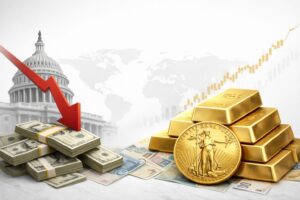
Silver Rises Over 120% YTD




Gold set an all-time high of $5,595 per ounce on January 28, 2026 [Investing News Network]. By mid-April, it pulled back to approximately $4,724 — a decline of around 15% [Trading Economics, April 13, 2026]. For investors watching from the sidelines, the concept of gold dip buying — stepping in after a price correction with a long-term view — is firmly back in the conversation. But “prices are lower, so buy” isn’t a strategy on its own. This guide walks through what’s actually driving the pullback, what the data says, and how to approach it with discipline rather than impulse.
Why Did Gold Prices Fall in 2026?
Gold doesn’t fall in a vacuum. This correction has four clear drivers.
A stronger dollar: When the U.S. dollar strengthens, gold becomes more expensive for international buyers and prices retreat. This inverse relationship has held consistently for decades.
Higher real interest rates: Gold pays no interest or dividends. With the Federal Reserve holding rates steady at 3.50%–3.75% through early 2026, yield-bearing assets offer a genuine alternative for capital [ETF Trends, February 2026].
Profit-taking after a historic run: Gold climbed roughly 64% in 2025 alone, reaching multiple record highs [World Gold Council, January 2026]. After any run of that scale, institutional funds lock in gains — pushing prices lower even when the underlying investment case stays intact.
Fading safe-haven demand: Some of the risk-off positioning that drove gold’s 2025 surge has unwound as markets reassess the near-term geopolitical picture.
These are cyclical forces, not permanent, structural ones. Historically, they’ve created accumulation windows within longer bull markets — which is certainly not the end of the story.
Your Gold Buying Guide Most investors overpay when they buy gold. Then overpay again when they sell. This guide shows you exactly what to own — and why.
What Is Gold Dip Buying?
Gold dip buying means purchasing gold during a price correction, with the expectation that prices will recover over time.
The logic is straightforward: if you believe in gold’s long-term role as a store of value and inflation hedge, a lower price means you’re acquiring the same asset — with the same structural tailwinds — at a better entry point.
The comparison to stock market dip buying is useful, but incomplete. With stocks, you’re betting on a company’s future earnings. With gold, you’re buying a long-term hedge against inflation, currency debasement, and monetary instability. That calls for a different measure of success that needs thinking in years, not months.
Why Investors Are Buying the Dip
Several structural forces make this correction look more like an opportunity than a turning point.
Inflation remains above target: The PCE price index — the Fed’s preferred inflation measure — rose 2.8% year-over-year in February 2026, with core PCE at 3.0% [Bureau of Economic Analysis via Fox Business, April 2026]. Purchasing power is still being eroded, and that’s precisely the environment where gold has historically earned its place in a portfolio.
Central banks are still accumulating: Global central banks purchased a net 863 tonnes of gold in 2025 — the fourth-largest annual total on record, and well above the 2010–2021 average of 473 tonnes per year [World Gold Council, Gold Demand Trends Full Year 2025]. Critically, 95% of central banks surveyed expected global reserves to increase over the next 12 months — the highest optimism in the survey’s eight-year history [World Gold Council, Central Banks]. That level of institutional demand creates a structural floor under prices.
The 2008 precedent is worth understanding: During the financial crisis, gold fell roughly 30% peak-to-trough as investors raised cash yet closed the year essentially flat while the S&P 500 lost over 50%. From that trough, gold gained approximately 166% by 2011 [GoldSilver.com, “How Gold Performs in Recessions”]. Corrections within bull markets have consistently resolved upwards.
For a deeper look at how gold and silver behave across different market environments, see: Fewer Losses, Better Returns: How Gold and Silver Diversify Your Portfolio.
Is This a Good Time to Buy Gold?
For long-term investors with conviction in gold’s fundamentals, yes — a 15% pullback with an intact investment thesis is historically a buying window, not a warning sign. That said, the honest answer requires looking at both sides.
Reasons to consider buying: At ~$4,724, you’re entering roughly 15% below the all-time high. The investment thesis — monetary debasement, central bank demand, inflation persistence — is intact. JP Morgan projects gold reaching ~$5,000 by Q4 2026; UBS has raised its target to $6,200 by September 2026 [“Gold Price Forecasts for 2026, Revisited After Q1”].
Risks worth acknowledging: A 15% correction can deepen. March CPI jumped to 3.3% — the highest since May 2024 — largely on energy prices tied to geopolitical conflict, reinforcing the Fed’s reluctance to cut rates [Trading Economics, April 2026]. A stronger dollar or sustained high yields could push gold lower before any recovery. And capital committed here isn’t working elsewhere — if recovery takes 12–18 months, other assets may outperform.
A dip is a strategic opening for investors with conviction in gold’s long-term role. It’s not a trigger for an impulsive buy.
Gold Price Outlook
Short term: Volatility will continue. Rate signals, dollar strength, and geopolitical developments will keep pushing gold in both directions.
Medium term: The conditions behind gold’s 2024–2025 rally, such as rate-cut expectations, central bank buying, above-target inflation still remain in play. JP Morgan’s ~$5,000 Q4 2026 base case and UBS’s $6,200 target suggest meaningful recovery potential from current levels.
Long term: The structural case is solid. Gold overtook U.S. Treasuries late in 2025 to become the world’s largest reserve asset by value[BlackRock]. As long as governments run deficits and central banks expand balance sheets, gold’s role as sound money endures.
How to Approach It Strategically
Stagger your entries: Spread purchases across several weeks or months rather than committing everything at once; this is the precious metals equivalent of dollar-cost averaging. It removes the pressure of timing the exact bottom.
Don’t go all-in early: A 15% correction can always deepen before it recovers. Staging your entries means you have room to keep buying if prices fall further, which improves your average cost over time.
Watch the right indicators: Real yields and the DXY dollar index are the most reliable near-term signals for gold’s direction. Falling real yields and a weakening dollar both tend to be supportive of gold prices.
Set your allocation target first: Most financial professionals suggest 5–15% in precious metals as part of a diversified portfolio [“How to Buy Gold”]. Know your number before you start buying; this keeps decisions principled, not reactive.
Investing in Physical Metals Made Easy

People Also Ask
Is now a good time to buy gold in 2026?
For long-term investors, yes. At approximately $4,724 — roughly 15% below the January 2026 all-time high — the current correction offers a more attractive entry point while the fundamental case (inflation persistence, central bank demand, monetary debasement) remains fully intact.
Is gold a good investment after a price drop?
Yes, particularly for long-term investors seeking inflation protection or portfolio diversification. A lower entry price improves your return potential over time. Conviction in the underlying case should come before the price drop, not follow from it.
What causes gold price corrections?
Dollar strength, rising real interest rates, profit-taking after major rallies, and reduced safe-haven demand. These are cyclical pressures — not structural changes in gold’s long-term value.
Gold vs silver: which is better to buy during a dip?
Gold is the more stable core position; silver is a higher-volatility complement. Most investors use gold as the primary allocation and add silver for additional upside exposure. The gold-to-silver ratio can help signal relative value between the two.
Should beginners buy gold during a dip?
Only as part of a deliberate, long-term strategy. Understanding why you’re buying matters more than when. Buying on price momentum alone often leads to selling at the wrong time too.
How much gold should I hold?
Most professionals suggest 5–15% of a portfolio in precious metals, depending on risk tolerance and investment goals. Gold is a hedge and diversifier — not a growth engine.
Will gold prices recover after this correction?
History and current institutional forecasts both suggest yes, though timing is unpredictable. JP Morgan projects gold reaching approximately $5,000 by Q4 2026; UBS has raised its target to $6,200 by September 2026.
The Bottom Line
A 15% pullback from an all-time high is significant — but it doesn’t change the long-term case for gold. The forces behind the January 2026 peak — monetary debasement, persistent inflation, and record central bank accumulation — are still present.
Buying a dip works when it’s built on real conviction and executed with patience — not when it’s a reaction to headlines or the fear of missing a low. Investors who define their allocation in advance, stagger their entries, and measure success in years rather than months are the ones who tend to come out ahead in precious metals.
If that describes your approach, this correction may be exactly the opening you’ve been waiting for. And GoldSilver.com has you covered with everything you need to know to begin.
This article is for informational purposes only and does not constitute financial advice. Past performance is not indicative of future results. Always consult a qualified financial advisor before making investment decisions.
SOURCES
1. Investing News Network — What Was the Highest Gold Price Ever? Updates on Gold’s Record-Breaking Performance
2. Trading Economics — Gold Spot Price, April 13, 2026
3. ETF Trends — Two Measures of Inflation: February 2026
4. World Gold Council — Gold Market Commentary: January 2026
5. Fox Business / Bureau of Economic Analysis — February 2026 PCE: Fed’s Favored Inflation Gauge Remained Stubbornly High
6. World Gold Council — Gold Demand Trends: Full Year 2025
7. World Gold Council — Central Banks: Gold Demand Trends Full Year 2025
8. GoldSilver.com — How Gold Performs in Recessions: What History Tells Us
9. GoldSilver.com — Gold Price Forecasts for 2026, Revisited After Q1
10. JP Morgan Global Research — Gold Price Forecast: A New High?
11. Trading Economics — United States Inflation Rate (CPI), March 2026
12. GoldSilver.com — How to Buy Gold: A Beginner’s Guide for Investors
13. BlackRock / iShares — Gold Rush 2.0: Gold Not Slowing Down in 2026