Silver Rises Over 120% YTD




Published: 09-14-2026, 02:18 pm
Gold is trading near $4,306 an ounce today, down about 1% from this morning’s open. Silver sits near $63.59, down roughly 1.6%. Both are pulling back into a Fed decision that, on paper, should be far worse for them than a 1% dip.
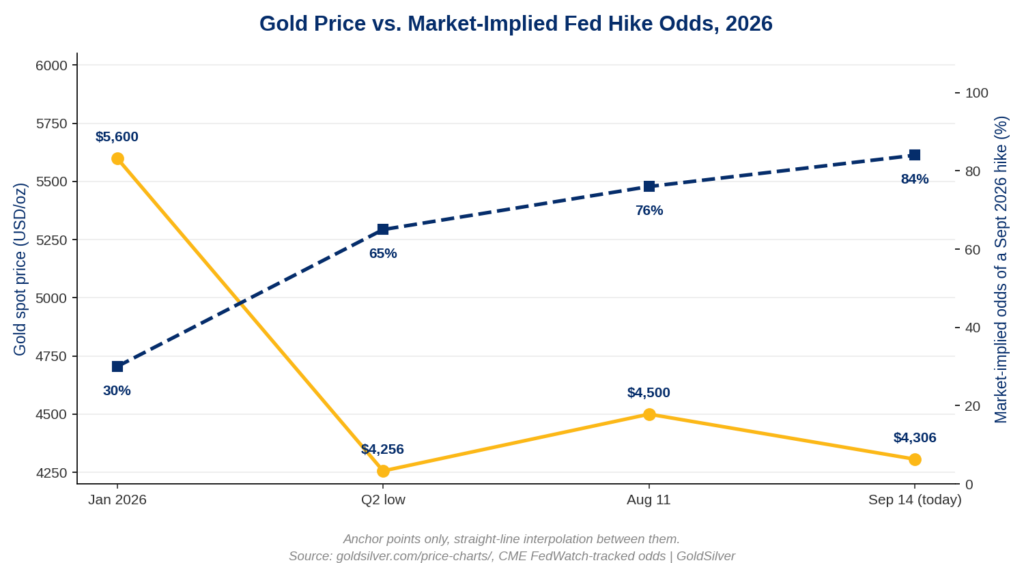
On September 16, the Federal Reserve is expected to raise its policy rate for the first time this cycle. Market-implied odds sit at 83-85%, according to Fed-funds-futures trackers. That is not a hold with hawkish language attached. That is an actual hike. It is the kind of event the old textbook says should send gold lower and keep it there.
It hasn’t. Gold set a record above $5,600 in January. It corrected by roughly a quarter through the spring. It has spent the second half of the year rebuilding toward the mid-$4,000s. All the while, the market’s own rate-hike odds climbed from a coin flip toward near-certainty. If the old rate/gold relationship still ran this market, that sequence shouldn’t have happened.
Why Did Gold Stop Reacting to Real Yields?
The old rule was simple. Gold pays no yield. When real interest rates rise, the opportunity cost of holding it rises too, and money rotates into bonds. Analysts at J.P. Morgan (Gregory Shearer, Head of Base and Precious Metals Strategy) have documented the breakdown of that rule since 2022. It deepened further through 2024 and 2025. Gold pushed to new highs during stretches when real yields on 10-year Treasury Inflation-Protected Securities stayed firmly positive. That is exactly the environment the old model says should have punished it.
A broken correlation isn’t proof of anything by itself. Correlations break for a season, then reassert themselves. But three years of the same pattern is different. It spans multiple Fed regimes and multiple inflation scares. That points to something structural: a change in who is setting gold’s marginal price.
The Knowledge That Changes Everything
Two essential guides — yours free. Understand why gold matters and why fiat currencies always fail.
Who Is Buying Gold Instead of Selling Into the Hike?
Here’s the mechanism. For most of the post-2008 era, gold’s price was set at the margin by Western investors. They moved in and out of ETFs like GLD, chasing the real-yield trade: buying when rates fell, selling when they rose. That’s the buyer the old model was built to describe.
Starting in 2022, central banks became a second source of demand. This buyer is far less rate-sensitive. According to World Gold Council data, central banks bought over 1,000 tonnes of gold in each of 2022, 2023 and 2024, and 863 tonnes in 2025. At $60-85 billion a year, that absorbed roughly a quarter of annual global mine production. A reserve manager building a decades-long reserve position doesn’t sell because the Fed hiked 25 basis points.
A Second Buyer Has Joined the Central Banks
More recently, retail and institutional investors have picked up a larger share of the demand baton alongside central banks (World Gold Council). That adds a second layer of buying that also isn’t purely a real-yield trade. Official-sector purchases are still running strong too: Poland added roughly 51 tonnes in Q2 2026, and China added about 33 tonnes. That was China’s largest single-quarter purchase since late 2023 (World Gold Council, Q2 2026). Neither buyer group unwinds a position over one FOMC statement. That is a large part of why gold has stopped flinching every time hike odds climb.
This is also why bank price targets haven’t moved even as hike odds have. Goldman Sachs still holds a 2026 year-end target of $4,900. JPMorgan’s Q4 target sits at $4,500. Bank of America’s 2026 average target is $4,360. HSBC’s average target is $4,560. Every one of those figures sits at or above today’s price. The desks setting them already priced in the September 16 hike. If the old rate-sensitivity model still ruled this market, those targets would have moved down with hike odds. They haven’t, because the analysts are pricing in the same structural buyer this piece describes.
What Will the Fed’s September 16 Decision Actually Change?
None of this makes a hike irrelevant. A surprise move, or a statement more hawkish than the 83-85% odds already assume, can still push gold lower near term. Real yields still matter at the margin. They’ve just stopped being the only thing that matters. On the evidence of the last three years, a hike does not reopen the case against gold’s structural bull thesis. The old rate mechanism now sits underneath a genuinely different buyer, and that buyer is far less rate-sensitive.
Gold’s own institutional target series has held through this exact repricing. GoldSilver’s September 2026 Fed-meeting outlook laid this out bank by bank. The Treasury side of this same debasement story doesn’t depend on the Fed at all. That angle is covered in our explainer on what the Treasury is already doing.
For a reader deciding how much of their savings to hold in physical metal, the practical takeaway is simple. It comes down to what you’re hedging against. If you’re trading gold as a short-term rate bet, the Fed’s September 16 decision matters enormously, and it could go against you. If you’re holding it as protection against currency debasement and counterparty risk, a single Fed meeting was never the thing that mattered. That is the same reason central banks themselves are buying.
Stay On Top of Gold & Silver Prices
Get important market alerts sent straight to your inbox.
People Also Asked
Does a Fed rate hike always hurt gold prices?
Historically, yes. Higher real yields raise the opportunity cost of holding a non-yielding asset. Since 2022, that relationship has weakened. Central-bank reserve buying, not yield-sensitive investor flows, has increasingly set gold’s marginal price.
Why are central banks buying gold instead of Treasuries?
Reserve managers are diversifying away from currency and sovereign counterparty risk (World Gold Council). This buying is not primarily rate-sensitive, unlike a private investor’s yield trade. It does not reverse over a single policy decision.
Have bank gold price targets changed ahead of the September hike?
No. Goldman Sachs holds $4,900. JPMorgan holds a $4,500 Q4 target. Bank of America averages $4,360. HSBC averages $4,560. All four have held steady through the repricing of hike odds.
How much gold have central banks bought since 2022?
Over 1,000 tonnes in each of 2022, 2023 and 2024, per World Gold Council data. Add 863 tonnes in 2025. That absorbs roughly a quarter of annual global mine production.
SOURCES
1. Yahoo Finance — JPMorgan Predicts $2,600 Gold Prices By 2025
2. State Street Global Advisors — Gold 2026 Outlook: Can the Structural Bull Cycle Continue to $5,000?
3. World Gold Council — Gold Demand Trends Q2 2026: Central Banks
4. CBS News — What Is the Highest Gold Price in History?
5. EBC Financial Group — Highest Gold Price Ever: Why Gold Hit $5,600 Faster Than Past Cycles
6. Investing.com (Reuters) — UBS Forecasts Two US Fed Rate Hikes in 2026 After Strong Jobs Report
7. GoldSilver — Gold Price Outlook September 2026
8. GoldSilver — Gold Doesn’t Need a Rate Cut. It Needs What the Treasury Is Already Doing.
9. ThriveInMarkets — FOMC Meeting Schedule 2026: All Fed Meeting Dates & Times
10. StreetStats — Fed Funds Rate Forecast 2026-2031
11. Central Bank Watch — Fed Rate Probability: FOMC Meeting Odds & Rate Cut Forecast 2026
12. GoldSilver Price Charts — Live Gold & Silver Spot Prices
Disclaimer: This article is for informational purposes only and does not constitute investment advice. Past performance is not indicative of future results. Always consult a qualified financial advisor before making investment decisions.
You May Also Like:
- How Much Gold Should You Own at 25, 45, or 65?
- Gold Price Outlook September 2026: What the Fed’s September 15-16 Meeting Means for Your Metals
- Do You Have to Report Gold Stored in a Foreign Vault? FBAR and FATCA Rules Explained
- Tokenized Gold: What It Actually Is, and Where the “Just Like Owning Gold” Pitch Breaks Down
- IRA-Eligible Gold: The Coins and Bars That Actually Qualify
- The No-Home-Storage-IRA Myth: Why the IRS Requires a Depository
- What Is a Gold IRA? The Purity Rule the IRS Never Wrote
- What Is ZIRP (Zero Interest Rate Policy) and How It Changed Gold Forever