Silver Rises Over 120% YTD




Published: 10-21-2025, 03:38 pm
Key Takeaways at a Glance
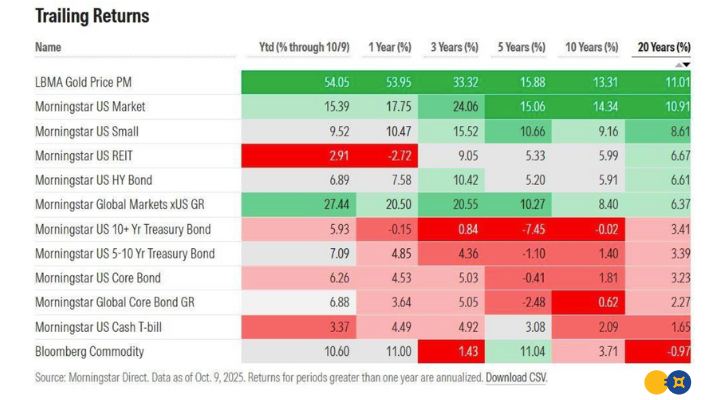
- Gold has led across timeframes in the latest trailing-returns snapshot: ~54% YTD and ~54% 1‑year; double‑digit annualized returns over 3, 5, 10 and 20 years.
- Over 20 years, gold’s annualized return is comparable to, or higher than, broad U.S. equities in the dataset—while bonds and commodities lag.
- This is due to structural demand (notably central bank buying), de-globalization/fracture risk, and persistent inflation pressures have changed the traditional investment landscape.
- A 5–15% strategic allocation has historically improved portfolio resilience, reducing drawdowns and volatility while preserving purchasing power.
For decades, the investing playbook was simple: stocks for growth, bonds for stability, and gold? Gold was the insurance policy you hoped you’d never need.
That script is being rewritten.
New data from Morningstar shows gold hasn’t just kept pace with traditional assets — it’s led the pack across nearly every timeframe measured. Through October 9, 2025, gold delivered 54% year-to-date returns and double-digit annualized gains over 3, 5, 10, and even 20 years. That 20-year performance? It’s now comparable to, or better than, U.S. equities, while bonds and commodities lag far behind.
This isn’t a flash-in-the-pan rally. Something structural has changed in how gold behaves, and smart investors are taking notice. Central banks are hoarding it. Institutions are rotating into it. And the traditional knock against gold — “it doesn’t pay a dividend” — is looking increasingly irrelevant when the “income” assets are getting crushed by inflation.
The question isn’t whether gold belongs in your portfolio anymore. It’s how to size your gold allocation — and how to own it the right way.
What the Numbers Actually Tell Us
The Morningstar trailing returns snapshot puts gold at the top of the table across most periods:
- Short term: 54% year-to-date and 1-year gains—driven by safe-haven demand, central bank buying, and dollar weakness.
- Medium term: Low-to-mid teens annualized returns over 3 and 5 years—even as real interest rates rose.
- Long term: Low-double-digit annualized returns over 10 and 20 years—beating or matching U.S. equities while bonds and commodities lagged.
Here’s why that matters: Gold delivered equity-like returns with bond-like diversification. In an era where inflation can crush both stocks and bonds simultaneously, having an asset that moves to its own rhythm is worth more than most investors realize.
Why Gold Stopped Playing by the Old Rules
If you’ve been watching gold’s price action over the past few years and thinking “this doesn’t make sense”—you’re not wrong. Gold shouldn’t be hitting all-time highs while interest rates rise. The textbook says higher yields crush gold.
The textbook is out of date. Three structural shifts explain why gold has entered a new regime:
1. Central banks became permanent buyers
Global central banks — particularly in emerging markets and Asia — have been adding gold to reserves at a pace not seen in decades. They’re diversifying away from dollar dependency and building sanction-proof reserves. Unlike retail investors or speculators, central banks aren’t price-sensitive. They’re strategic accumulators. That puts a floor under the market that didn’t exist before.
2. The world got more fragmented
Trade wars, sanctions, supply chain reshoring, and geopolitical fractures have made macro volatility the new normal. When the global order frays, neutral assets that aren’t anyone’s liability — like gold — gain appeal. Gold doesn’t care about tariffs, sanctions, or whose currency wins the reserve battle.
3. Inflation isn’t going back in the box
From massive fiscal spending to energy transitions to deglobalization, inflationary pressures are baked into the system. In stagflationary environments — where growth stalls but prices keep rising — gold has historically outperformed while equities struggle. That playbook is live right now.
Bottom line: Gold’s role has evolved from “crisis insurance” to core strategic reserve—for central banks, institutions, and individual portfolios alike.
The Portfolio Math: How Much Gold Should You Own?
You don’t need a 50% gold position to benefit. The data shows portfolios with a 5–15% gold allocation have historically delivered stronger risk-adjusted returns than traditional 60/40 portfolios — especially during periods of elevated inflation or equity market stress.
But increasingly, institutional voices are calling for more than “modest.” In September 2025, Morgan Stanley’s Chief Investment Officer Mike Wilson made waves by recommending a 20% allocation to gold — effectively retiring the decades-old 60/40 portfolio model in favor of a new “60/20/20” framework.
His reasoning? Bonds have lost their safe-haven status amid persistent inflation, unsustainable debt, and unconventional monetary policy. Gold, he argued, is the new “anti-fragile” asset.
Where should you start? Here are three allocation levels based on your goals:
- Conservative (5% gold / 95% traditional): Minimal tracking error, meaningful downside protection.
- Balanced (10% gold / 90% traditional): Historically delivers stronger risk-adjusted returns without dramatically changing portfolio character.
- Defensive (15% gold / 85% traditional): Maximizes resilience—especially valuable if you’re near or in retirement.
Regardless of which level you choose, rebalance annually and let the allocation do its work across market cycles — not day-to-day noise.
The bottom line: You’re not chasing returns. You’re building resilience.
How to Own Gold the Right Way
Owning gold isn’t complicated, but how you own it matters — a lot.
Start with physical bullion. If the goal is wealth preservation and eliminating counterparty risk, nothing beats owning the real thing. Stick with sovereign-minted coins (American Eagles, Canadian Maple Leafs) or investment-grade bars in popular sizes. Liquidity matters.
Choose secure storage. Home storage compromises insurance coverage and resale ease. Segregated, insured vaulting gives you clear title, insurance backing, and fast liquidity when you need to sell.
Consider tax-advantaged options. A Precious Metals IRA lets you shelter gains while holding physical gold. Make sure your custodian and depository are IRS-approved and your metal selection is compliant.
Stay fee-smart. Look for transparent premiums and competitive storage fees. Avoid hidden spreads or layers of middlemen.
When you’re ready to act, make it simple and secure. GoldSilver offers vetted coins and bars, transparent pricing, and insured storage—so your gold does what it’s supposed to do.
Investing in Physical Metals Made Easy

People Also Ask
Did gold really beat stocks over the last 20 years?
Yes—based on recent trailing-returns data, gold’s 20-year annualized performance is comparable to, or higher than, broad U.S. equities while bonds and commodities lag. That makes a strategic gold allocation a credible core holding, not just crisis insurance. Explore allocation basics and bullion options at GoldSilver.
How much gold should I have in my portfolio?
A common framework is 5–15% depending on risk tolerance, time horizon, and income needs. That range has historically improved diversification and reduced drawdowns.
Why is gold rising even with higher interest rates?
Three structural forces are at work: sustained central-bank buying, geopolitical fragmentation, and persistent inflation risk. Together they’ve supported gold even as real yields rose.
What’s the best way to own gold—physical bullion or ETFs?
ETFs are convenient, but they carry fund and counterparty risks. Physical bullion (coins and bars) provides direct ownership, high liquidity, and can be vaulted securely. Compare coins, bars, and storage options at GoldSilver.
Is now a good time to buy gold or should I wait?
Timing the perfect entry is hard; many investors phase in and rebalance annually. A disciplined 5–15% sleeve seeks resilience across cycles instead of chasing short-term moves. GoldSilver offers transparent pricing to help you dollar-cost average.