Silver Rises Over 120% YTD




Published: 10-05-2026, 10:26 am
Last verified October 2026.
De-dollarization is the gradual shift by central banks away from holding the US dollar as their dominant reserve asset. In practice, that usually means adding gold and other currencies instead. In 2026, this shift stopped being a theory investors had to take on faith. Specifically, it is now a documented pattern, visible in the World Gold Council’s own survey data and in the IMF’s own reserve statistics.
Central banks bought a reported 289 tonnes of gold in the second quarter of 2026. That is the World Gold Council’s largest quarterly figure on record. Meanwhile, the dollar’s share of global reserves fell to 56.7%, per IMF data. A record 45% of reserve managers surveyed by the WGC in 2026 said they plan to add more gold. They expect to do so within the next year.
Key Takeaways:
- Central banks bought a record 289 tonnes of gold in Q2 2026 (World Gold Council), keeping up a four-year run near 1,000 tonnes a year, though the WGC’s own 2026 forecast is a more moderate 850 tonnes.
- The dollar’s share of global reserves fell to 56.7% in Q2 2026 (IMF COFER data), down from a peak above 72% in 2001.
- A record 45% of central banks plan to add gold in the next 12 months (WGC 2026 survey); 89% expect global holdings to keep climbing.
- The mechanism is specific: the 2022 freezing of $300 billion in Russian reserves put a line item on every reserve manager’s risk model that used to be theoretical.
- Most reserve managers target a 15-20% gold allocation, not open-ended accumulation. This is a diversification program with a destination, not a flight from the dollar.
Why Does This Matter Right Now?
GoldSilver has covered the basics before: is the dollar losing its reserve currency status and what de-dollarization actually means. This piece instead focuses on what’s new in the 2026 data.
For individual investors, the useful signal here is less about any single number. It is more about who is buying. This is not retail money chasing a price move. Instead, it is sovereign balance sheets executing a multi-year plan. That plan has nothing to do with what gold did last Tuesday.
As of early October 2026, gold trades in the mid-$4,100s, down roughly 5% from its September record, per GoldSilver’s own live price charts. Silver sits in the low $60s, down about 9% from its own September peak. That said, it would be easy to read that pullback as evidence the de-dollarization story has cooled off. The institutional data says the opposite: official-sector buying did not slow when prices did. That gap, between what price charts show and what central bank balance sheets show, is the actual story worth understanding.
The Knowledge That Changes Everything

Two essential guides — yours free. Understand why gold matters and why fiat currencies always fail.
Why Are Central Banks Buying Gold Right Now?
The short answer is reserve diversification driven by geopolitical risk, not a bet on next quarter’s gold price. As of mid-2026, central banks had averaged roughly 1,000 tonnes of gold purchases a year for four consecutive years. That is a pace the market had not seen since the era of fixed exchange rates.
The World Gold Council fielded its 2026 Central Bank Gold Reserves Survey between February and May, with a record 76 central banks responding. The survey found that 93% of reserve managers now hold some gold, up from 81% a few years earlier, and that 84% expect gold to make up a larger share of their reserves five years from now. The Council’s own head of central banks described demand as remaining on an upward trajectory. Separately, 68% of central banks said in March 2026 they planned to increase gold holdings that year, up from 62% the year before.
Individual countries tell the same story at different scales. For example, Poland added 82 tonnes in 2026, working toward a stated 700-tonne target. Similarly, Turkey added 45 tonnes in January alone, pushing its reserves to 565 tonnes. China’s central bank, meanwhile, reported a 20-tonne addition in July. That was its largest monthly rise since late 2023, a pattern GoldSilver covered in our analysis of China’s gold imports versus its official buying. It was also its 21st straight month of reported buying, taking disclosed holdings to roughly 2,366 tonnes, or about 8% of its foreign exchange reserves. None of these are retail-sized moves. None are reversible in a weekend the way a trading position is.
Is the Dollar Really Losing Its Reserve Currency Status?
Not in the way that phrase usually implies. The dollar remains the dominant reserve and trade-settlement currency by a wide margin. Nothing in the 2026 data shows an abrupt handoff to a rival currency. Instead, what the data shows is narrower and more precise: a multi-decade decline in concentration. Specifically, the IMF’s own reserve data puts the dollar’s share of allocated reserves at 56.7% at the end of Q2 2026. That is down from 57.2% in Q1, and down from a peak above 72% back in 2001. The World Gold Council’s own central bank survey confirms the same pattern from the buying side.
The euro, by comparison, has held roughly steady near one-fifth of reserves over the same stretch. Meanwhile, the gains have mostly gone to a broader group of currencies, and to gold itself. In fact, gold’s share of global reserves has nearly doubled over the past quarter-century. Notably, conflating “losing reserve share” with “losing reserve status” is the most common error in this topic. The difference is worth being precise about: a household that moves a third of its savings into a mix of assets has not declared bankruptcy. It has simply diversified.
What Does the 2022 Russian Reserve Freeze Have to Do With Gold?
This is the mechanism that gets skipped in most coverage of this topic. Naming it precisely matters more than simply repeating the word “geopolitics.” After the invasion of Ukraine, Western governments froze roughly $300 billion of Russia’s central bank assets. In doing so, they demonstrated something specific: a sovereign dollar or euro reserve is not unconditionally safe. Instead, it is safe only on the condition of that country’s relationship with the government whose banking system holds the asset.
For the United States itself, a reserve of US Treasuries carries no such risk. However, for every other country, the freeze changed the calculation. It converted an abstract tail risk into a specific, dated, quantified event. Reserve committees now model that risk explicitly, rather than assume it away. Gold held in a country’s own vault, by contrast, is simply a claim on a physical object and a domestic legal system. It does not depend on another government’s goodwill.
How Much Gold Are Central Banks Actually Buying, and Is It Slowing Down?
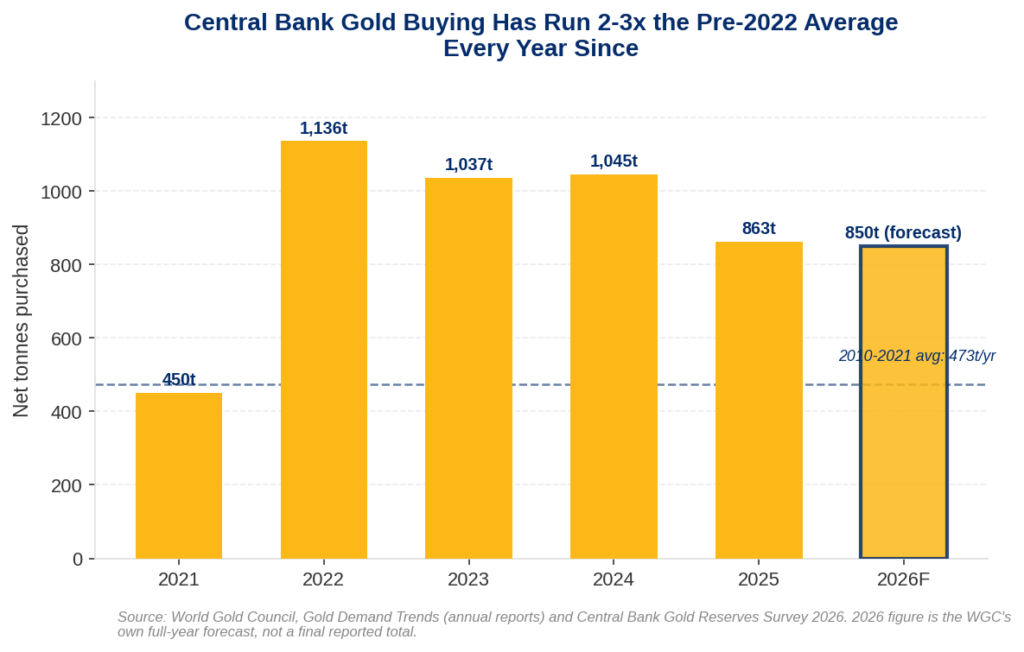
As of early October 2026, the most recent full-quarter figure is Q2 2026’s reported 289 tonnes. That is a record for a single quarter, according to World Gold Council data. Zoom out to the annual picture, though, and the pattern is even clearer (Chart 1). Per World Gold Council data, central banks averaged just 473 tonnes a year between 2010 and 2021. Every year since 2022 has run two to three times that average. The Council’s own full-year forecast for 2026 continues the trend.
The World Gold Council’s Q3 2026 report is expected in early November. It will be the next real test of whether the Q2 pace held through the autumn price correction. Even so, one thing is already clear from the survey data: reserve managers are not treating the recent pullback as a reason to pause. Official buying historically moves on a multi-year mandate, not on a 90-day price chart. And the 2026 survey results, fielded before the correction, already captured record forward-looking buying intentions.
Second Corner: Is Central Bank Buying the Whole Story?
The surface read on this data is simple: central banks are buying, so gold is in a structural bull market, full stop. That take is directionally right, but it is incomplete.
Reserve managers, notably, do not buy without limit. Most survey respondents point to a conventional target of 15-20% of total reserves held in gold. That is a ceiling most major holders have not yet reached, though they are visibly moving toward it. In other words, this is a multi-year glide path toward a destination, not an infinite climb. The deeper dynamic worth watching, then, is not whether central banks keep buying. The data already answers that question. Instead, watch how close each country sits to its own ceiling. That is what will eventually slow official demand, regardless of price.
What Does This Mean for an Individual Investor?
A reserve manager diversifying out of concentrated dollar exposure is running a familiar kind of logic. Specifically, it is the same logic a household runs when it avoids keeping its entire net worth in one bank, one currency, or one employer’s stock. The scale is different. Still, the underlying reasoning is not.
Central banks, crucially, are not buying gold because they expect it to double next year. Rather, they buy it because an asset with no counterparty is a sensible piece of a portfolio. That portfolio is built to survive a scenario where a single financial system stops cooperating. An individual saver can apply that same reasoning at their own scale.
Stay On Top of Gold & Silver Prices
Get important market alerts sent straight to your inbox.
People Also Asked
What percentage of global reserves is gold?
Gold’s share of total global reserves has nearly doubled over the past 25 years. It has moved from roughly 10% to close to 20%, per IMF-based estimates. Notably, that shift happened even as the dollar’s own share fell over the same period.
Is de-dollarization the same as the dollar collapsing?
No. In fact, the dollar still settles the large majority of global trade invoicing and payment messaging. Instead, de-dollarization is a slow shift in how reserves are spread out, not a sudden break. Treating the two as the same thing overstates what the data supports.
Should individual investors care about what central banks are doing with their reserves?
The direction, if not the scale, is informative. Specifically, a reserve manager’s job is to manage risk over many years, not to make a trading call. For that reason, this same pattern, seen across dozens of countries for four years running, is a reasonable guide for a long-term allocation decision.
How much gold did central banks buy in 2026?
Central banks bought a reported record 289 tonnes in the second quarter of 2026 alone, per World Gold Council data. The Council’s own full-year forecast for 2026 is approximately 850 tonnes. In short, that continues a run averaging roughly 1,000 tonnes a year since 2022. That is well above the 473-tonne average seen between 2010 and 2021.
Which central banks are buying the most gold?
Reported 2026 activity includes Poland, at 82 tonnes toward a 700-tonne target. It also includes Turkey, at 45 tonnes in January, and China, now on a 21st consecutive month of buying with disclosed holdings near 2,366 tonnes. Notably, China and Russia are both widely believed to buy more gold than they report, based on years of World Gold Council commentary.
Why don’t central banks just hold more US Treasuries instead of buying gold?
Treasuries pay interest and gold does not. That is a real cost. However, Treasuries are also a direct claim on the US banking system. The 2022 freezing of Russian reserves showed that claim can be cut off by a political decision. By contrast, gold held at home has no such risk. That is the tradeoff reserve managers are choosing to make.
SOURCES
1. World Gold Council – Central Banks Set to Step Up Gold Buying Over the Next Year – June 16, 2026
2. World Gold Council – Gold Demand Trends, Full Year 2023: Central Banks – January 31, 2024
3. Mining.com – Central Banks’ Gold Buying Momentum Carries Into 2026 – March 2026
4. Mining.com – 2022 Was Record Year for Central Bank Gold Buying, WGC Confirms – Early 2023
5. OilPrice.com – Central Banks Continue Gold Buying Spree – Early 2023
6. Modern Diplomacy – Central Banks Are Buying Gold Like De-Dollarization Is Already Happening – September 14, 2026
7. Discovery Alert – Central Bank Gold Purchases: 2026 Market Analysis – March 2026
8. Canadian Mining Report – Central Banks Are Still Buying Gold: Here’s Why – March 2026
9. Canadian Mining Report – Central Banks Keep Buying Gold as Government Debt Mounts – August 2026
10. bne IntelliNews – Dollar’s Grip on Global Reserves Slips to Lowest Level This Century – July 13, 2026
11. Central Banking – Dollar’s Share of Foreign Reserves Fell Slightly in Q2 – IMF – September 30, 2026
12. FXStreet – 2024 Started as 2023 Ended With Central Banks Buying More Gold – March 7, 2024
13. Incomeshares – Central Bank Gold Reserves: How Much Do They Hold? – March 3, 2025
14. GOLDINVEST.de – Gold Remains in Demand: World Gold Council Sees New Central Banks on the Buyer Side in 2026 – May 2026
Disclaimer: This article is for informational purposes only and does not constitute investment advice. Past performance is not indicative of future results. Always consult a qualified financial advisor before making investment decisions.
You May Also Like:
- Proof Gold Coins: Same Gold, So Why the Bigger Price?
- Silver Fell Harder Than Gold in September. The Solar Thrifting Story Isn’t Why.
- K-Shaped Economy: Why Asset Owners Win and Wage Earners Don’t
- Gold in Medicine: Dental, Surgical, and Pharmaceutical Uses Explained
- What Is Gold Backwardation? The Rare Signal That Struck 3 Times in 2025
- A Bank Just Said the Fed Isn’t Done Hiking. Here’s the Math on What That Does to Gold.
- Gold Fell 23% This Year. One Number Explains Why.
- What Is the Debt-to-GDP Ratio, and What the US Number Tells You About Gold