Silver Rises Over 120% YTD




If you’ve ever followed the gold market closely, you’ve probably asked yourself: what is COMEX, and why does it seem to move gold prices every single day?
Even investors who own physical bullion often don’t realize that the global gold price isn’t set by dealers selling coins or vaults storing bullion. It’s largely driven by trading activity on a futures exchange in New York — the Commodity Exchange, better known as COMEX.
Understanding how COMEX works is essential if you want to make sense of short-term price swings, volatility, and the sometimes puzzling disconnect between futures contracts — often called ‘paper gold’ — and physical demand.
Let’s break it down.
What Is COMEX?
COMEX (the Commodity Exchange) is a division of CME Group, based in New York, where futures contracts for gold, silver, copper, and other metals are traded.
Originally founded in 1933, COMEX became the dominant marketplace for precious metals futures. Today, it functions as the primary price discovery mechanism for gold worldwide. In practical terms, it’s where the global gold price is established each trading day.
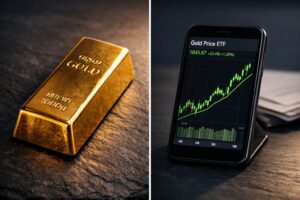
When you see “gold is trading at $5,000 per ounce,” that price is typically derived from the most active COMEX gold futures contract — not from physical bullion transactions.
That distinction matters more than most investors realize.
The Financial System Isn’t Safer — And You Know It As risks mount, see why gold and silver are projected to keep shining in 2026 and beyond.
How Gold Futures Pricing Works
A gold futures contract is a standardized agreement to buy or sell a specific amount of gold (usually 100 troy ounces) at a predetermined price on a future date.
For example:
- A trader buys a December gold futures contract at $5,000 per ounce.
- That contract represents 100 ounces.
- The total contract value is $500,000.
Importantly, the trader does not pay $500,000 upfront. Futures contracts are leveraged instruments, meaning only a fraction of the total value (also known as margin) is required to control the position.
But here’s the key: most traders never intend to take delivery of 100 ounces of gold.
Instead, they’re speculating on price movements.
If gold rises to $5,200, the trader can sell the contract before expiration and capture the $200 per ounce gain — or $20,000 on the contract. If gold falls, they take a loss. In most cases, the position is settled financially rather than through physical delivery.
In other words, COMEX is primarily a financial marketplace — not a physical gold warehouse.
Why Most Contracts Never Result in Delivery
Despite representing enormous quantities of gold on paper, only a small fraction of COMEX contracts ever result in physical delivery.
In most months, typically less than 5% of outstanding contracts actually go to delivery. The rest are closed out, rolled forward, or settled financially before expiration.
Why?
Because the majority of participants are:
- Hedge funds
- Institutional traders
- Banks
- Algorithmic trading firms
They’re trading for price exposure, leverage, or hedging purposes — not to take possession of metal and store it in a vault.
This dynamic creates what many investors refer to as the “paper gold market.” On any given day, the total gold represented by open COMEX contracts can exceed the amount of registered gold available for delivery by a wide margin.
That doesn’t mean the system is fraudulent. It simply reflects how futures markets are structured. They are designed primarily for liquidity, price discovery, and risk management — not for mass physical settlement.
Still, this structure explains something important…
Why Physical Demand Can Diverge from Paper Prices
There are times when coin shops report shortages, premiums on physical gold rise, retail demand surges, and central banks aggressively accumulate bullion — and yet the gold price stalls or even drops.
How is that possible?
Because short-term pricing is driven primarily by futures flows, not by physical coin sales.
If hedge funds unload large volumes of contracts, gold prices can fall quickly — even when physical demand is strong beneath the surface. Conversely, heavy speculative buying on COMEX can push prices sharply higher, even if retail investors are relatively quiet.
This dynamic creates temporary disconnects between “paper gold” markets and physical gold markets — which is one reason many long-term investors focus less on daily price swings and more on owning physical metal outright.
Over time, underlying supply and demand still matter. But in the short run, COMEX trading activity often dominates price action.
Does COMEX Control Gold Prices?
COMEX does not “control” gold prices in the sense of centrally planning them. Rather, it functions as the primary marketplace where buyers and sellers meet to establish price through competitive bids and offers.
However, because futures trading volume is so large — often many multiples of annual global mine production — financial flows can outweigh physical fundamentals in the near term. For long-term investors, this is critical to understand.
Gold’s underlying drivers — inflation, currency debasement, real interest rates, central bank accumulation, geopolitical instability — tend to assert themselves over time.
But day-to-day volatility? That’s often driven by positioning in the futures market.
Why COMEX Matters to Physical Gold Investors
If you own physical gold as a hedge against inflation or systemic risk, you may feel disconnected from the futures market.
But COMEX still matters — because it determines the spot price used to value your holdings, drives short-term volatility, influences investor sentiment, and shapes media narratives around gold.
Understanding how COMEX works changes how you interpret price movements. Instead of reacting emotionally to daily swings, you begin to distinguish between structural demand for hard assets and short-term speculative positioning.
That perspective can be powerful.
The Bigger Picture: Paper Markets vs. Monetary Reality
Gold has served as a monetary anchor for thousands of years.
Futures markets are modern financial overlays — useful for liquidity and price discovery, but ultimately derivative of the underlying asset.
When confidence in financial systems is high, paper markets dominate. When confidence cracks — during inflationary cycles, currency instability, or geopolitical stress — physical gold demand tends to assert itself more forcefully.
That’s why seasoned investors don’t just watch the price.
They monitor:
- Central bank accumulation
- Real interest rates
- Debt levels
- Currency trends
- Delivery volumes on COMEX
Because over the long run, monetary fundamentals matter far more than short-term leverage.
Final Thoughts: Why Understanding COMEX Gives You an Edge
If you’re serious about protecting purchasing power, you can’t afford to ignore how the gold price is set.
Understanding what COMEX is, and how futures positioning influences short-term price movements, helps you:
- Stay rational during volatility
- Separate short-term noise from long-term trends
- Avoid panic during paper-driven selloffs
- Build conviction in your allocation strategy
Gold isn’t just another asset. It functions as monetary insurance.
And the more you understand the mechanics behind pricing, the more confidently you can navigate volatility — and position yourself for what comes next.
Investing in Physical Metals Made Easy

People Also Ask
What is COMEX and how does it affect gold prices?
COMEX is the primary futures exchange where gold contracts are traded, and it plays a central role in setting the global gold price. Most short-term price movements are driven by futures trading activity rather than physical coin or bar sales. Understanding this helps investors interpret volatility more clearly.
Does COMEX control the price of gold?
COMEX doesn’t centrally “control” gold prices, but it is the main marketplace where buyers and sellers establish price through futures contracts. Because trading volumes are so large, financial flows can influence short-term price movements more than physical supply and demand.
Why doesn’t most COMEX gold trading result in physical delivery?
The majority of futures traders are speculating on price changes or hedging risk — not taking possession of gold. In most months, only a small percentage of contracts go to delivery, with most positions settled financially before expiration.
Why can gold prices fall even when physical demand is strong?
Short-term gold pricing is often driven by futures market positioning. If large institutional traders sell contracts, prices can decline even when coin shortages or rising premiums signal strong physical demand. Over time, however, underlying fundamentals tend to reassert themselves.
What is the difference between paper gold and physical gold?
“Paper gold” refers to financial instruments like futures contracts that track the price of gold without requiring ownership of the metal. Physical gold, by contrast, involves direct ownership of coins or bars. Many long-term investors prefer physical gold as a hedge against systemic risk.
You May Also Like
- What Are Margin Requirements? Why CME’s Hike Triggered a Silver Crash
- Why Margin Hikes Could Make Gold and Silver Prices More Volatile
- Silver Price Forecasts Revisited: Why Wall Street Got It Wrong
- Why Metals Dominated Every Asset Class in 2025 [and What It Means for 2026]
- Best Investment Of 2026: Silver’s Setup Is Hard To Ignore