Silver Rises Over 120% YTD




Published: 08-20-2026, 05:01 pm
Key Takeaways
- Sound money is money whose supply cannot be expanded by decree, so it holds purchasing power over time instead of losing it.
- The principle guided 19th-century monetary policy and meant a metallic standard: coins of defined weight, with paper redeemable on demand [Source: Mises Institute].
- Since 1971, the U.S. dollar has lost roughly 87% of its purchasing power, according to Bureau of Labor Statistics data [Source: BLS CPI-U].
- Gold rose from $35 per ounce to above $4,500 over that same period, a gain exceeding 12,000% [Source: goldsilver.com/price-charts/].
- Central banks bought a record 289 tonnes in the second quarter of 2026, the strongest Q2 in the data series, though first-half buying ran below recent years [Source: World Gold Council, Gold Demand Trends Q2 2026].
You earn money, spend it, and try to save some of it. But have you ever asked whether the money itself holds its value?
That question sits at the center of a principle that shaped monetary policy for more than a century. Understanding sound money changes how you read every paycheck and every savings balance. It also explains a puzzle: gold has climbed more than 12,000% since 1971, while the dollar has steadily lost ground [Source: BLS CPI-U; goldsilver.com/price-charts/].
Where Did the Term “Sound Money” Come From?
The phrase entered wide use in the 19th century, as country after country adopted the gold standard. Sound money meant a metallic standard: standard coins representing a defined quantity of metal fixed by law, with token coins and paper redeemable in that metal on demand [Source: Mises Institute, “The Classical Idea of Sound Money”; Cato Institute].
Crucially, the principle was political as well as economic. Ludwig von Mises argued that the demand for sound money first arose in response to rulers debasing the coinage, and that it belonged in the same category as written constitutions and bills of rights. It was a constraint on government power [Source: Mises Institute].
A popular account also traces the phrase to merchants dropping coins to hear whether they rang true, since genuine metal rings and debased metal thuds. That story circulates widely, though the documented usage points to the 19th-century monetary debates rather than to the test itself.
Either way, the underlying distinction still matters. It separates a system where saving rewards patience from one where saving quietly punishes it.
The Knowledge That Changes Everything
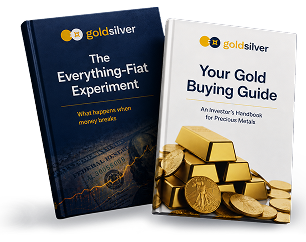
Two essential guides — yours free. Understand why gold matters and why fiat currencies always fail.
How Does Sound Money Differ from Fiat Currency?
Sound money meets three conditions. It stores value reliably, it resists arbitrary inflation, and no institution can create more of it by decree.
Fiat currency meets none of them. The word “fiat” comes from Latin, meaning “let it be done.” Fiat money carries value because a government says it does, so no natural limit caps how much can exist.
The numbers make this concrete. The M2 money supply, which measures the pool of spendable dollars in the U.S. economy, sat near $700 billion in 1971. By June 2026, it reached $23.2 trillion [Source: Federal Reserve H.6 Release, July 28, 2026]. The dollar count multiplied more than 30 times in 55 years, while real economic output grew roughly fourfold.
Consequently, each dollar represents a smaller claim on real goods. The Bureau of Labor Statistics calculates that the dollar has lost roughly 97% of its purchasing power since the Federal Reserve was created in 1913, and about 87% since 1971 [Source: BLS CPI-U].
Why Did the Dollar Leave the Gold Standard?
For most of American history, the dollar connected to gold. Under the classical gold standard, running from the 1870s through World War I, each dollar represented a fixed weight of metal. That arrangement limited money creation and produced notable price stability [Source: Mises Institute].
The link weakened through the 20th century. Congress created the Federal Reserve in 1913. During the Great Depression, the government revalued gold and restricted private ownership. After World War II, the Bretton Woods agreement fixed the dollar to gold at $35 per ounce while other currencies pegged to the dollar.
Then, on August 15, 1971, President Nixon suspended the dollar’s convertibility into gold. Foreign governments and central banks had been redeeming their dollar reserves at an accelerating pace, and the country was issuing more dollars than its gold could cover.
That decision, known as the Nixon Shock, cut the dollar’s final tie to sound money. For the first time in modern history, the world’s reserve currency carried no anchor.
What Has Happened to the Dollar Since 1971?
The results have been consistent and measurable. A dollar held since 1971 now buys roughly 12 cents’ worth of goods and services [Source: BLS CPI-U]. Even over the recent stretch, a dollar held since January 2020 had surrendered about 22% of its purchasing power by early 2026 [Source: BLS CPI-U].
Meanwhile, U.S. national debt has grown from roughly $400 billion in 1971 to $39.9 trillion in August 2026 [Source: U.S. Treasury, Debt to the Penny]. Servicing that debt now costs more than national defense: net interest outlays reached $970 billion in fiscal 2025, and the Congressional Budget Office projects they pass $1 trillion in fiscal 2026 [Source: Congressional Budget Office].
These facts connect. Once no gold anchor restrained money creation, governments could spend without immediate consequence. However, the consequence never disappeared. It simply moved onto anyone holding that currency as savings. Monetary expansion works as a tax on savers.
Why Do Central Banks Still Buy Gold If the Gold Standard Ended?
Here is a detail worth sitting with: the institutions that manage fiat currencies keep accumulating gold.
Central banks bought a net 289 tonnes in the second quarter of 2026, a 62% jump from the same quarter a year earlier and the strongest second quarter in the data series [Source: World Gold Council, Gold Demand Trends Q2 2026]. Poland led with 51 tonnes, and China added 33 tonnes.
The picture is not uniformly one-directional, and honest reading requires saying so. First-half net demand totalled 345 tonnes, the lowest since 2022, because Turkey, Russia and Azerbaijan sold heavily early in the year. The World Gold Council also revised its first-quarter estimate down sharply, from 244 tonnes to 57 tonnes [Source: WGC].
Nevertheless, intent remains firm. In the Council’s 2026 Central Bank Gold Reserves Survey, 89% of respondents expected global official reserves to rise over the next year, and a record 45% expected to increase their own holdings [Source: WGC Central Bank Gold Reserves Survey 2026].
When the most conservative financial institutions on earth keep adding gold across a price correction, their behavior states something their policy documents do not.
How Does Sound Money Protect Your Savings?
Gold traded at $35 per ounce when Nixon closed the gold window. As of August 2026, it trades above $4,500 [Source: goldsilver.com/price-charts/]. Silver has followed a similar path, climbing from under $2 to the high $60s.
Those gains are not primarily speculative. They mirror the dollar’s decline. Consider the comparison directly: since 1971, U.S. consumer prices rose roughly 725%, while gold rose more than 12,000% [Source: BLS CPI-U; goldsilver.com/price-charts/]. Gold did not become more useful over five decades. The measuring stick shrank, and gold recorded the change.
Therefore, the practical meaning of sound money becomes clear. An asset whose supply is limited by geology rather than by policy holds purchasing power across decades and generations.
For the individual saver, the lesson is direct. Holding wealth entirely in a currency designed to lose value is a slow method of becoming poorer. Allocating part of your savings to physical gold and silver requires no forecast about the future. It requires only that you take seriously what has already happened, repeatedly, to every fiat currency in recorded history.
Stay On Top of Gold & Silver Prices
Get important market alerts sent straight to your inbox.
People Also Ask
Gold and silver are the most widely recognized examples because both are durable, scarce, and impossible to create by decree. Other commodities have served as money throughout history, but these two have proven most resilient across cultures and centuries.
A formal return would require restructuring the global monetary system. For individual savers, though, the more useful question is whether they can apply sound money principles personally by holding assets outside the fiat system.
Appropriate allocation varies by circumstance and goals. The underlying principle is diversification across assets that respond differently to monetary expansion. Even a modest position in physical metal introduces a store of value with a multi-millennia track record.
SOURCES
1. Bureau of Labor Statistics — Consumer Price Index (CPI-U) Historical Data
2. Federal Reserve — H.6 Money Stock Measures, July 28, 2026
3. U.S. Treasury — Debt to the Penny Dataset
4. Congressional Budget Office — The Accuracy of CBO’s Budget Projections for Fiscal Year 2025
5. World Gold Council — Gold Demand Trends Q2 2026: Central Banks
6. World Gold Council — Central Bank Gold Reserves Survey 2026
7. Mises Institute — The Classical Idea of Sound Money
8. Cato Institute — Sound Money in Theory and Practice
9. GoldSilver — Live Gold and Silver Price Charts
Disclaimer: This article is for informational purposes only and does not constitute investment advice. Past performance is not indicative of future results. Always consult a qualified financial advisor before making investment decisions.
You May Also Like:
- Vault Storage vs. Gold ETFs: Who Owns the Gold You Paid For?
- Silver Price Outlook August 2026: Down 47% and Barely Owned
- What Does an Inverted Yield Curve Mean for Gold Prices — and How Do You Use It?
- Gold Price Outlook August 2026: What Three Data Prints in One Week Mean for Your Metals
- 14 Million Coins Sold. Zero Design Changes in 35 Years. Here’s Why Investors Keep Choosing the Philharmonic.
- Two Inflation Numbers Come Out Every Month. The Fed Only Cares About One.
- Why Your Commodity ETF Gives You Almost No Gold — and What That Costs You