Silver Rises Over 120% YTD




Daily News Nuggets | Today’s top stories for gold and silver investors
March 5th, 2026 | Brandon Sauerwein, Editor
Wall Street Just Made a $1.3 Billion Bet on Silver
Jane Street is one of Wall Street’s largest and most sophisticated trading firms. Now it’s making a major move in silver. Regulatory filings show the firm built a $1.3 billion stake in the iShares Silver Trust (SLV) — expanding its holdings by roughly 500 times in a single quarter.
Trades of this size are unusual in the silver market, which is relatively small and thinly traded. The position doesn’t necessarily mean Jane Street is outright bullish. But it does signal expectations for significant price movement — or rising volatility — ahead.
The broader setup supports that read. Industrial demand for silver keeps climbing, driven by solar panels, electronics, and other high-growth sectors. Geopolitical uncertainty is adding a safe-haven bid on top of that. Silver is catching attention from multiple directions at once.
That matters in a market where liquidity is limited. Large institutional positions don’t just reflect expectations — they can help create them. The timing of that move may not be coincidental.

The Iran Conflict Is Choking a Critical Gold Supply Route
The escalating conflict involving Iran isn’t just a geopolitical story — it’s already hitting the gold market. Airlines across the region have canceled flights amid security concerns, grounding the air cargo routes that move bullion between trading centers. The disruption is centered on Dubai, one of the world’s most important gold transit hubs.
Dubai’s role in the precious metals trade is easy to underestimate. The emirate links gold mined in Africa and refined in Europe with the largest consumer markets in Asia — particularly India and China. Industry estimates put roughly 20% of global bullion flows through Dubai every year.
Gold travels by air precisely because of its value and security requirements. That makes flight disruptions unusually damaging. If the conflict drags on, analysts warn the bottleneck could lift regional premiums, tighten physical availability, and add another layer of volatility to an already unsettled market.
Iran Tensions Send Oil Higher — and Inflation Fears With It
Oil prices moved higher Thursday as the escalating conflict involving Iran stoked fears of supply disruptions across the Middle East. Traders are watching the Strait of Hormuz closely. It’s one of the world’s most critical oil shipping routes — and it runs straight through the tension zone.
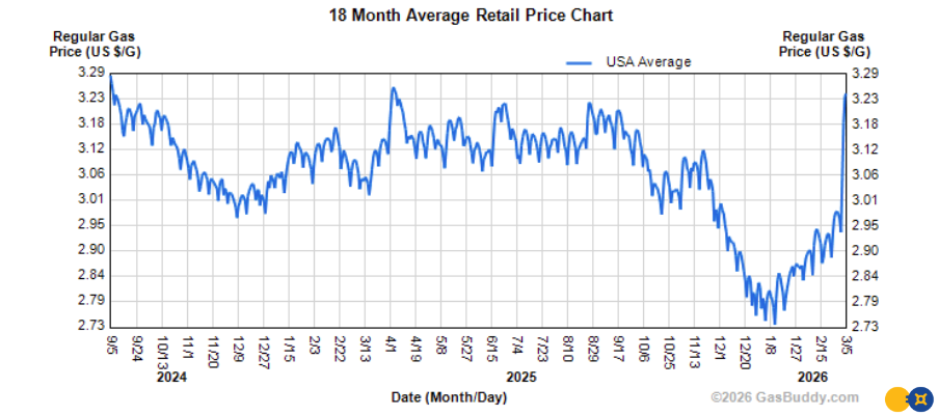
The impact is already showing up at the pump. U.S. gasoline prices have jumped sharply in recent days, reversing months of declines. That chart below tells the story: a long slide, then a near-vertical reversal.
Rising energy prices don’t just stay in the energy market. Oil spikes feed inflation expectations — and that complicates the Federal Reserve’s path on interest rates. Historically, that combination has been supportive for gold.
Gold and Silver Dip — But the Pullback Doesn’t Change the Story
Despite everything covered above, gold and silver prices today slipped in early trading. As of around 10 a.m., gold traded near $5,100 per ounce and silver hovered around $82.40 — both down modestly on the day.
This is a familiar pattern. After sharp geopolitical-driven moves, traders often take profits or rotate into the dollar. That temporary pressure can weigh on metals even when the underlying case hasn’t changed.
It hasn’t changed. Conflict in the Middle East, rising oil prices, and mounting inflation concerns are all still in play. In volatile markets, gold and silver tend to trade choppily — short-term pullbacks within longer-term demand trends. Today looks like one of those pullbacks.
Layoffs Are Slowing — But the Labor Market Isn’t Out of the Woods
Layoff announcements fell last month, offering some relief after a prolonged stretch of workforce reductions. Data from outplacement firm Challenger, Gray & Christmas shows fewer planned job cuts compared to earlier in the year — a sign some companies may be pausing after aggressive cost-cutting.
The context matters, though. Much of the recent trimming came from the tech sector, where firms overhired during the boom years and spent 2024 unwinding that. Even with the recent decline, planned layoffs are still running higher than a year ago.
The broader picture is one of gradual cooling. Higher interest rates and slower growth continue to weigh on hiring plans. A softening labor market could help ease wage pressures — which matters for inflation, and by extension, for what the Fed does next.