Silver Rises Over 120% YTD




Daily News Nuggets | Today’s top stories for gold and silver investors
March 12th, 2026 | Brandon Sauerwein, Editor
The Price of War: Iran War Tops $11 Billion in Week One
The Iran War is entering its second week — and U.S. and Israeli strikes are still expanding across the region. As uncertainty mounts over the length and scope of this campaign, gold prices are rising.
And that’s not the only thing rising. The first week of the Iran War has already topped $11.3 billion. That’s according to Pentagon estimates covering air and naval strikes, missile intercepts, logistics, and fresh troop deployments across the Middle East.
That number will keep climbing. Technologically intensive conflicts burn through advanced munitions and air defense systems fast. Fuel, equipment, and force projection aren’t cheap — and this is just week one.
History offers a clear pattern here. Wars widen deficits. They inject uncertainty into markets. And when both happen at once, capital tends to move toward assets that don’t depend on political stability or government solvency. Gold has filled that role for centuries — and the early market reaction suggests investors are paying attention.

Stay Ahead with Gold & Silver News The most important market insights, Fed updates, and global trends — everything investors need to make smarter, safer decisions.
$200 Oil? Tehran Issues Stark Energy Warning
An Iranian military spokesperson is warning that oil prices could soar to $200 per barrel if U.S. and Israeli strikes against Iran continue, framing the potential spike as a direct consequence of rising instability across the Middle East.
The warning comes as the conflict begins to disrupt global energy flows. Oil has already surged above $100 a barrel after attacks on regional infrastructure and shipping routes in the Persian Gulf. Much of the concern centers on the Strait of Hormuz — the narrow passage connecting Persian Gulf oil to the rest of the world.
If tensions escalate further—particularly if shipping through the strait becomes severely restricted—the result could be a major supply shock. Energy spikes of this scale tend to ripple across the global economy, pushing up fuel prices, worsening inflation, and increasing market volatility. Historically, that kind of environment pushes investors toward hard assets. The gold price response to the Iran War suggests that rotation is already underway.
Iran Leader Signals Hormuz Will Stay Closed
Ayatollah Mojtaba Khamenei, Iran’s new supreme leader, is sending a clear message: the Strait of Hormuz stays closed. The signal suggests Tehran intends to keep maximum pressure on global energy markets — however long this war runs.
The stakes are hard to overstate. About 20% of the world’s oil supply moves through that narrow passage. Persian Gulf producers depend on it to reach buyers in Asia, Europe, and the United States. There is no easy detour.
Tanker traffic is already slowing. Attacks on shipping are increasing. A prolonged closure doesn’t just mean higher oil prices — it means another inflation shock hitting an already fragile global economy, at exactly the moment central banks are running out of room to respond.
The Biggest Emergency Oil Release in History Didn’t Stop Prices From Rising
The International Energy Agency just triggered the largest coordinated reserve release in its 50-year history — roughly 400 million barrels from strategic stockpiles across more than 30 countries.
The goal: stabilize energy markets after the Iran conflict choked off shipments through the Strait of Hormuz. About one-fifth of the world’s oil supply moves through that narrow passage. When it’s disrupted, the whole global economy feels it.
But here’s what the market said in response: oil still went up.
WTI crude climbed more than 4% on the day of the announcement. That’s the market sending a clear message — the disruption is bigger than any emergency lever can quickly fix. Past reserve releases followed crises like the Gulf War, Hurricane Katrina, and Russia’s invasion of Ukraine. This one is already in that company, and the conflict is still in its second week.
When the largest reserve release in history can’t move prices in the right direction, that tells you something about the scale of what we’re dealing with.
Gold Price Rises Amid Iran Conflict as Metals Continue Climb
The gold price is pushing back toward $5,200 as the Iran war continues to drive safe-haven demand. Silver jumped roughly 2% today to $87. Both metals are up approximately 20% year-to-date — while the S&P 500 and Nasdaq sit in negative territory.
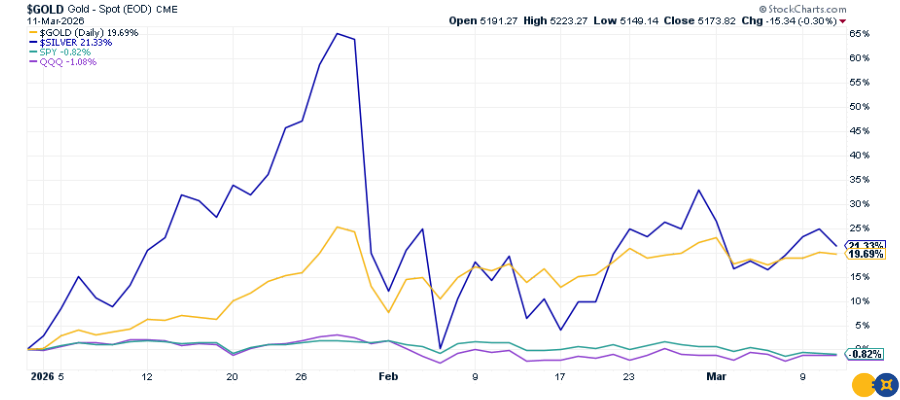
What makes this rally notable isn’t just the gains — it’s the resilience behind them. Earlier this year, precious metals posted two of their largest single-day declines on record. Confidence briefly wavered. Then prices snapped back, signaling that demand underneath the volatility remains strong.
Gold has now held above $5,000 for roughly 30 days. That kind of sustained support suggests a new price floor may be forming — not a speculative spike. Silver has tracked closely behind, drawing interest from investors who want both industrial exposure and monetary protection.
While equities have struggled under the weight of war headlines, tariff uncertainty, and recession fears, gold and silver have quietly compounded. In a year that has thrown nearly everything at markets, the metals are doing exactly what they’re supposed to do.
Investing in Physical Metals Made Easy