Silver Rises Over 120% YTD




Published: 06-12-2026, 11:57 am
The Strait of Hormuz has been closed since February. That single fact drove oil above $90, pushed US inflation to 4.2%, pinned the Fed in place, and sent gold down more than 20% from its January high — not because the world got safer, but because war-driven inflation gave the Fed no room to move.
On Friday, a peace deal emerged. And for the first time since March, that entire chain started to reverse.
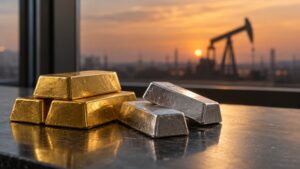
Gold August futures opened at $4,234.90, up 3.4% from Thursday. Silver futures opened at $67.49, up 5.5%. Both metals then pulled back as traders weighed whether the deal was real. By mid-morning, gold had settled near $4,205 and silver near $66.91 (goldsilver.com/price-charts/, June 12, 2026).
The retreat is not confusion. It reflects exactly what Ole Hansen, head of commodity strategy at Saxo Bank, warned: “After more than 30 similar announcements over the past couple of months, investors have become increasingly cautious about taking such signals at face value.” Watch what Iran does at the table, not what any party claims in the media.
What follows is the mechanism behind today’s move — and the four surrounding stories that explain what it means for long-term holders of gold and silver.
Why Did Oil Fall — and What Does That Mean for Gold?
Oil dropped sharply on Friday. US crude futures fell approximately 1.6%. Brent fell roughly 1.75%.
That move matters for gold — not because the two assets always travel together, but because of the specific chain connecting them right now.
The Iran conflict began on February 28, 2026, with the closure of the Strait of Hormuz. The strait carries roughly 25% of the world’s seaborne oil. Closing it sent Brent from around $72 per barrel before the strikes to approximately $96 by late May (Staunovo, UBS, April 2026). That oil surge fed directly into US inflation. May CPI came in at 4.2%. The Federal Reserve, already managing a stubborn post-pandemic inflation cycle, had no room to cut rates. Rate-hike odds climbed above 70% by early June.
Higher rates mean higher real yields. Higher real yields are gold’s primary short-term headwind. That chain — war, oil, inflation, yields, gold pressure — is why gold fell more than 20% from its January high even as the structural case for owning it strengthened.
Friday’s oil drop reverses that chain at the first link. A reopened strait means lower energy costs. Lower energy costs reduce the inflation pulse that has been pinning the Fed’s hands. A less constrained Fed means lower real yields over the following 12 to 18 months.
Gold is not surging because a peace deal is good news in a general sense. Gold is repricing because a peace deal removes the specific mechanism that has been working against it since March.
Why this matters for long-term holders: The structural case for gold — fiscal deficits, currency debasement, central bank accumulation — never changed during this drawdown. What changed was one temporary, war-driven headwind. Friday’s oil move is early evidence that headwind may be lifting.
The Edge Every Investor Needs Smarter precious metals investing starts here. The Nuggets Newsletter brings you essential market insights, Fed updates, global trends, educational videos, and much more.
What Is the Gold Price Today, June 12, 2026?
Gold August futures opened at $4,234.90 per troy ounce on Friday. That represented a 3.4% gain from Thursday’s opening price.
As of mid-morning, gold had moderated to approximately $4,205 per ounce (goldsilver.com/price-charts/). The initial surge reflected relief buying. The pullback reflected caution about whether the deal would hold.
Ole Hansen, head of commodity strategy at Saxo Bank, framed it plainly. “After more than 30 similar announcements over the past couple of months, investors have become increasingly cautious about taking such signals at face value,” he said. “Gold traders appear to be taking the same view: forget what Trump says and focus instead on what the Iranians do” (Hansen, Saxo Bank, June 12, 2026).
That is the right frame for now.
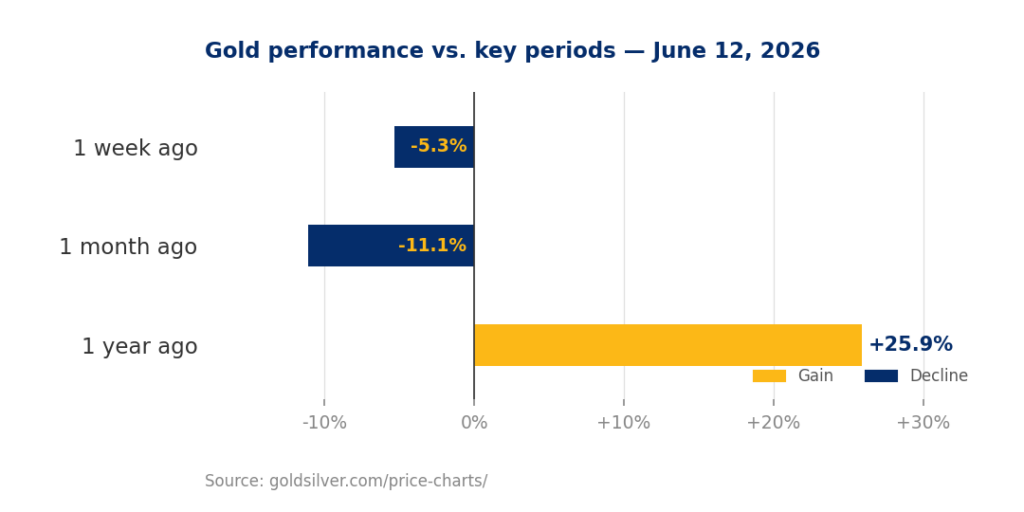
Context for long-term holders: Gold’s year-over-year gain stands at +25.9% as of Friday. The recent drawdown from January’s peak is real. The structural drivers that produced that run have not changed.
What Is the Silver Price Today, June 12, 2026?
Silver July futures opened at $67.49 per ounce on Friday. That was a 5.5% gain from Thursday’s close.
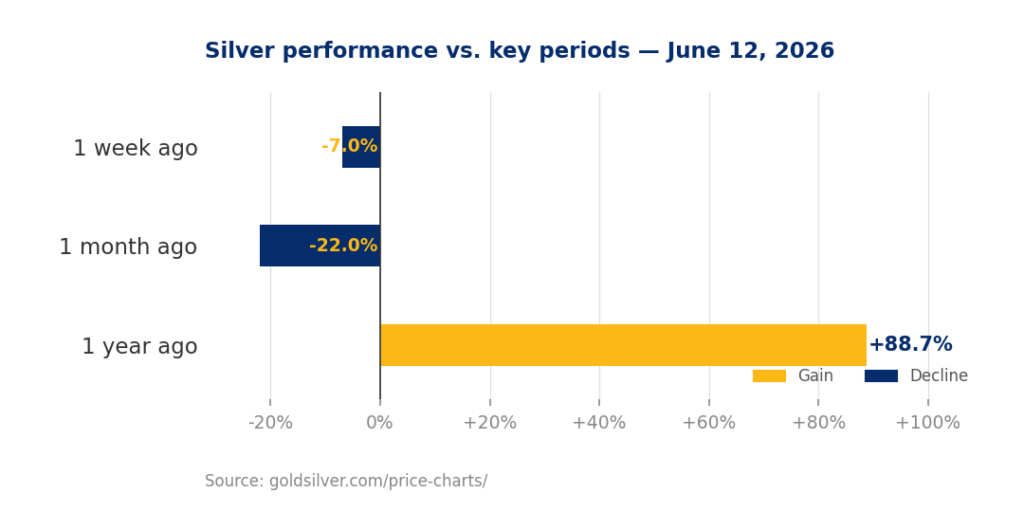
By mid-morning, silver had settled near $66.91 per ounce (goldsilver.com/price-charts/). Like gold, silver’s move reflected the same geopolitical catalyst. Both metals responded to the Iran peace deal news. Both then partially retraced as traders waited for confirmation.
Hansen’s caution applies equally to silver. Watch what Iranian officials do at the negotiating table, not what any party claims in the media.
Does Selling Silver Trigger a Higher Tax Rate Than Stocks?
Yes — and most investors do not know this.
The IRS classifies physical silver as a collectible. That changes how long-term gains are taxed. For most stocks, long-term capital gains are taxed at 0%, 15%, or 20%. For physical silver held more than one year, gains are taxed at your ordinary income rate. However, that rate is capped at 28%.
In practice, this means the following. If you are in the 22% or 24% bracket, silver gains are taxed at that same rate. If you are in the 32%, 35%, or 37% bracket, the 28% cap applies — still higher than the 20% maximum on most equity gains.
This is a planning consideration, not a reason to avoid silver. Understanding the tax treatment upfront allows you to structure ownership more efficiently.
What Are the Terms of the US–Iran Peace Deal?
Iranian state media published a 14-point draft agreement on Friday. The document reportedly includes three core elements.
First, Iran pledges to reopen the Strait of Hormuz within 30 days. Second, the US would lift oil sanctions and unfreeze Iranian funds. Third, the US and its allies would present reconstruction plans for Iran worth at least $300 billion (Mehr News Agency, June 12, 2026).
All American forces would need to withdraw from Iran under the reported terms.
Bloomberg separately reported the deal could be signed as soon as Sunday in Switzerland, ahead of the G7 summit running June 15–17 in Evian, France. Iran’s Foreign Ministry cautioned that the time and location remain unconfirmed.
The Strait of Hormuz is a critical global trade route. Before the conflict began on February 28, 2026, roughly 25% of the world’s seaborne oil trade and 20% of global LNG passed through it (2026 Strait of Hormuz crisis, Wikipedia; US-Iran ceasefire and nuclear talks in 2026, House of Commons Library).
Markets moved decisively on Friday. The pan-European Stoxx 600 gained 1.8%. US crude oil futures fell approximately 1.6%. Brent fell roughly 1.75%.
Notably, gold’s reaction was more measured than the equity reaction. That divergence is meaningful. Gold is not trading this as a short-term relief event. It is pricing gradually, as it does when geopolitical uncertainty partially resolves and real-yield dynamics reassert themselves as the primary driver.
How Will Kevin Warsh Change How the Fed Communicates?
Kevin Warsh was sworn in as the 17th Federal Reserve chair on May 22, 2026. His first FOMC meeting is scheduled for June 16–17 (Chase, What To Expect at Kevin Warsh’s First Federal Reserve Meeting).
Warsh has not committed to holding a press conference after every meeting. His predecessor Jerome Powell held one after each meeting. That potential shift matters for how investors read Fed signals.
Warsh has long argued that the Fed communicates too much. In his view, over-communication has created policy errors. He believes the Fed has oversteered markets by telegraphing rate decisions too far in advance.
“If one has a press conference, one wants to deliver some important news,” Warsh said at his Senate confirmation hearing on April 21, 2026.
His concern is specific. When the Fed pre-signals a rate path, internal pressure builds to follow through — even when conditions have changed. The result is policy that trails reality rather than responds to it.
The immediate question heading into next week: will Warsh remove the so-called “easing bias” from the FOMC statement? That phrase signals the committee leans toward further rate cuts. Three members dissented at the last meeting. They wanted the Fed to stop leaning toward cuts. JPMorgan chief economist Michael Feroli told reporters that Warsh is unlikely to openly signal rate hikes — but could signal a more neutral stance (Feroli, JPMorgan, June 2026).
Warsh has also expressed skepticism about the “dot plot” — the Fed’s published chart of officials’ rate forecasts. He believes publishing those forecasts too early causes the Fed to hold positions longer than warranted (Warsh, Senate testimony, April 21, 2026).
Why this matters for precious metals: Rate expectations drive real yields. Real yields drive gold’s opportunity cost. A quieter Fed does not change the fiscal arithmetic. It makes the short-term path harder to read. For long-term holders, the mechanism remains the same: when fiscal deficits widen, currencies face debasement pressure, and real rates eventually compress, gold’s structural case reasserts itself. That outcome does not depend on what the Fed says next week. It depends on what governments spend over the next decade.
What Should Gold and Silver Investors Watch Next?
The most important date on the calendar is June 16–17 — Warsh’s first FOMC meeting. Three things are worth tracking.
First, watch whether the easing bias is removed from the policy statement. Removal signals the Fed is moving to neutral. That alone would shift rate-cut expectations forward.
Second, watch the oil market’s reaction to any deal confirmation over the weekend. A Brent print below $90 would be the clearest early signal the inflation chain is reversing.
Third, watch gold’s behavior at the $4,200 level. That is the immediate support. A close above $4,250 on confirmed deal news would indicate the market has moved from pricing hope to pricing reality.
Key Takeaways
- The oil drop is the real story. The Hormuz closure sent Brent from $72 to ~$96, fed 4.2% CPI, and gave the Fed no room to cut — that is the specific mechanism that pushed gold down 20% from January. Friday’s oil decline reverses that chain at its first link.
- Gold and silver both surged then retreated. August gold futures opened at $4,234.90 (+3.4%); July silver opened at $67.49 (+5.5%). Both pulled back to ~$4,205 and ~$66.91 by mid-morning as traders applied caution to unconfirmed deal terms.
- Warsh’s first FOMC meeting on June 16–17 is the next structural signal. Removal of the easing bias — widely expected — would confirm the Fed is moving to a neutral stance, shaping the real-yield environment that drives gold’s opportunity cost over the next 12 to 18 months.
Stay On Top of Gold & Silver Prices
Get important market alerts sent straight to your inbox.
SOURCES
1. Saxo Bank — CNBC — For Warsh as Fed Chair, Silence May Be the Point
2. UBS Research — UBS — Iran War Volatility Has Boosted Commodities Across the Complex
3. Mehr News Agency — Iranian State Media, June 12, 2026 (14-point draft agreement terms)
4. US Energy Information Administration — EIA — Strait of Hormuz World Oil Transit Chokepoints
5. International Energy Agency — IEA — Strait of Hormuz Oil Security
6. House of Commons Library — CBP-10637 — US-Iran Ceasefire and Nuclear Talks in 2026
7. Federal Reserve — Federal Reserve — Kevin Warsh Sworn In as 17th Chair, May 22, 2026
8. Fortune — Fortune — Trump Says Fed Rate Increase Would Be Wrong Ahead of Warsh Debut
9. CNBC — CNBC — For Warsh as Fed Chair, Silence May Be the Point
10. US Senate Banking Committee — Senate Banking Committee — Kevin Warsh Confirmation Hearing Testimony, April 21, 2026
Disclaimer: This article is for informational purposes only and does not constitute financial or investment advice. Always consult a qualified financial adviser before making investment decisions.
You May Also Like:
- Silver Fell 22% in 30 Days. Gold-Silver Ratio Hits 63.
- Every Bearish Catalyst Landed at Once. Gold and Silver Went Up Anyway.
- Gold at Seven-Month Lows: Why Geopolitical Fear Is Not Enough
- Gold Slides to $4,130 as Iran War Turns Inflation Against It
- May CPI Printed 4.2%. Core Inflation Beat. So Why Did the Gold Price Drop?
- Gold Is Down 9%. The CPI Print That Could Either Extend the Drop — or End It.
- Gold Price News: Goldman, China, CPI, and the Fed Explained
- Gold Near $4,330 as Rate-Hike Bets Hit 70% and China Acts
- Gold Is Down 22% — The Same Drop as 2022. The Floor Is Not the Same.
- Silver Falls 6% on Jobs Beat. The Six-Year Deficit Didn’t.