Silver Rises Over 120% YTD




🌆 Evening News Nuggets | Today’s top stories for gold and silver investors
April 9th, 2026 | Brandon Sauerwein, Editor
The Iran ceasefire is already fraying, the Fed is publicly divided, and gold Federal Reserve policy uncertainty is at a cycle peak. Here’s what today’s news means for your money.
What’s Next for the US-Iran Ceasefire?
The two-week ceasefire between the U.S. and Iran is barely 48 hours old — and already on shaky ground. President Trump posted overnight that the U.S. military is “loading up and resting, looking forward to its next conquest.” Iran, meanwhile, accused Israel of breaching the deal by launching strikes on Lebanon that killed at least 182 people on Wednesday [CNBC]. Tehran warned it would be “unreasonable” to proceed with permanent peace talks under those conditions.
The core disagreement centers on the Strait of Hormuz. Trump says the ceasefire requires Iran to immediately and completely reopen the waterway. Iran says safe passage is possible — but only through coordination with its armed forces. Those are two very different things. An estimated 2,000 ships are still waiting to transit [NPR].
VP JD Vance is heading to Islamabad Friday for direct talks brokered by Pakistan. Iran has submitted a 10-point counterproposal that includes demands for the withdrawal of all U.S. combat forces from regional bases, the lifting of all sanctions, and the release of frozen Iranian assets [CNBC]. Trump called the plan a “workable basis” for negotiation — but also labeled the version reported by the NYT and CNN as “totally fake.”
After more than five weeks of fighting, Trump’s original war goals — regime change, halting Iran’s nuclear program, and seizing the Strait — remain largely unmet [NPR]. Defense Secretary Hegseth countered that Iran has been rendered “combat ineffective for years to come.” But the Council on Foreign Relations noted that Iran now holds leverage over the Strait of Hormuz that it did not have before the war began.

Stay Ahead with Gold & Silver News The most important market insights, Fed updates, and global trends — everything investors need to make smarter, safer decisions.
Where Did Gold and Silver Prices Land After the Ceasefire Volatility?
Gold closed at $4,765.65 per ounce on Wednesday, up 1.1% on a session that ranged from $4,699 to $4,801[Investing.com]. Silver settled at $75.59, up 2.5%, after swinging between $72.89 and $76.62.
Both metals spiked sharply the day before, when the ceasefire was announced. Gold touched $4,856 and silver hit $77.82 on Tuesday before giving back most of those gains on a broad equity relief rally.
Gold & Silver Prices — 2026 Year-to-Date
Daily closing prices · Source: Investing.com
Gold — Apr 9 Close
Silver — Apr 9 Close
Gold and silver have had a brutal 2026 so far — despite both being up on the year. Gold peaked at $5,400 on January 28 before crashing nearly 10% the next day. Silver’s move was even more violent — it closed at $116.61 on January 28, then lost 27% in a single session on January 30 [Investing.com]. Both metals partially recovered in February, with gold climbing back to $5,277 by February 27 — the last trading day before the war began.
The war gave gold a brief second wind. On March 2, the first trading day after the U.S.-Israel offensive, gold closed at $5,327. But the rally didn’t hold. Oil above $100 reignited inflation fears. Rate-cut expectations evaporated. And a broader cash scramble dragged both metals lower through March. Gold bottomed at $4,380 on March 26 — down 18% from its January high. Silver fell to $67.79 on March 20, down 42% from its peak.
As of Wednesday, gold is up 9.7% on the year. Silver is up 4.0%.
None of that changes the longer-term picture. The “debasement” and “de-dollarization” trades that powered gold’s 65% gain in 2025 haven’t gone anywhere. U.S. debt-to-GDP now exceeds 120%. Defense spending is climbing. And central banks, particularly in emerging markets, keep buying. China’s gold reserves still represent just 8% of its total reserve assets. That leaves 92% denominated in dollars or allied currencies — a ratio that looks increasingly untenable given sanctions risk and growing questions about U.S. Treasury credibility.
Short-term, gold can sell off in a cash scramble. It’s happened before. But the macro backdrop driving this cycle — fiscal stress, currency debasement, central bank accumulation — hasn’t changed. If anything, six weeks of war and $100 oil have made the case stronger.
Why Did Oil Prices Snap Back Above $100?
WTI crude jumped back above $100 per barrel on Thursday — up more than 6% to $100.27 by midmorning — after plunging more than 15% the day before [CNBC]. Brent crude swung between gains and losses around $95–$98. The ceasefire, it turns out, didn’t actually open the Strait of Hormuz.
ADNOC CEO Sultan Al Jaber confirmed Thursday that the strait has not opened to ship traffic. Tehran has made clear that vessels must obtain Iranian permission to pass [CNBC]. Iranian state media reported that transit was halted again after Israel’s continued strikes in Lebanon — though the White House disputed this.
The EIA’s Q1 review tells the broader story. Brent crude started 2026 at $61 per barrel and closed the quarter at $118 — the largest quarterly price increase on an inflation-adjusted basis in data going back to 1988 [EIA]. U.S. retail gasoline hit $3.99 per gallon by March 30, while diesel reached $5.40.
For context: roughly 20% of the world’s daily oil and natural gas supply moves through Hormuz. The IEA has warned this disruption could be more severe than the oil shocks of the 1970s [Trading Economics].
Are Rate Hikes Back on the Table for the Fed?
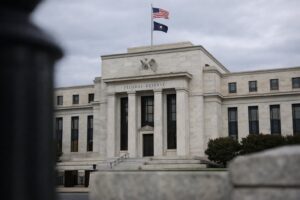
The Federal Reserve released the minutes from its March 17–18 meeting on Wednesday. The short version: the committee is more worried about inflation than it was in January, and the war is making everything harder to forecast.
The committee held rates steady at 3.50%–3.75% for the second consecutive meeting. The vote was 11-1, with Governor Stephen Miran the sole dissent in favor of a cut [Federal Reserve]. The March statement added new language: “The implications of developments in the Middle East for the U.S. economy are uncertain.”
The hawkish lean showed up in the numbers. The “vast majority” of participants said progress toward the 2% inflation target could be slower than expected. Seven of 19 members now project zero rate cuts in 2026, up from six in December [Sensei News]. Some argued for statement language that explicitly acknowledges the possibility of rate increases — not just cuts.
Powell said in March that hikes are “not off the table.” That makes this the first cycle where both cuts and hikes are on the table at the same time.
The next catalyst: March CPI data drops Friday. It will be ‘s the first inflation reading to fully capture the oil price spike triggered by the war. February CPI came in at 2.4% year-over-year [Kraken]. A hot print could kill what’s left of the rate-cut case for 2026.
Investing in Physical Metals Made Easy

Sources: CNBC · NPR · Al Jazeera · Council on Foreign Relations · Bloomberg · Trading Economics · U.S. Energy Information Administration · Federal Reserve · Wells Fargo Investment Institute · Fund Selector Asia / Schroders · Schroders · Kraken · Sensei News · Britannica · Investing.com
Prices as of market close, April 9, 2026. This content is for informational purposes only and does not constitute investment advice. Past performance does not guarantee future results.
This article is for informational purposes only and does not constitute financial or investment advice. Always consult a qualified financial advisor before making investment decisions.
You May Also Like