Silver Rises Over 120% YTD




Published: 05-25-2026, 10:12 am
Key Takeaways
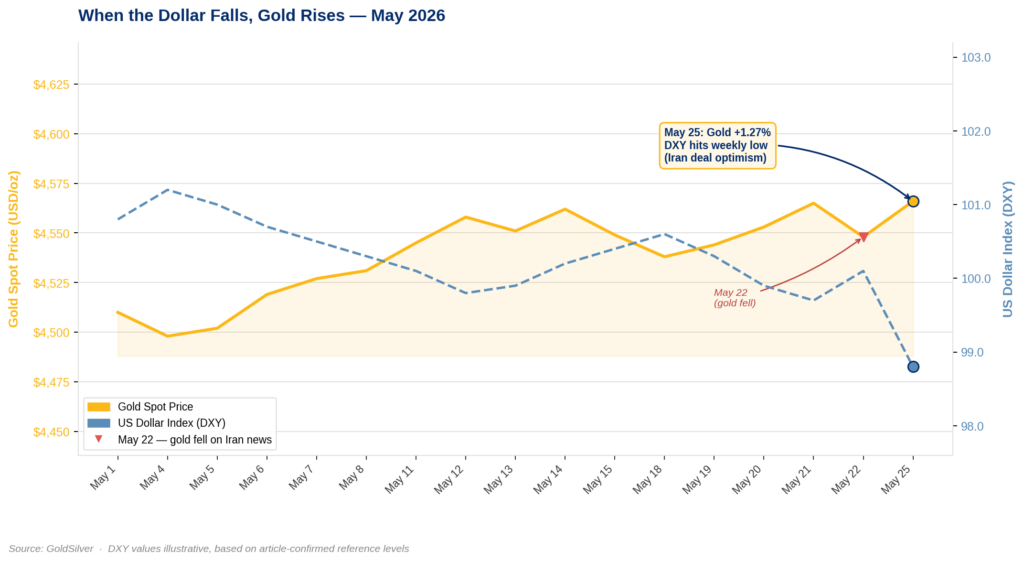
- Gold gained +$57 (+1.27%) to $4,565.99 on May 25 as dollar weakness — driven by US-Iran deal optimism — made gold cheaper for the 95% of global buyers who don’t transact in USD
- The Hormuz deal is not done: Trump confirmed it “isn’t even fully negotiated yet,” Iran has made no commitment on nuclear issues, and Rubio said the US will deal with it “another way” if diplomacy fails
- The long-term thesis is unchanged — nearly $39 trillion in US federal debt, monetary debasement, and central banks buying gold at the fastest pace in decades don’t turn on a single headline
The Iran peace story sent gold price down on May 22. Yet today — Monday, May 25 — the same story sent it up over 1%. Same catalyst. Opposite direction. That’s not a contradiction. It’s a tutorial in how gold actually moves.
Gold jumped +$57 to $4,565.99 on Memorial Day, with US equity and bond markets closed and London setting the price. The trigger: weekend reports that the US and Iran had “largely negotiated” a framework agreement to reopen the Strait of Hormuz.
Three days ago, the same headlines sent gold lower. Understanding why the direction flipped is worth more than any single price alert you’ll read today.
Why Did Gold Fall on Iran News Three Days Ago?
The May 22 move was about inflation. Peace progress pushed oil lower, which cut inflation pressure and gave the Fed slightly more room to hold rates. Markets read that as one less reason to own gold as a hedge. Small move down. Logical.
But what that move wasn’t: investors losing faith in gold. Instead, it was one variable — inflation outlook — ticking down a fraction. The structural floor didn’t budge.
The Edge Every Investor Needs Smarter precious metals investing starts here. The Nuggets Newsletter brings you essential market insights, Fed updates, global trends, educational videos, and much more.
Why Is the Same Story Pushing Gold Higher Today?
However, today’s driver is the dollar, not inflation — a completely different variable. Hormuz optimism dropped oil again, but the bigger knock-on hit currency markets: the US dollar index fell to its lowest level in a week. When the dollar weakens, gold becomes cheaper for every buyer who isn’t paying in US dollars. That’s most of the world.
Consider: a Japanese retiree, a German pension fund manager, a Mumbai jeweler — they all convert local currency into dollars before buying gold. When the dollar drops, they get more gold per unit of their own money. Demand rises. Price follows.
In fact, gold has moved inversely to the dollar for decades. That relationship held perfectly today — weaker dollar, higher gold price — and it explains why the exact same Iran story produced two opposite outcomes three days apart.
What Is the Gold-Silver Ratio Signalling?
Meanwhile, silver’s move tells a separate story worth reading. It gained +3.1% to $77.87 on May 25 — more than double gold’s rise — tightening the gold-silver ratio from roughly 60 to 58.6.
When silver outpaces gold by that margin, it usually means one of two things: risk appetite returning, or industrial demand coming back. Today both are probably in play. Lower oil cuts manufacturing input costs. A weaker dollar makes silver cheaper for buyers across Asia. A Hormuz opening would also ease supply chain pressure that has been squeezing global industry for months.
For context, a compression from 60 toward 50 has preceded some of silver’s strongest runs. In 2020, that ratio fell from 125 to 65 in under a year. Silver’s +3.1% today looks less like a one-day trade and more like the market starting to price in a world that moves again.
Is the Hormuz Deal Actually Going to Happen?
Right now, markets have priced in a deal. The facts don’t fully support it yet.
Trump confirmed on Sunday that the agreement “isn’t even fully negotiated yet.” Three issues remain unresolved: sanctions relief timing, Iran’s nuclear program, and physical control of the waterway post-ceasefire. On Monday, Secretary of State Marco Rubio told reporters in New Delhi the US would reach “a good agreement” or handle Iran “another way.” That’s diplomatic language for: we’re not there yet. A senior Iranian diplomat told state media Iran has made no commitment on nuclear issues.
That gap between “largely negotiated” and “signed” is where deals die.
However, there’s a bear case for today’s rally worth naming. If the deal closes and oil falls hard, dollar weakness reverses and the inflation-hedge argument softens at the same time. In that scenario, both tailwinds flip at once. Anyone holding gold purely on Hormuz optimism owns a fragile position.
What most coverage is missing entirely is the European Central Bank angle. ECB Governing Council member Joachim Nagel said on May 12 that the bank must act if the Iran war threatens price stability. The EU’s own spring forecast now projects eurozone inflation at 3.0% for 2026 — up from 1.9% — driven by the Hormuz energy shock.
Markets are pricing in two ECB rate hikes this year. If the deal falls apart and oil stays high, that number moves higher. A rate-hiking ECB strengthens the euro, weakens the dollar further, and so amplifies the exact mechanism that drove gold up today. The ECB’s rate path has become a second lever on the gold price, and almost nobody is watching it.
Next week’s Personal Consumption Expenditures (PCE) index — the Fed’s preferred inflation gauge — is the first signal to watch. Any Rubio statement out of New Delhi before then is the second.
What Does Today’s Move Mean for the Long-Term Case?
Of course, the Hormuz talks are not the thesis. It’s a daily variable moving through a backdrop that was already pointing one direction.
That environment includes nearly $39 trillion in US federal debt, confirmed by the US Congress Joint Economic Committee as of May 5, 2026. It also includes a Fed caught between stubborn inflation and slowing growth, unable to move in either direction. Furthermore, the dollar has lost over 97% of its purchasing power since 1913. And central banks worldwide have been buying gold at the fastest pace in decades — a trend the World Gold Council tracked through 2022, 2023, and 2024 that hasn’t reversed.
Today’s catalyst was a currency move. Tomorrow it will be something else. What doesn’t change is the pressure underneath.
Gold as of 12:48 UTC, May 25, 2026: $4,565.99 (+1.27%). Silver: $77.87 (+3.11%).
Stay On Top of Gold & Silver Prices
Get important market alerts sent straight to your inbox.
SOURCES
1. nFusion Solutions — Live Spot Price Feed
2. CNBC — Trump Not Rushing Iran Deal
3. Reuters via Al-Monitor — Rubio Says US Will Either Have Good Agreement or Deal With Iran Another Way
4. NPR — US-Iran Peace Deal Emerging, While War Threats Still Loom
5. Bloomberg — ECB Must Act If Iran War Threatens Price Stability, Nagel Says
6. European Commission — Spring 2026 Economic Forecast
7. Reuters via Investing.com — ECB Keeps Rates on Hold and Warns About Iran War Hit
8. US Congress Joint Economic Committee — Monthly Debt Update, May 2026
9. Federal Reserve Bank of Minneapolis — Consumer Price Index Historical Data
10. World Gold Council — Gold Demand Trends Full Year 2024, Central Banks
11. World Gold Council — Historical Gold and Silver Price Data
Disclaimer: This article is for informational purposes only and does not constitute financial or investment advice. Always consult a qualified financial adviser before making investment decisions.
You May Also Like:
- Gold Falls 0.5% on Iran Deal: The Floor Holds
- Is Gold Being Repriced? 5 Major Institutions Say Yes.
- Silver Dropped 12%. Gold Dropped 3%. That Gap Is the Story.
- Gold Price Holds Firm After Hawkish Fed Minutes — Here’s Why
- Why London Still Sets the Gold Price — and Asia Doesn’t
- Gold Price at ~$4,502: Is the Dip a Buy? BofA Says $6,000
- Gold Didn’t Fall on Iran Peace News. That’s the Point.
- Trump Called Off the Strike. Gold’s Real Risk Is Still $39 Trillion.