Silver Rises Over 120% YTD




🌅 Morning News Nuggets | Today’s top stories for gold and silver investors
April 6th, 2026 | Brandon Sauerwein, Editor
Gold and silver prices whipsawed Monday as Iran war tensions collided with ceasefire hopes — here’s what moved markets and what it means for the week ahead.
Is the Iran War Heading Toward a Deal — or an Escalation?
Tuesday’s 8PM deadline is the most consequential moment in weeks for global markets. Trump extended his ultimatum for Tehran to reopen the Strait of Hormuz, while allies Pakistan, Egypt, and Turkey push for a last-minute 45-day ceasefire [Bloomberg]. The goal: head off threatened U.S. strikes on Iranian power plants and bridges before the clock runs out.
But the signals from both sides are hard to reconcile. Trump told Fox News he saw a “good chance” for a deal by Monday. Hours later, a senior Iranian official told Reuters the opposite — Iran won’t reopen the Strait under a temporary ceasefire, won’t accept deadlines, and believes Washington isn’t ready for a permanent one either [CNBC].
That’s not a negotiation. That’s two sides describing different realities.
Brent crude swung from nearly $112 down to $109 as headlines shifted — a preview of what Tuesday night could bring. A deal sends oil lower, relieves inflation pressure, and likely triggers a broad market rally. No deal, and the energy shock gets worse. There’s no middle ground here, which is exactly what makes this week so difficult to trade.
Are Gold and Silver Finding Their Footing?
Gold dropped as low as $4,600 at the open before recovering to $4,679, nearly flat on the day. Silver hit $71.04, then bounced to $73.49, up about 0.5%. The reversal came after Axios reported the U.S. and Iran are discussing a potential 45-day ceasefire [Yahoo Finance].
Gold and silver prices have now fallen more than 12% since the Iran war began in late February. War is supposed to be good for gold. What’s different this time is that the same conflict driving safe-haven demand is also pushing oil above $100 — which feeds inflation fears, strengthens the dollar, and makes rate cuts less likely. That combination squeezes the paper gold market hard.
Monday’s intraday bounce shows the floor is there. But until the Hormuz situation resolves — one way or another — expect metals to keep trading on headlines rather than fundamentals.
Dimon’s Warning: Iran, AI, and the Slow Creep of Sticky Inflation
JPMorgan’s annual shareholder letter is one of the most closely read documents in global finance. Monday’s edition didn’t disappoint. Dimon acknowledged the U.S. economy has real tailwinds — tax cuts, deregulation, AI-driven capital spending. Then he explained why none of that may matter [CNN].
Dimon identified the Iran war as the single biggest threat to gold and silver prices and the broader macro outlook. Oil and commodity shocks, supply chain disruption, sticky inflation — the kind that doesn’t respond neatly to Fed policy. He called it “the skunk at the party — inflation slowly going up, as opposed to slowly going down.” [Yahoo Finance]
That framing should resonate with anyone watching gold. Sticky inflation that keeps rates elevated is exactly the environment where gold’s bull case gets complicated — not broken, but complicated.
Dimon didn’t stop at geopolitics. He flagged private credit markets, where actual losses are already running higher than the environment warrants. He warned AI will “definitely eliminate some jobs” in the medium term, possibly faster than workers can adapt. And he told Axios the U.S. is facing more simultaneous risks than at any point since World War II. That’s not a list of tail risks. That’s the base case, according to the head of the world’s largest bank.
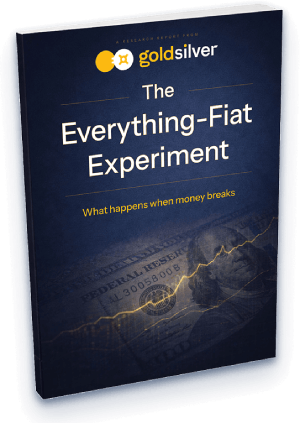
What Happened in 1971? The guide that explains the moment our financial system changed.
Did March’s Jobs Report Actually Signal a Recovery?
The March number looked good on the surface. Employers added 178,000 jobs — nearly three times the consensus forecast of 60,000 — and unemployment ticked down to 4.3%[Indeed Hiring Lab]. After months of grim data, it felt like a turning point.
It probably isn’t. Healthcare and social assistance carried most of the weight, continuing a pattern that’s propped up headline numbers for over a year. Long-term unemployment is still rising. Workers displaced from shrinking sectors aren’t finding new ones. One strong month doesn’t change a trend.
And the trend, according to the Fed, is worse than the monthly numbers suggest.
What Did Jerome Powell Say About Job Growth?
Speaking after the Fed’s March 18 decision to hold rates steady, Powell was unusually direct:
“Effectively, there’s zero net job creation in the private sector — nonexistent, really — growth in the labor force, which of course we’ve never had in our history.” — Federal Reserve Chair Jerome Powell, March 18, 2026
Here’s the context that makes that statement land harder. In February, the economy shed 92,000 jobs. December and January were revised down by a combined 69,000 [Yahoo Finance]. That means three consecutive months of essentially no growth — right before March’s surprise beat.
So which story is true — the beat or the stagnation? Probably both. March was real. But one month of better-than-expected hiring doesn’t erase the underlying reality Powell described. The private sector labor market has flatlined. That’s the backdrop the Fed is working with — and it’s the backdrop gold and silver are trading against too.
Investing in Physical Metals Made Easy

Sources: Bloomberg · CNBC · Yahoo Finance · CNN · Yahoo Finance · Indeed Hiring Lab · Yahoo Finance
This article is for informational purposes only and does not constitute financial or investment advice. Always consult a qualified financial advisor before making investment decisions.