Silver Rises Over 120% YTD




Daily News Nuggets | Today’s top stories for gold and silver investors
February 2nd, 2026
Gold and Silver’s Historic Crash
Gold and silver just posted their worst declines in decades. Gold fell below $5,000 on Friday — down nearly $1,000 from Thursday’s record high near $5,600. Silver crashed 31%, its steepest one-day drop since 1980.
The trigger? President Trump’s nomination of Kevin Warsh as Fed chair. Warsh’s hawkish reputation eased fears about central bank independence. That sent the dollar rallying and sparked mass profit-taking after both metals’ parabolic run. Gold had surged 66% in 2025. Silver gained 135%.
But the selloff wasn’t just about Warsh. Analysts had warned the rally was overstretched. Technical indicators flashed red. When volatility spiked, liquidity dried up. Banks pulled back. Margin calls forced leveraged traders to exit. The crowded trade unwound fast.
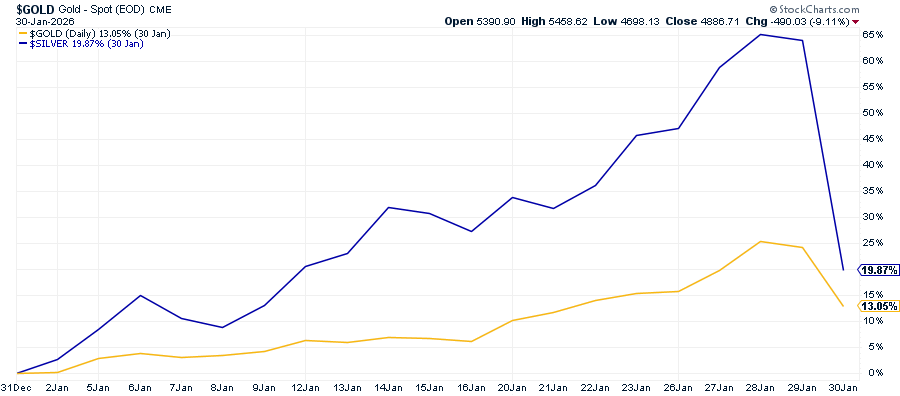
Even after the crash, gold is still up 8% this year. Silver is up 16%. The fundamentals — geopolitical risk, currency concerns, record debt — haven’t changed. But what sparked the selling frenzy?

Stay Ahead with Gold & Silver News The most important market insights, Fed updates, and global trends — everything investors need to make smarter, safer decisions.
China’s Speculative Frenzy Fueled the Metals Crash
Chinese speculators played a starring role in both gold and silver’s historic rally — and their equally dramatic collapse. For weeks, a wave of hot money from Chinese retail investors, equity funds, and trend-following algorithms pushed metals to record highs. The buying frenzy echoed 1979-1980, with shoppers in China and Germany queueing for hours to buy bullion.
Silver’s tiny market — just $98 billion in annual supply compared to gold’s $787 billion — made the moves even wilder. On Friday, the iShares Silver Trust recorded over $40 billion in trading volume, rivaling tech ETFs. Options activity was equally frenzied. Some Reddit traders posted gains exceeding 1,000%.
Then came the reversal. Trump’s nomination of Kevin Warsh as Fed chair sent the dollar higher. Chinese investors took profits instead of buying more. Within hours, silver plunged 26% — the biggest drop on record. MKS strategist Nicky Shiels summed it up: January was “the most volatile month in precious metals history.”
January 2026 Returns Gold and Silver
But not everyone fled. In fact, some investors saw opportunity…
Singaporeans Queue to Buy Gold Despite the Crash
While gold plummeted on Monday, Singaporeans lined up to buy the dip. At United Overseas Bank’s headquarters, customers queued for physical bullion even as prices cratered — showing remarkable resilience in retail demand.
It’s a pattern playing out across Asia. Retail investors in Singapore view the selloff as an opportunity, not a warning. UOB reported a 65% jump in gold savings account purchases through Q3 2025, and physical gold sales rose 42%.
The buying reflects a broader shift in Asia toward tangible assets amid currency concerns and market volatility.
While traders in New York scrambled to exit, Asian buyers jumped in — and major banks were taking notice.

JP Morgan Sees Gold at $6,300 Despite the Crash
Hours after gold’s worst day since 1983, JP Morgan raised its year-end price target to $6,300 — a 35% gain from current levels. The bank isn’t fazed by the volatility.
“We remain firmly bullishly convicted in gold over the medium-term,” JP Morgan wrote in a note Monday. The driver? Central banks. The bank now forecasts 800 tons of official-sector gold purchases in 2026, citing an “ongoing, unexhausted trend of reserve diversification.”
Translation: countries are still moving away from the dollar. And that’s not changing anytime soon.
Deutsche Bank also stood by its bullish view, reiterating a $6,000 forecast despite Friday’s 9.8% plunge. Both banks see the crash as a shakeout of leveraged speculators—not a breakdown in fundamentals. JP Morgan framed it as a “real asset outperformance vs paper assets” story that’s far from over.
The bullish conviction extends beyond price targets to portfolio construction itself.
Morgan Stanley Breaks With 60/40, Recommends 20% Gold
Morgan Stanley just made one of Wall Street’s boldest calls in decades. Chief Investment Officer Mike Wilson now recommends a 60/20/20 portfolio — 60% stocks, 20% bonds, 20% gold — abandoning the classic 60/40 that’s anchored investing for generations.
Wilson’s rationale is stark: bonds no longer provide reliable protection. During last spring’s tariff chaos, Treasuries sold off alongside stocks while gold rallied. “Gold is now the anti-fragile asset to own, rather than Treasuries,” Wilson wrote. He calls it a “more resilient inflation hedge.”
The strategy treats gold as essential portfolio infrastructure — not a speculative side bet. Wilson pairs equities and gold as dual hedges that work in opposite conditions: stocks thrive on growth, gold on real rate declines.
The recommendation arrives as central banks shift reserves. For the first time since 1996, they hold more gold than U.S. Treasuries — validating Wilson’s view that fiscal stress and currency concerns are reshaping portfolio construction.