Silver Rises Over 120% YTD




Published: 09-18-2026, 03:56 pm
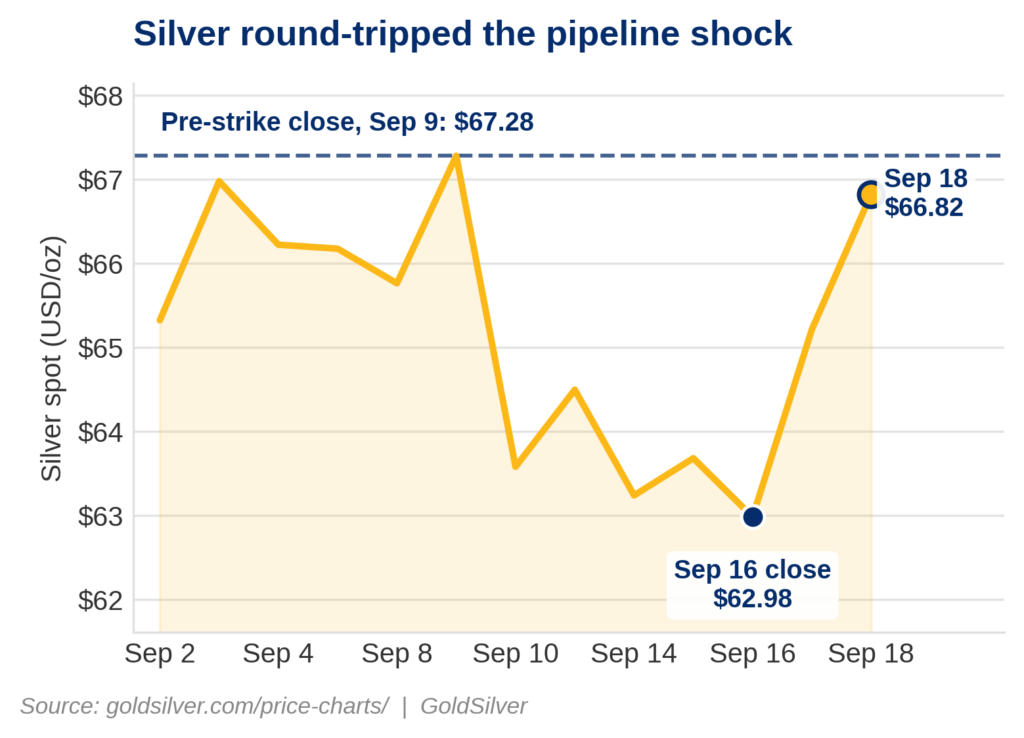
Silver closed at $67.28 an ounce on September 9. Since then, a drone strike shut Saudi Arabia’s largest oil pipeline. Treasury yields hit their highest level since 2007. The Fed raised rates for the first time in over three years. A tanker was struck in the Strait of Hormuz. Silver now trades a little below where it started. Nine days of all that, and the net move is under a dollar.
Silver rose today because real yields fell, not because inflation fear faded. Falling oil prices pulled Treasury yields back from multi-year highs. That lowered the real return on bonds, which is what a non-yielding metal competes against. Silver sits at $66.54 an ounce as of 18:45 UTC on Friday, September 18, up 2.0% on the session. Gold is at $4,381, up 0.9%.
Key Takeaways:
- Both metals are back within roughly 1% of their September 9 closes. So the pipeline shock has essentially round-tripped.
- The selloff was not an inflation scare. From September 9 to September 16, the 10-year real yield rose 22 basis points. Meanwhile the breakeven inflation rate fell 4 [Federal Reserve].
- Silver moved roughly twice as far as gold in both directions. That is what a real-rate move looks like, not a silver story.
Why did silver go up today?
Oil fell for a third straight session. Saudi Arabia says it will restore about half its damaged East-West pipeline within days, and the full 745-mile line in roughly six weeks. However, that timeline is Riyadh’s own account of its own repair job. So hold it lightly. Brent came down to about $102 a barrel, having traded as high as $108.59 on September 16.
Drones struck the line on September 10, damaging pumping stations. Saudi Arabia shut the whole pipeline the next day as a precaution. It carries crude to Yanbu on the Red Sea, the main way Saudi oil avoids the Strait of Hormuz. Losing it put a large supply premium into oil. That premium is now draining away, the same chain we traced when both metals first began rebounding on Thursday.

The Edge Every Investor Needs Smarter precious metals investing starts here. The Nuggets Newsletter brings you essential market insights, Fed updates, global trends, educational videos, and much more.
Did silver break out, or just recover?
It recovered. Most coverage today describes silver escaping a $63 to $64 range. But that range was only five sessions old. In fact it was the shock itself.
Silver’s low was $62.68 on September 16, or 6.8% below the September 9 close of $67.28. It has since recovered most of that ground. Even so, it is still short of where it started. The gold-silver ratio tells the same story: 65.4 before the strike, 67.7 at the trough, and back near 66 today.
Why is the inflation explanation wrong?
Here the standard account breaks down. Three series, September 9 to September 16 [Federal Reserve]:
- The 10-year Treasury yield rose from 4.83% to 5.01%.
- The 10-year real yield, measured on inflation-protected Treasuries, rose from 2.46% to 2.68%.
- The 10-year breakeven rate fell from 2.37% to 2.33%. That rate is the gap between the first two. Therefore it is the market’s inflation forecast.
If oil at $108 had frightened the bond market about inflation, breakevens would have risen. Instead they fell. What rose, by 22 basis points, was the real yield. That is the return an investor keeps after inflation, and the only thing a non-yielding metal competes against.
So the metals never sold off on inflation fear, and they are not rallying now because it faded. They sold off because the real cost of holding them jumped. They have recovered because that cost came back down. We made the same point in August, when hike odds doubled in a week and real yields barely moved.
Why did silver move twice as much as gold?
Positioning explains part of it. CFTC data for the week ending September 8, the last reading before the strike, put silver’s net speculative long at 25.2% of open interest against gold’s 56.4% [CFTC]. In other words, gold was the crowded trade. Silver carried less length, but it has always been the higher-beta metal. It fell 6.4% to gold’s 3.1% into the September 16 close, then has roughly doubled gold’s move back out again. That rebuilt long, not the hike, was the setup worth understanding before the Fed voted.
Why do real yields matter more than headlines?
A real-yield move hits these metals harder than any headline does. Gold and silver sit outside the interest-rate machinery entirely. They pay nothing. So they compete only with what cash and bonds pay after inflation. When that number rises, they get cheaper. When it falls, they do not need a crisis to work.
Which points at the thing worth keeping. Gold’s most reliable driver has never been the Fed’s decision at a meeting. Rather, it is where the market thinks real yields are going. This week it repriced that twice, yet barely moved its inflation forecast. Both metals followed the discount rate. The oil headlines were loud, but the 22 basis points were the story.
Two things decide what happens next: whether the restart lands on schedule, and whether the 10-year real yield holds below the 2.68% it hit on September 16. Watch the second one.
Spot prices as of 18:45 UTC, September 18, 2026 [goldsilver.com/price-charts/]. Moves against the September 9 and 16 closes are fixed history.
Stay On Top of Gold & Silver Prices
Get important market alerts sent straight to your inbox.
SOURCES
1. GoldSilver – Silver Price Charts (18 September 2026)
2. Federal Reserve – Market Yield on U.S. Treasury Securities at 10-Year Constant Maturity (DGS10) (observations 9 and 16 September 2026)
3. Federal Reserve – 10-Year Treasury Inflation-Indexed Security, Constant Maturity (DFII10) (observations 9 and 16 September 2026)
4. Federal Reserve – 10-Year Breakeven Inflation Rate (T10YIE) (observations 9 and 16 September 2026)
5. Commodity Futures Trading Commission – Commitments of Traders (report week ending 8 September 2026)
6. Federal Reserve – FOMC Statement and Summary of Economic Projections (16 September 2026)
7. CNN – Saudi Oil Pipeline Shut Down After Attack Triggers Fires (11 September 2026)
8. Al Jazeera – Saudi Arabia Shuts Critical Oil Pipeline After Drone Attack: What It Means (12 September 2026)
9. Bloomberg – Saudi Arabia Seeks to Resume Half of Key Oil Pipeline Within Days (16 September 2026)
10. Associated Press – Saudi Pipeline Hit by Drones Will Be Out of Service for Weeks (14 September 2026)
11. OilPrice.com – Drone Strikes Hit Saudi Arabia’s Vital East-West Oil Pipeline (10 September 2026)
12. U.S. Energy Information Administration – Short-Term Energy Outlook (second-half 2026 outlook, accessed 18 September 2026)
Disclaimer: This article is for informational purposes only and does not constitute investment advice. Past performance is not indicative of future results. Always consult a qualified financial advisor before making investment decisions.
You May Also Like:
- Iran Hit a Tanker in Hormuz and Trump Threatened Iran. Oil Isn’t Reacting.
- Rates Just Went Up Twice. Five Reasons Gold Didn’t Care.
- The Bank of Japan Just Hiked to a 31-Year High. Gold Barely Noticed.
- The Fed Hiked. The Bank of England Held. They Landed on the Same Rate.
- Jobless Claims Just Beat Estimates. Gold Rallied Anyway. Here Are 4 More Signals Behind It.
- Gold and Silver Rip Higher as the Fed-Hike Selloff Reverses
- The Fed Just Hiked. 16 of 18 Officials Say It’s Not Done.