Silver Rises Over 120% YTD


Published: 10-19-2026, 04:41 pm
Last verified October 2026.
Social Security COLA (Cost-of-Living Adjustment) vs inflation comes down to timing. The 3.6% raise for 2027 was built from prices measured in July, August and September 2026. The Social Security Administration (SSA) announced it on Wednesday, October 14, 2026. Higher Social Security checks start arriving in January. For a saver, that means income resets once a year while prices move every month. SSA’s COLA compares average third-quarter prices for 2026 with 2025 (SSA fact sheet, October 14, 2026).
Gold closed at $4,165.61, down 3.8% from a year earlier, on Friday, October 16, 2026 (GoldSilver price charts).
Key Takeaways:
- SSA set the 2027 COLA at 3.6% on October 14, 2026, using wage-earner prices (CPI-W) for July to September.
- The Bureau of Labor Statistics (BLS) reported CPI-W up 3.9% to September (October 14, 2026). The formula averages the quarter, so the raise sits below that reading.
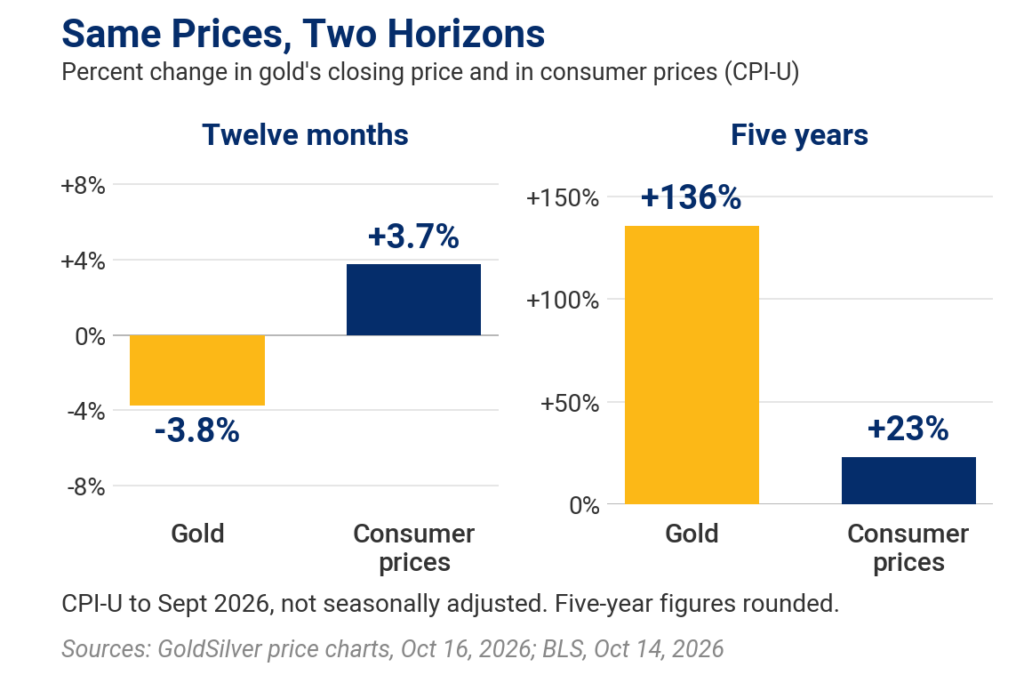
- Gold fell 3.8% in twelve months but rose about 136% in five years (GoldSilver price charts, October 16, 2026). Consumer prices (CPI-U) rose 3.7% and about 23% (BLS, October 14, 2026).
How Is the Social Security COLA Calculated, and When Is It Paid?
CPI-W is the Consumer Price Index for Urban Wage Earners and Clerical Workers. SSA uses it by law (SSA COLA page, October 14, 2026). Benefits payable for December carry the raise, and people get them in January. The raise reaches 76 million people on Social Security and Supplemental Security Income (SSA COLA page, October 14, 2026). The average retired worker’s check rises $75, from $2,095 to $2,170 (SSA 2027 COLA Fact Sheet, October 14, 2026).

The Edge Every Investor Needs Smarter precious metals investing starts here. The Nuggets Newsletter brings you essential market insights, Fed updates, global trends, educational videos, and much more.
Social Security COLA vs Inflation: Why Does the Raise Feel Late?
A surface take is that 3.6% is the largest raise since 2023, or that $75 is small. But both describe the number, not the timing. BLS reported on October 14, 2026 that CPI-W rose 3.9% over the twelve months to September. That is still above the 3.6% raise. The formula averages three months, so a late reading can sit above the average. Prices rose faster by September than earlier in the quarter. The formula did what it says. Even so, it looks backward.
The January 2021 COLA was 1.3%. Later, it hit 8.7% in January 2023. Then came 3.2%, 2.5% and 2.8% (SSA history, October 14, 2026). Each raise arrived after the prices behind it.
Think of a COLA as a year-end statement: official, accurate, and a year behind a live balance. However, households feel the gap differently. For instance, BLS reported on October 14, 2026 that gasoline rose 34.2% over twelve months. Food rose 2.5%. So the headline rate can differ from a household’s own experience.
Does Gold Keep Up With Inflation?
Not on every horizon. Gold’s closing price fell 3.8% over the twelve months to October 16, 2026 (GoldSilver price charts). Consumer prices (CPI-U) rose 3.7% over the twelve months to September (BLS, October 14, 2026). Over five years, however, the order reversed. Gold rose about 136%, from $1,767.20 on October 15, 2021 (GoldSilver price charts). CPI-U rose about 23% from September 2021 to September 2026 (BLS, October 14, 2026). So the same basket cost about 23% more.
The start date matters. Counting from October 17, 2025 gives a 2.0% decline, not 3.8%. That is why what one ounce of gold has bought over long periods is the better test.
The fair objection: gold lost ground in the year the COLA measures. True. The two figures are one daily repricing seen through two windows, and neither predicts the next.
Is There Anything to Track After the COLA?
Nothing in particular. Most people with a my Social Security account can read the notice online (SSA COLA page, October 14, 2026). That starts in late November 2026; higher Social Security payments begin in January 2027 (SSA COLA page, October 14, 2026). Those are dates to know, not numbers to track. Which part of your wealth waits for a formula, and which part does not? You can decide once and revisit when appropriate.
Stay On Top of Gold & Silver Prices
Get important market alerts sent straight to your inbox.
SOURCES
1. Social Security Administration – 2027 Cost-of-Living Adjustment (COLA) Fact Sheet – October 14, 2026
2. Social Security Administration – Cost-of-Living Adjustment (COLA) Information for 2027 – October 14, 2026
3. U.S. Bureau of Labor Statistics – Consumer Price Index, September 2026 News Release (USDL-26-1574) – October 14, 2026
4. U.S. Bureau of Labor Statistics – Consumer Price Index, September 2021 News Release (USDL-21-1831) – October 13, 2021
5. Federal Reserve Board – FEDS Notes: Why Gold Didn’t Actually Overtake Treasury Securities as the World’s “Favorite” Reserve Asset – September 3, 2026
6. GoldSilver – Gold Price Chart, Daily Closing Prices – Closing prices of October 15, 2021; October 16, 2025; October 17, 2025 and October 16, 2026
Disclaimer: This article is for informational purposes only and does not constitute investment advice. Past performance is not indicative of future results. Always consult a qualified financial advisor before making investment decisions.
You May Also Like:
- How Gold’s Correction Impacted Portfolios
- Central Bank Gold Buying: Why 39 Tonnes Matters
- Investors Turn to Treasuries as AI Stocks Slide
- London Gold Vault Holdings Rose 3.78% in Q3. What Changed?
- Gold Rebounds Above $4,130: What Changed for Owners?
- How 3.7% Inflation Impacts Wealth Preservation
- Gold and Silver Dip on a Hot CPI Report
- Currency Swing Erases Gold’s Brief Dip
- Short-Term Pressure Pushes Gold Down
- Squeezed at the Pump, Steady in the Vault