Silver Rises Over 120% YTD




Published: 08-28-2026, 09:46 am
America’s checking account just got a $33.6 billion deposit in a single day. Treasury Secretary Scott Bessent may spend part of the nearly $967 billion sitting in it. He would use it to do something no Federal Reserve rate decision can do on its own: buy back government bonds without borrowing a single new dollar.
Gold sits at $4,592 an ounce this morning, essentially flat on the day. Silver trades at $70.42, up about 1.7% from its open. Neither move is the story. The story is what’s sitting in Washington’s checking account, and why officials are considering spending it down.

The Edge Every Investor Needs Smarter precious metals investing starts here. The Nuggets Newsletter brings you essential market insights, Fed updates, global trends, educational videos, and much more.
What Is the Treasury General Account, and Why Does It Matter for Gold?
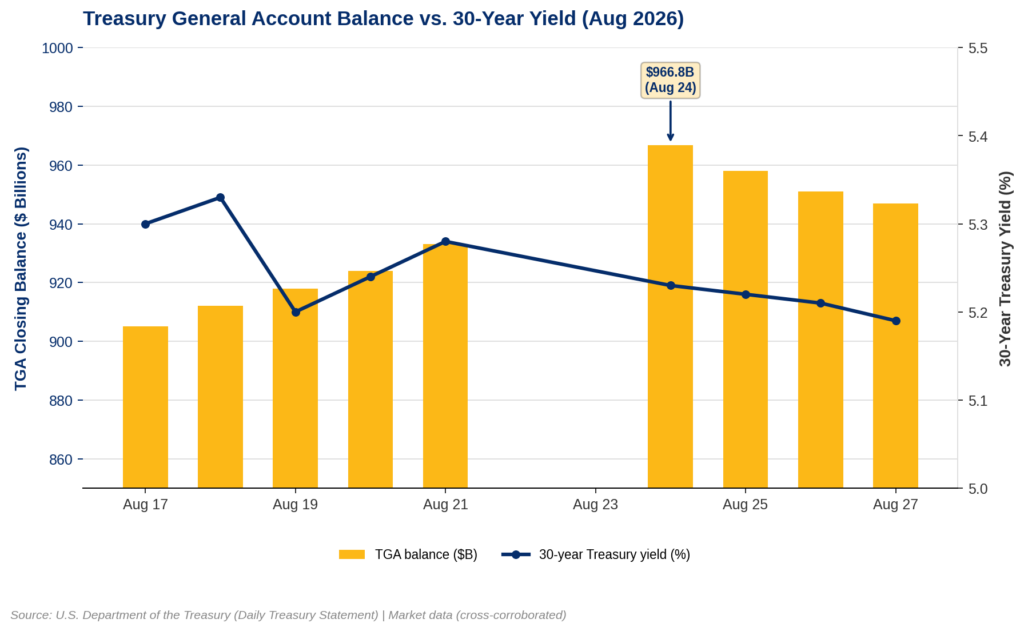
The Treasury General Account, or TGA, is the federal government’s operating account at the Federal Reserve. It’s the place tax receipts land before the government spends them. Treasury’s own Daily Treasury Statement shows the account closed at $966.8 billion on August 24. That’s up $33.6 billion in a single session. Withheld individual and payroll taxes brought in $25.1 billion of that gain. Customs duties added another $17.7 billion.
Two senior Treasury officials told CNBC on August 24 that this account is a candidate funding source. The target is the bond buyback program Treasury announced on August 19. That announcement doubled the maximum size of Treasury’s long-end buyback operations, from $2 billion to at least $4 billion per operation. The change takes effect September 9.
Why Does It Matter Where the Buyback Money Comes From?
Here’s the distinction that got lost in five days of “Treasury buys bonds, gold jumps” headlines. There are two ways to fund a buyback, and they are not the same trade. Treasury can issue new short-term debt to raise the cash. That’s essentially opening a new credit line to pay down an old one, and it’s what most bond desks assumed when the August 19 announcement first landed. Or Treasury can spend down cash it already collected in taxes. That cash has been sitting idle in an account that ballooned to nearly double its typical operating cushion under the Biden-era standard of $550 to $600 billion.
The second path matters more, mechanically, because the TGA sits at the Fed. When Treasury draws that balance down to pay for bond purchases, cash flows back into the banking system. That’s roughly the same direction as a Fed liquidity move. And it happens without a single new Treasury bond needing to be sold in that moment. Think of it as paying off a credit card with money already in your checking account, instead of moving the balance to a new card. The bill still gets paid either way. But one method adds a fresh IOU to the system. The other doesn’t.
What Have Analysts Said About the Treasury General Account Plan?
Deutsche Bank’s Michael Hsueh told clients in a note that the Treasury policy shift is “underlining the gold constructive view,” adding that it risks pushing gold above his $4,800 target. UBS chief strategist Bhanu Baweja called the move “a very important signal for gold.” He argued the dollar, not bullion, will absorb the cost of Washington managing its own borrowing rate. Not everyone is convinced the plan amounts to much, though. RBC Capital Markets’ Blake Gwinn described the TGA idea as “very slapdash.” He told Bloomberg he sees very low odds the account actually gets tapped at meaningful scale. Treasury officials, for their part, would not specify an amount or a timeline when CNBC asked. They said only that the option is on the table.
That gap between “powerful new lever” and “mostly talk” is worth sitting with. The 30-year Treasury yield had climbed above 5.3% at one point, its highest level since 2007. It has eased modestly since the original August 19 buyback announcement, though it remains historically elevated. Whatever Treasury does with the TGA on September 9 will be the first real test of whether officials are serious, or simply trying to talk the bond market into calming down.
What Does This Mean for the Sound Money Case?
The deeper story isn’t whether $967 billion moves markets. In a Treasury market with more than $31 trillion in securities outstanding, it probably can’t move much on its own. The deeper story is that the U.S. government now runs its own borrowing costs the way an over-leveraged household runs a maxed-out card. It moves cash from one pot to pay another bill, instead of borrowing less overall. A Treasury that reaches for tax cash instead of new debt to defend the bond market isn’t showing strength. It’s showing that officials are wary of how the market would react to still more Treasury debt, landing on top of an already-strained sale calendar. That’s a sign about fiscal trust, not Fed policy. And it’s coming from a completely different building than the Federal Reserve.
For a saver watching from outside the bond market, the lesson isn’t which lever gets pulled next. It’s that a currency’s stability now rests on which discretionary account officials choose to drain, month to month. It doesn’t rest on a fixed, rules-based process working cleanly on its own. That discretion is precisely the risk physical gold and silver sit outside of.
What Should Investors Watch Next?
September 9 is the date that resolves the “talk vs. action” question. That’s when the first buyback operation under the new, doubled size actually executes. Watch whether Treasury’s public buyback announcements that week name the TGA explicitly as a funding source. Or watch whether the department quietly falls back on short-term bill issuance instead, the outcome Gwinn expects. Either way, the 30-year yield’s reaction in the days around that operation will tell you more about whether this mechanism has real teeth than any single day’s move in gold or silver.
Stay On Top of Gold & Silver Prices
Get important market alerts sent straight to your inbox.
SOURCES
1. U.S. Department of the Treasury — Daily Treasury Statement, Operating Cash Balance
2. U.S. Department of the Treasury — Treasury Announces Increased Sizes of Nominal Long-End Liquidity Support Buybacks Beginning September 9
3. CNBC — Bessent Could Tap Near $1 Trillion Treasury General Account to Fund Bond Buybacks, Sources Said
4. CNBC — Buy Gold on the Treasury Bond Market Intervention, Says Deutsche Bank
5. AdvisorHub — Bessent Stops Short of New Bond Measures Amid Report on Cash Use
6. SIFMA — US Treasury Securities Statistics
Disclaimer: This article is for informational purposes only and does not constitute investment advice. Past performance is not indicative of future results. Always consult a qualified financial advisor before making investment decisions.
You May Also Like:
- Six Paper Claims, One Ounce of Silver: What First Notice Day Reveals
- Five Gold Signals Fired This Week. None of Them Are About Today’s Price.
- Gold Fell 9% the Last Time Warsh Spoke. He’s Back Tomorrow.
- Gold Ran Past Wall Street’s Own Price Targets. Four Banks Disagree on What Happens Next.
- Silver Beat Gold in August. Almost Nobody Said So.
- Americans Spent More in July. They Got Nothing Extra for It.
- The Fed Has Two Hike Numbers Right Now. Almost Everyone Quotes the Wrong One.