Silver Rises Over 120% YTD




Published: 08-26-2026, 12:07 pm
Everybody reported the same month. Everybody named the wrong winner.
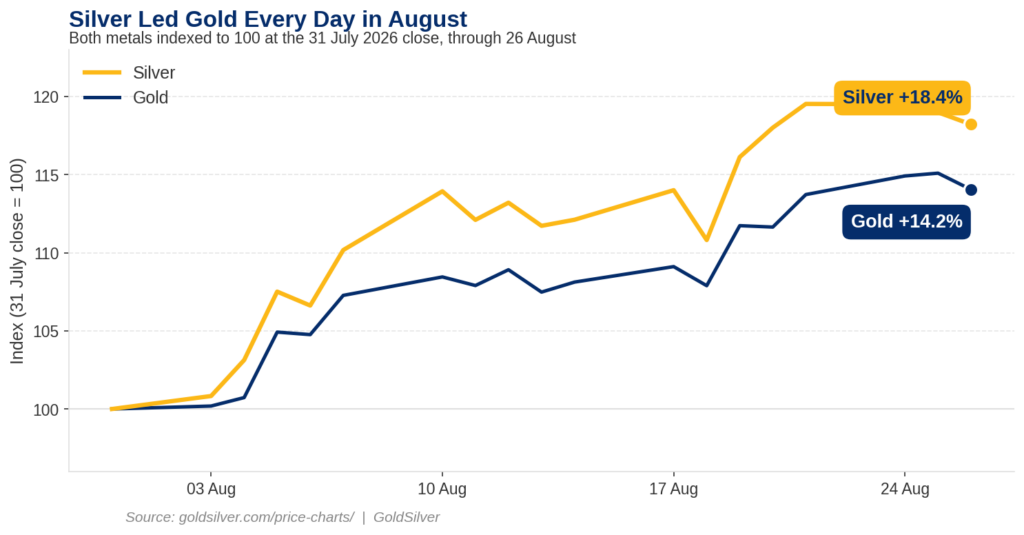
From the July 31 close through Tuesday’s close, silver rose 19.0%. Gold rose 15.1%. If you hold both metals, the junior partner did the heavy lifting.
Key takeaways
- Silver gained 19.0% from the July 31 close through the August 25 close. Gold gained 15.1%.
- The gold-silver ratio fell from 70.1 to just under 68 over that same window.
- The 10-year real yield was 2.38% on August 24, according to Federal Reserve data. That is the condition under which gold is supposed to struggle.
Both metals fell on Wednesday. Gold trades just under $4,600 and silver in the high $60s. Those monthly figures are fixed, because they measure two completed closes.
So which metal had the better August?
Silver, by nearly four percentage points. And for a week the wires have carried one line: gold is heading for its strongest month since September 1999. UOB said so, and Reuters reported it on August 25. Fair enough. But it is a gold-only story about a month that silver won.
The gold-silver ratio says the same thing a second way. It measures how many ounces of silver one ounce of gold buys. All month, that number has been falling.
But the figure matters most because of who noticed. Almost nobody. Across the last week, we tracked the sound money conversation. Gold came up roughly eight times for every mention of silver. So a 19% month drew no unusual attention at all.
Why is gold rising when real yields are this high?
Here is where the easy explanations run out. The 10-year real yield sits at 2.38%, according to Federal Reserve data for August 24. That is the market yield on inflation-indexed Treasuries. It is a positive return above inflation, and it is close to risk-free.
But the textbook says gold should struggle against that. Instead, both metals climbed.
Moreover, the shape of the curve shows why the usual story does not fit. The 10-year nominal yield is 4.70%. The 2-year is 4.24%. So the long end pays 46 basis points more than the short end. That is a term-premium curve, not a rate-cut curve. Nobody is being paid to wait for cheaper money. They are being paid to hold government debt for longer, and metal is bid anyway.
The Edge Every Investor Needs Smarter precious metals investing starts here. The Nuggets Newsletter brings you essential market insights, Fed updates, global trends, educational videos, and much more.
Why did silver move more than gold?
Because silver’s market is smaller and thinner. So the same input moves it further. We have made this point on the way down. In May, silver dropped 12% while gold dropped 3%, and the gap was the story then too. Silver moves harder than gold in both directions. And August was the first month in a while when harder meant up.
Meanwhile the institutional bid arrived late. The World Gold Council’s July 2026 flow data showed Asian funds leading global gold ETF inflows for the year. Meanwhile North America sat in net outflow. Western money did not lead this rally. It joined it.
What happened in September 1999?
The comparison runs backwards, and that is the useful part. On September 26, 1999, fifteen European central banks signed the Washington Agreement. Then they capped their combined gold sales at 400 tonnes a year for five years. Before that, gold had just printed a 20-year low. The August futures contract settled at $257.80 that July, according to the CFTC’s 2000 report on the period. Then the price jumped roughly 14% within days.
So that month happened because governments promised to stop selling gold. This one is happening while a government works to support the market for its own debt. Same size of move, opposite direction of official pressure.
Therefore the second corner is not the ranking at all. It is what the pairing tells you about owning two metals instead of one. They price the same monetary question at different speeds. Gold registers it first. Then silver registers it harder. A holder watching only gold saw two-thirds of this month.
What should you watch now?
Fed Chair Kevin Warsh gives his first Jackson Hole keynote Friday at 10:00 ET. After that, two sessions remain in the month. Then the calendar turns to gold’s weakest stretch.
Over the last 20 years, September has averaged roughly -0.3% for gold. And it finished lower in about 60% of them. And in the seven years gold entered September already up double digits, four Septembers went against it.
A record month is not a forecast.
Stay On Top of Gold & Silver Prices
Get important market alerts sent straight to your inbox.
SOURCES
1. Federal Reserve Bank of St. Louis (FRED) — Market Yield on U.S. Treasury Securities at 10-Year Constant Maturity, Inflation-Indexed (DFII10), August 24, 2026
2. Federal Reserve Bank of St. Louis (FRED) — Market Yield on U.S. Treasury Securities at 10-Year and 2-Year Constant Maturity (DGS10, DGS2), August 24, 2026
3. Reuters, via CNBC — Gold Hovers Near Three-Month High on Dollar Weakness, Treasury Bond Buyback Plans, August 25, 2026
4. World Gold Council — Gold ETF Flows: July 2026, August 2026
5. World Gold Council — First Central Bank Gold Agreement (CBGA1), the Washington Agreement on Gold, September 26, 1999
6. U.S. Commodity Futures Trading Commission — Report on Gold Options Trading on September 28, 1999, March 10, 2000
7. GoldSilver — Gold and Silver Price Charts, retrieved August 26, 2026
Disclaimer: This article is for informational purposes only and does not constitute investment advice. Past performance is not indicative of future results. Always consult a qualified financial advisor before making investment decisions.
You May Also Like:
- Americans Spent More in July. They Got Nothing Extra for It.
- The Fed Has Two Hike Numbers Right Now. Almost Everyone Quotes the Wrong One.
- Gold and Silver Pulled Back Today. The Treasury’s Plumbing Explains Why.
- A Stablecoin Issuer Bought More Gold Last Year Than Any Central Bank
- Two Investors Ran the Debt Math Separately. Both Landed on 15% Gold.
- Gold Nears $4,700, Silver Holds Above $69. Why Is Everyone Waiting on One Friday Speech?
- Gold Hits 3-Month High as Oil Falls Ahead of Bessent’s Iran Sanctions Announcement