Silver Rises Over 120% YTD




Published: 09-10-2026, 12:44 pm
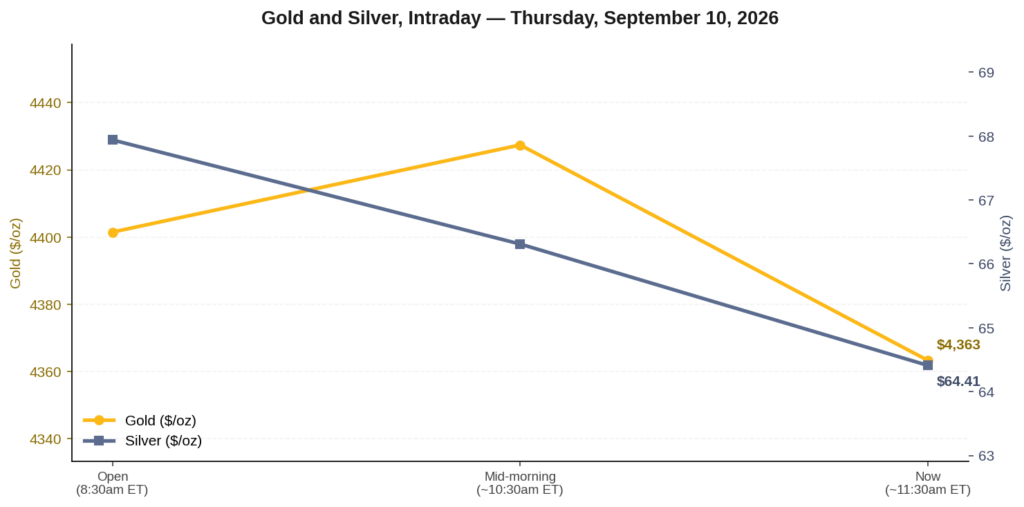
Last verified: September 10, 2026. Gold and silver both sold off Thursday morning. Silver fell roughly 3-4% on the session, and gold dropped closer to 1%. Naturally, readers are asking the same question: if inflation is running hot, why are the two metals everyone calls an inflation hedge going down?
Here is the short answer. The U.S. Bureau of Labor Statistics reported Thursday that its Producer Price Index (PPI) rose 0.4% in August, matching forecasts. But the annual rate accelerated to 5.4%, the highest reading of the year and a tenth above what economists expected. As a result, traders repriced the Federal Reserve’s September 16 meeting. Markets are now pricing roughly 60% odds of a rate hike. That’s a sharp reversal from the market’s prior assumption that the Fed was done raising rates. Gold slipped toward $4,370 an ounce, down about 0.7-0.9% on the day. Silver broke below $65 an ounce after opening near $67.94, its strongest open of the week before reversing hard.
So Why Did Gold and Silver Fall on an Inflation Report?
Here’s the mechanism, in plain terms. Gold and silver pay you nothing to hold them: no coupon, no dividend. When the market expects the Fed to hike, it also expects yields on bonds and savings accounts to rise. That raises the opportunity cost of parking money in a metal that just sits there instead of earning interest. Put simply, higher expected real yields, meaning interest rates minus inflation, make yield-paying assets relatively more attractive. Meanwhile, non-yielding assets like gold and silver become relatively less attractive, even when the reason rates are rising is inflation itself.
That’s the paradox that trips people up, and it’s worth sitting with. Inflation is usually gold’s friend. However, a Fed response to inflation, in the form of higher rates, is not. Today, the rates channel simply won out over the inflation channel.
The Edge Every Investor Needs Smarter precious metals investing starts here. The Nuggets Newsletter brings you essential market insights, Fed updates, global trends, educational videos, and much more.
Is an Oil Shock Doing the Fed’s Work for It?
Here’s what the headline PPI number doesn’t tell you on its own. According to the BLS release, energy alone drove more than three-fourths of August’s rise in goods prices. Energy prices jumped 4.2% for the month, and diesel fuel surged 24.1% on its own. Meanwhile, core PPI, which strips out food and energy, rose just 0.2%, below the 0.3% economists expected. In other words, this was not a broad, demand-driven inflation surprise. It was a narrow, energy-driven one.
That distinction matters. Notably, Brent crude has pushed above $100 a barrel this week as the U.S.-Iran conflict has intensified. Reports point to strikes near shipping lanes in the Strait of Hormuz corridor. Because of that, a meaningful share of today’s inflation acceleration traces back to a geopolitical oil shock, not an overheating economy. A Fed cornered into hiking by an energy shock it doesn’t control is therefore a very different situation than a Fed hiking because growth is running hot.
In fact, Morgan Stanley’s own research team has made a related point this year. Gold does not reliably hedge every geopolitical shock in the short term. In a fast, volatility-driven selloff, investors sell whatever is liquid to meet margin calls and near-term cash needs, gold and silver included. That’s a short-term liquidity dynamic, not evidence that the metals have stopped working.
Still, Friday’s Consumer Price Index is the next test. If it confirms that this inflation is persistent, rather than a one-month, oil-driven blip, the more interesting question becomes whether the Fed can keep real yields elevated for long. That’s a question about the Fed’s credibility, not about gold’s or silver’s mechanics.
Has the Long-Term Case for Gold and Silver Changed?
Even so, none of today’s move touches the structural case for owning gold and silver. For example, the money supply has to keep expanding just to service existing government debt. Inflation, in turn, is the mechanism that quietly reduces the real value of that debt over time. Meanwhile, cash savings continue to earn less than inflation takes away. A single-session repricing of Fed odds doesn’t undo any of that arithmetic. It simply moves the near-term price while the long-term thesis sits untouched.
GoldSilver has covered this pattern before. Six banks cut their 2026 gold targets between June and August, and every single cut came after the price had already moved. That’s a reminder that same-week reactions to a single data print are rarely the full story. Similarly, our August outlook noted that central banks bought a record 288.9 tonnes of gold in the second quarter, even as prices moved lower. In short, official-sector buyers tend to look through exactly this kind of session.
What Should Gold and Silver Holders Watch Next?
Looking ahead, Friday’s CPI print is the next binary catalyst before the Fed’s September 16 decision. A cooler-than-expected reading could unwind today’s hike repricing quickly. A hot one would cement it. Either way, watch the mechanism, real yields, rather than the headline inflation number alone. This week’s PPI was “hot” on one measure and “cool” on another; the mechanism is what tells you which one actually matters.
Stay On Top of Gold & Silver Prices
Get important market alerts sent straight to your inbox.
SOURCES
1. U.S. Bureau of Labor Statistics — Producer Price Index News Release (Sept 10, 2026)
2. CNBC — Wholesale Prices Rose 0.4% in August, as Expected (Sept 10, 2026)
3. TheStreet — Stock Market Today: S&P 500 Falls as Oil Prices Spike (Sept 10, 2026)
4. FXStreet — Gold Comes Under Pressure Ahead of US PPI as Fed Rate Hike Risks Linger (Sept 10, 2026)
5. Trading Economics — Gold: Price, Chart, Historical Data, News (Sept 10, 2026)
6. Yahoo Finance — Silver Price Today: Silver Prices Back Off Ahead of Inflation Data (Sept 10, 2026)
7. Babypips — U.S. PPI Rose 0.4% in August 2026 (Sept 10, 2026)
8. Modern Distribution Management — August Producer Prices Rise 0.4%, Core Ticks Up (Sept 10, 2026)
9. Morgan Stanley Insights — A Test for Gold’s Safe-Haven Status (March 1, 2026)
Disclaimer: This article is for informational purposes only and does not constitute investment advice. Past performance is not indicative of future results. Always consult a qualified financial advisor before making investment decisions.
You May Also Like:
- Five Signals Pointing the Same Way Into Next Week’s Fed Decision
- Silver Just Fell Three Times Harder Than Gold. Here’s the PPI Story Behind It.
- Gold’s Tiny Output Is Worth Twice Aluminum’s. Here Are Four More Signals Like It.
- Fed Hike Odds Went From 54% to 26% to 58%. Now It’s a Coin Flip.
- Gold ETFs Just Pulled In $2 Billion. Silver Investors Pulled Out.
- Gold/Silver Ratio September 2026: What a 12-Week Round Trip Is Telling Holders
- Gold Is Falling Today. Four Other Signals Say the Hard-Assets Trade Isn’t.