Silver Rises Over 120% YTD




Published: 08-25-2026, 10:13 am | Updated: 08-26-2026, 11:56 am
Every trading desk in the world is waiting for one sentence out of Wyoming this week. Meanwhile, the Federal Reserve has published an agenda about something else entirely.
The Federal Reserve Bank of Kansas City hosts its annual economic policy symposium at Jackson Hole. It runs from Thursday, August 27 to Saturday, August 29, 2026. New Fed Chair Kevin Warsh gives his first keynote there on the Friday morning. Markets want to know whether the hiking cycle is paused or finished. That is a fair question. However, it is not the question on the programme.
Key takeaways
- Jackson Hole’s 2026 theme is payments and financial innovation, not the level of rates.
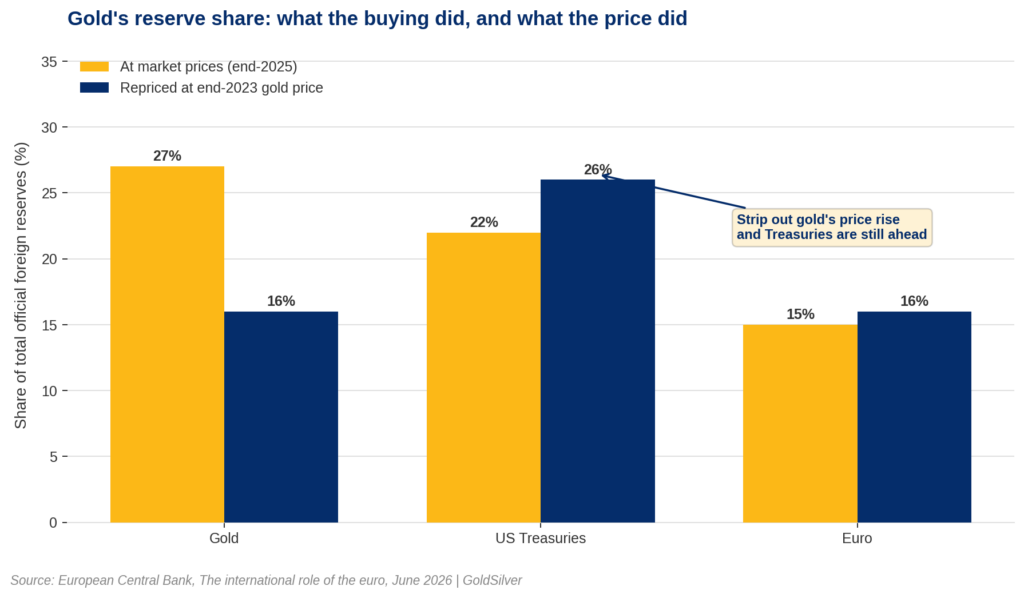
- The European Central Bank, in its June 2, 2026 report, put gold at 27% of total official foreign reserves at end-2025, ahead of US Treasuries at 22%.
- The 27% and the ECB’s price-adjusted 16% answer different questions: how much of reserves is gold now, and how much metal was actually added.
- Tether bought more than 100 tonnes of gold in 2025, more than any central bank, based on the issuer’s own attestations cited by the ECB.
What is the Fed actually discussing at Jackson Hole?
The topic this year is “Financial Innovation: Implications for Payments and Policy,” and that title is doing real work. Roughly 120 central bankers, policymakers and economists from more than 70 countries attend. Furthermore, the Kansas City Fed selects them based on the year’s theme. So the theme is not decoration. Rather, it signals what the institution thinks matters now.
The detailed programme is not public yet, so nobody knows which papers land. The subject is clear enough regardless. Who is allowed to issue dollars. What rails those dollars settle on. Whether privately issued digital money changes the way a policy rate reaches you.
The Edge Every Investor Needs Smarter precious metals investing starts here. The Nuggets Newsletter brings you essential market insights, Fed updates, global trends, educational videos, and much more.
Why are central banks buying gold?
Central banks buy gold because it carries no issuer, not because they expect a particular inflation print. The European Central Bank made that measurable on June 2, 2026. Its annual report on the international role of the euro put gold at 27% of total official foreign reserves at end-2025. That share overtook US Treasuries at 22% and the euro at 15%.
annot be reissued, upgraded, frozen, or redeemed at somebody else’s discretion. Whatever the Fed concludes about payment rails, that property is not on the agenda. After all, it was never the Fed’s to grant.
Is gold’s 27% share real, or just the gold price?
Now the part worth slowing down for. A reserve share can move for two different reasons. Central banks can buy more of something. Alternatively, the price of what they already hold can rise. Gold climbed roughly 60% in 2025 and 30% in 2024. So the same bars were suddenly worth far more, without anyone buying an ounce.
The ECB separated the two effects. It re-priced identical holdings using end-2023 gold prices. That strips the rally out and leaves only the buying. On that basis gold sits at 16%, level with the euro, with Treasuries ahead at 26%.
Both figures are real, and they answer different questions. The 16% tells you how much metal was actually added. The 27% tells you how much of the world’s reserve buffer is gold today. That second number is the one reserve managers report and manage against.
Does a rising share mean central banks chose gold?
There is also a third thing the arithmetic does not capture. A bank that lets gold drift from 20% to 27% and does not trim has made a decision. Large allocators normally rebalance toward a target. Declining to rebalance is an active choice. It is the choice most of them made, and several went further and bought more. The same report says how much further. Central banks bought around 850 tonnes in 2025, at record prices. The ECB adds that this buying may reflect efforts by some central banks to strengthen balance sheet resilience amid rising geopolitical risks. That sentence sits close to the valuation caveat, and it cuts the other way.
One note on whose report this is. The document is the ECB’s annual assessment of the euro’s international role. Its price-adjusted view places the euro level with gold rather than well behind it. The arithmetic is sound. It is still worth knowing who ran it.
The ECB is blunt about gold’s drawbacks as a reserve asset. Its price is volatile. It pays no interest. Physical metal costs money to store. Moreover, its supply does not stretch on demand when the world suddenly wants liquidity.
Why did a stablecoin issuer outbuy every central bank?
One detail in that report ties both halves together. Poland was the largest official-sector buyer of gold in 2025, at around 100 tonnes. Tether, the largest stablecoin issuer, bought more than that. In other words, the company whose entire product is a digital dollar acquired more gold last year than any central bank did.
That cuts both ways, and this article’s own logic says so. Tether is a private issuer, not a central bank. It settled with the CFTC for $41 million in October 2021. It settled with the New York Attorney General for $18.5 million in February 2021. Neither settlement involved admitting or denying the findings, and both concerned statements about whether its token was fully backed. Tether also publishes quarterly outside attestations rather than a full audit. Its gold sits inside a reserve dominated by US Treasuries. The tonnage itself comes from Tether’s own auditors’ reports, according to the ECB’s source note for that chart, rather than from an independent audit.
So read the purchase as evidence, not endorsement. A token backed by somebody else’s balance sheet is exactly the kind of claim this piece is about. Anyone holding that token owns a claim on a company, not the gold behind it. What is telling is that the issuer of one still wanted a reserve asset with nobody behind it.
Do faster dollars mean fewer dollars?
No, and that distinction is the whole mechanism. The same June 2026 ECB report put stablecoin capitalisation above $300 billion at the end of 2025. That is half again as much as a year earlier. Almost all of it is pegged to dollar-denominated assets. Therefore the innovation on the Jackson Hole agenda extends the dollar’s reach. It does not change how many dollars exist.
The ECB’s own researchers go further than that. Their work finds that stablecoin adoption weakens and complicates the transmission of monetary policy. It makes policy less effective and less predictable. That is precisely why a payments conference is a monetary policy conference.
Keep the scale honest, though. The ECB cites estimates that only about $400 billion of stablecoin retail payments settle annually. By comparison, global cross-border retail transactions run to roughly $44 trillion. The new rails are real. They are also early.
Can a Fed chair change gold’s case?
Some in the market think Warsh could say something gold-negative this week. Nobody knows. Anyone claiming to know the contents of an unpublished speech is guessing.
What a chair can move is your opportunity cost. Hold gold and you give up a yield. Federal Reserve H.15 data put the ten-year inflation-indexed Treasury at 2.35% on August 20, 2026. So a bullion holder gives up roughly that much a year in real terms. Large speculators have been paying it anyway. CFTC Commitments of Traders data for August 18, 2026 show them net long about 222,000 gold contracts. That is up around 22% in three weeks.
Paying a positive real carry to own an asset that yields nothing is not an inflation bet. Rather, it is a statement about the durability of the unit.
For context, gold trades in the mid-$4,600s as of August 25, 2026. That sits roughly 17% below the record set on January 28, 2026. In other words, this is a recovery inside a drawdown, not a new peak.
Here is the part a speech cannot reach. An ounce settles without a counterparty. It cannot be reissued, upgraded, frozen, or redeemed at somebody else’s discretion. Whatever the Fed concludes about payment rails, that property is not on the agenda. After all, it was never the Fed’s to grant.
Stay On Top of Gold & Silver Prices
Get important market alerts sent straight to your inbox.
SOURCES
1. European Central Bank — The International Role of the Euro, June 2, 2026
2. Federal Reserve Bank of Kansas City — 2026 Economic Policy Symposium: Financial Innovation, Implications for Payments and Policy, August 27 to 29, 2026
3. Federal Reserve Board — H.15 Selected Interest Rates, August 20, 2026
4. Commodity Futures Trading Commission — Commitments of Traders, COMEX Gold, August 18, 2026
5. GoldSilver — Gold and Silver Price Charts, August 25, 2026
Disclaimer: This article is for informational purposes only and does not constitute investment advice. Past performance is not indicative of future results. Always consult a qualified financial advisor before making investment decisions.
You May Also Like:
- Two Investors Ran the Debt Math Separately. Both Landed on 15% Gold.
- Gold Nears $4,700, Silver Holds Above $69. Why Is Everyone Waiting on One Friday Speech?
- Gold Hits 3-Month High as Oil Falls Ahead of Bessent’s Iran Sanctions Announcement
- Gold’s Speculative Crowd Hit a 60-Week High. Almost Nobody Bought.
- Gold Hit a Three-Month High. Silver Hit a Two-Month High. One Story Connects Them.
- The National Debt Hit $40 Trillion. Jefferies Just Turned Bullish on Gold.
- Gold Fell and Silver Rose on the Same Report. Here Is the Mechanism.