Silver Rises Over 120% YTD




History doesn’t repeat exactly — but it often rhymes.
Across thousands of years, civilizations have risen to extraordinary power only to slowly decline. The Roman Empire. Revolutionary France. The British Empire. Even modern economic powers.
At first glance, each collapse looks different. Different leaders, wars, and political systems.
But when you examine the underlying forces, a striking pattern appears: the rise and fall of empires is often driven by the history of currency debasement — and what happens when governments expand the money supply to fund wars, public spending, and political promises.
Understanding this pattern isn’t just interesting history. For investors today, it can provide valuable insight into how financial systems evolve—and how to protect wealth when they do.
Let’s look at one of the clearest historical examples: ancient Rome.
How Sound Money Helped Build the Roman Republic
Rome did not start as an empire.
It began as a republic around 500 BC after overthrowing a monarchy. For nearly two centuries, Rome experienced relatively stable economic growth and minimal inflation.
One reason was simple: sound money.
The Roman monetary system relied largely on gold and silver coins, with smaller denominations made from copper and bronze. Because these coins contained real precious metals, the supply of money was naturally limited.
That mattered.
Stable money tends to produce stable prices, which helps create a stable society. When people can trust the value of their money, trade expands, investment increases, and economies grow.
Interestingly, the early United States experienced something similar. For more than a century after its founding, the dollar was linked to gold and silver, and prices remained relatively stable.
But in both Rome and America, that stability eventually collided with a powerful force: government spending during war.
The Turning Point: War and Currency Debasement
Rome’s monetary problems began during the Second Punic War against Carthage.
War is expensive. Governments have two main ways to pay for it:
- Raise taxes
- Create more money
Rome chose the second option.
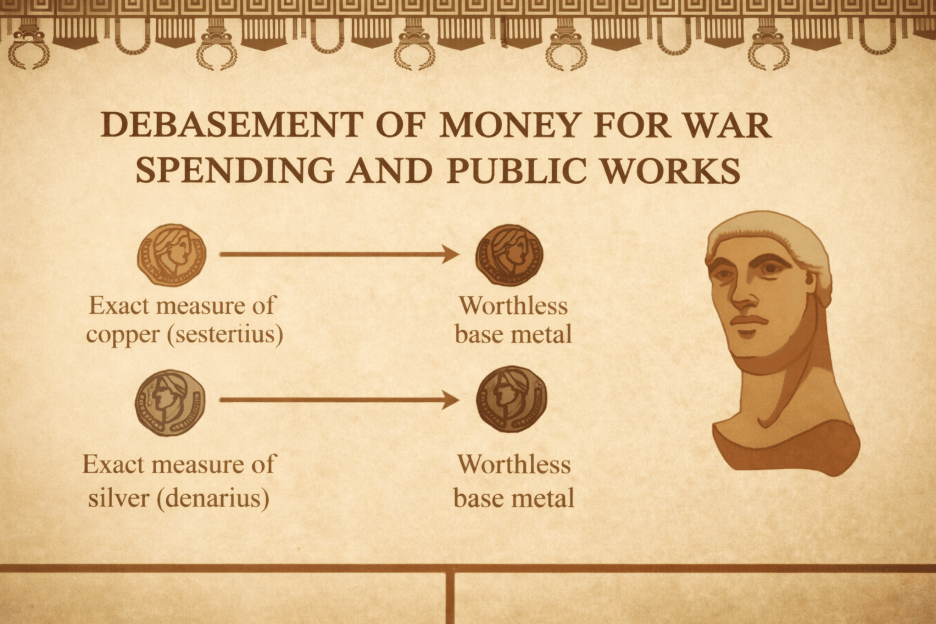
Instead of minting coins made purely from silver or gold, the government began melting down existing coins and mixing in cheaper base metals like copper to produce more currency.
This process — known as currency debasement — allowed Rome to stretch its precious metals further and finance growing military campaigns.
But it came with consequences.
When more money enters the system without a corresponding increase in goods and services, prices rise. Inflation begins to creep into the economy.
And once governments discover this monetary shortcut, history shows it’s very difficult to stop.
The Slippery Slope of Monetary Expansion
Rome didn’t debase its currency once. It did it repeatedly.
Over the following centuries, the silver content of Rome’s most important coin, the denarius, fell dramatically. What began as nearly pure silver gradually became a coin with only a thin wash of the precious metal.
At the same time, the Roman Empire continued expanding. More territory meant:
- More wars
- Larger armies
- Massive infrastructure projects
- Growing bureaucracies
All of it required funding. Debasing the currency became the easiest political solution.
By the later stages of the empire, the Roman government was producing coins that contained almost no precious metal at all.
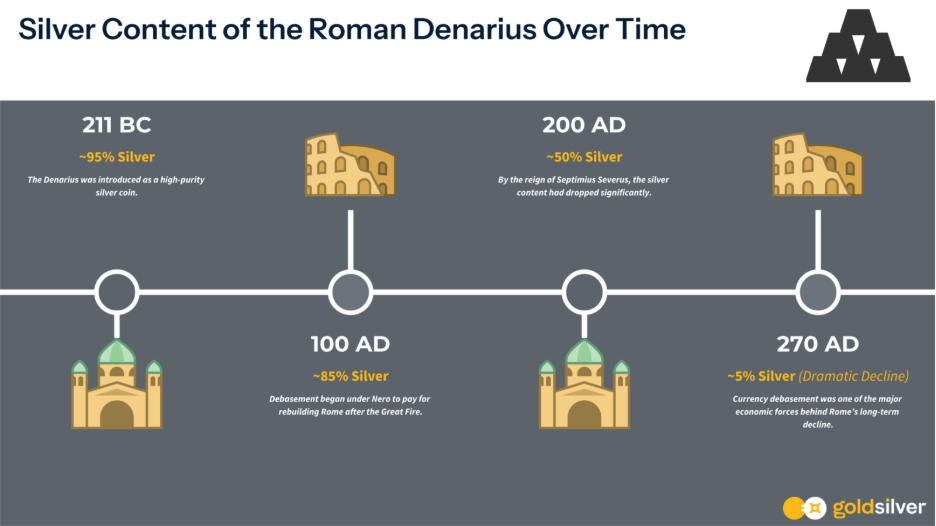
The result was predictable. Inflation accelerated, and economic stability deteriorated.
When Governments Intervene: The Failure of Price Controls
As inflation worsened, Roman leaders searched for solutions. One of the most famous attempts came in 301 AD, when Emperor Diocletian issued the Edict on Maximum Prices — a sweeping law that imposed strict wage and price controls across the entire empire.
Thousands of goods and services, from grain and clothing to labor wages, were assigned maximum prices. Charging more than the official rate could result in severe punishment, even death.
On paper, the policy aimed to stop inflation. In reality, it made things worse. Price controls distort the natural signals in an economy. When prices can’t adjust freely, producers stop making goods they can’t sell profitably, shortages develop, and black markets emerge.
Diocletian’s decree pushed economic activity underground rather than stabilizing it. The law eventually failed and was repealed — but the damage to Rome’s financial system was already well underway.
A Familiar Pattern in Monetary History
Rome’s story is not unique. Throughout history, governments facing rising debts and economic pressure have often taken similar steps:
- Expand the money supply
- Debase currency or print more of it
- Experience rising inflation
- Attempt to control prices or markets
- Trigger economic instability
We see echoes of this cycle again and again.
During the French Revolution, for example, the government issued paper currency called assignats, leading to runaway inflation and eventually strict price controls under the “Law of the Maximum.”
In the United States, similar policies appeared during the inflation crisis of the 1970s.
1971: America’s Monetary Turning Point
For much of its early history, the U.S. dollar was tied to precious metals.
Under the Bretton Woods system, global currencies were linked to the U.S. dollar, and the dollar itself was convertible into gold.
That changed dramatically in August 1971.
Facing rising deficits and pressure on U.S. gold reserves, President Richard Nixon suspended the dollar’s convertibility into gold — effectively ending the Bretton Woods system.
For the first time in modern history, the global financial system shifted fully to fiat currency — money not backed by a physical asset like gold.
Without the constraints of a gold standard, governments and central banks gained far greater flexibility to expand the money supply.
The results became evident quickly.
Throughout the 1970s, the United States experienced high inflation, rising interest rates, and economic volatility.
During that same decade, the price of gold rose dramatically — from $35 per ounce in 1971 to over $800 by 1980.
Stay Ahead with Gold & Silver News The most important market insights, Fed updates, and global trends — everything investors need to make smarter, safer decisions.
Why Gold Has Survived Every Monetary System
One of the most striking lessons from monetary history is that currencies come and go — but gold persists.
Civilizations across thousands of years have chosen gold as a store of value for several reasons:
- It cannot be printed or created at will
- It is scarce and difficult to mine
- It has universal acceptance across cultures
When currencies expand rapidly, gold often rises in price — not because gold is changing, but because the value of money is declining.
This pattern has repeated through multiple monetary transitions, from ancient Rome to modern fiat systems.
For investors, that historical resilience is one reason gold continues to play an important role in diversified portfolios.
What Investors Can Learn From the Fall of Empires
Studying the rise and fall of empires reveals an uncomfortable truth: Monetary instability tends to emerge gradually, then suddenly.
It rarely appears overnight. Instead, the process unfolds over decades:
- Governments borrow heavily
- Money supply expands
- Currency purchasing power erodes
- Financial systems become increasingly fragile
Eventually, the system reaches a turning point.
History doesn’t guarantee that modern economies will follow Rome’s path exactly. Today’s financial systems are more complex, and global institutions operate differently. But the underlying incentives for governments remain remarkably similar.
Debt, political pressure, and economic crises continue to shape monetary policy. That’s why many long-term investors look beyond traditional assets and include real stores of value — such as gold — in their strategy.
The Bigger Lesson From Monetary History
Rome’s collapse did not happen overnight. It was the result of centuries of policy decisions, economic pressures, and monetary experimentation.
But one factor appears again and again in the historical record: when money loses its integrity, societies eventually feel the consequences.
For investors, understanding this history isn’t about predicting disaster. It’s about recognizing patterns — and preparing accordingly. Empires rise and fall, currencies evolve, and financial systems change.
But throughout it all, one constant remains: the search for sound money and reliable stores of value. And for thousands of years, gold has been at the center of that search.
Want to go deeper? Mike Maloney traces this entire cycle — from Rome to the dollar — in one of the most-watched episodes of Hidden Secrets of Money.
[Watch Episode 9: Fall of Empires here.]
Investing in Physical Metals Made Easy

People Also Ask
Why did the Roman Empire debase its currency?
The Roman Empire debased its currency primarily to pay for wars, infrastructure, and growing government expenses. By reducing the silver content in coins, the government could mint more money without increasing taxes. Over time, this expansion of the money supply contributed to inflation and economic instability.
What is currency debasement?
Currency debasement occurs when a government reduces the precious metal content of its coins or expands the supply of money without increasing real economic output. In ancient Rome, this meant mixing cheaper metals into silver coins. In modern economies, debasement often occurs through excessive money printing or expanding fiat currency systems.
How did currency debasement affect the Roman economy?
As Roman coins contained less silver, prices for goods and services began rising across the empire. This inflation reduced purchasing power and disrupted trade. Over time, the loss of confidence in Roman money contributed to broader economic decline.
What happened when the U.S. left the gold standard in 1971?
In 1971, President Richard Nixon ended the dollar’s convertibility into gold, effectively transitioning the global financial system to fiat currency. This removed a major constraint on money creation and allowed governments and central banks more flexibility to expand the money supply. The following decade saw significant inflation and a sharp rise in the price of gold.
Why does gold tend to rise during periods of inflation?
Gold has historically acted as a store of value when currencies lose purchasing power. Unlike fiat money, gold cannot be printed or created by governments. When the money supply expands rapidly, gold often rises in price as investors seek protection from inflation.